


 1 Photo
P060
[caption id="attachment_54188" align="alignnone" width="800"]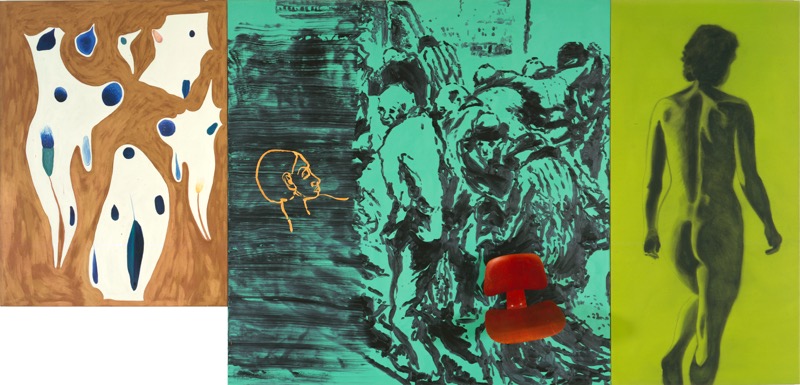 "Poverty Is No Disgrace," 1982, by David Salle, oil, acrylic, and chair on canvas
72 x 96 inches. Collection of the Akron Art Museum, Museum Acquisition Fund and gift of Larry Gagosian.[/caption]
By Michelle Trauring
The 1970s were not the ideal decade to be a painter when painting was allegedly dying. And the California Institute of the Arts in Los Angeles was not the ideal place to be.
The CalArts culture—which almost required artists to justify why they would even bother painting—did not embrace Ross Bleckner, David Salle and Eric Fischl, who all found themselves there as young, vulnerable, burgeoning artists expressing themselves through paint, only to be frowned down upon, attacked and pushed toward a style and age they hated.
For Mr. Salle and Mr. Fischl, the pressure got to them and they turned away from painting—and, even though it was for a short while in the grand scheme, they suffered for it, both artistically and emotionally.
Mr. Bleckner somehow held his ground, he said. He felt insecure and vulnerable, but he didn’t see another option.
“I loved to paint and like the idea that, like stars, sometimes things shine brightest right before their death,” Mr. Bleckner said in a recent email interview. “In addition, I’m a bit of a luddite. When I look at technology, cameras, recorders, or anything with numbers, it breaks. I had no other choice.”
[caption id="attachment_54191" align="alignright" width="325"]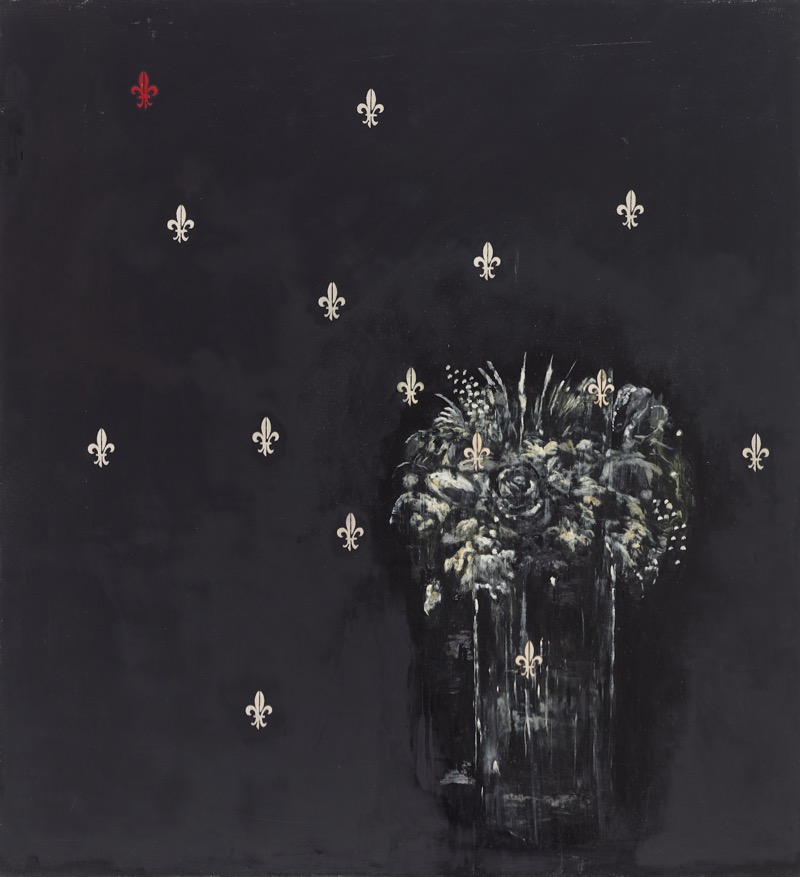 Swordflower, 1985, by Ross Bleckner, Oil on canvas,
77 x 70 inches.
Collection of the artist.[/caption]
There was a sense of helplessness, secrecy, shyness and understanding echoed between the three men, and it brought them together after meeting in the “autumn haze of 1972,” Mr. Bleckner said. In the nearly 45 years that have passed since, their artistic and personal lives have often traveled parallel tracks—moving from California to New York, then New York, and to the East End, and becoming internationally known and regarded painters in the process.
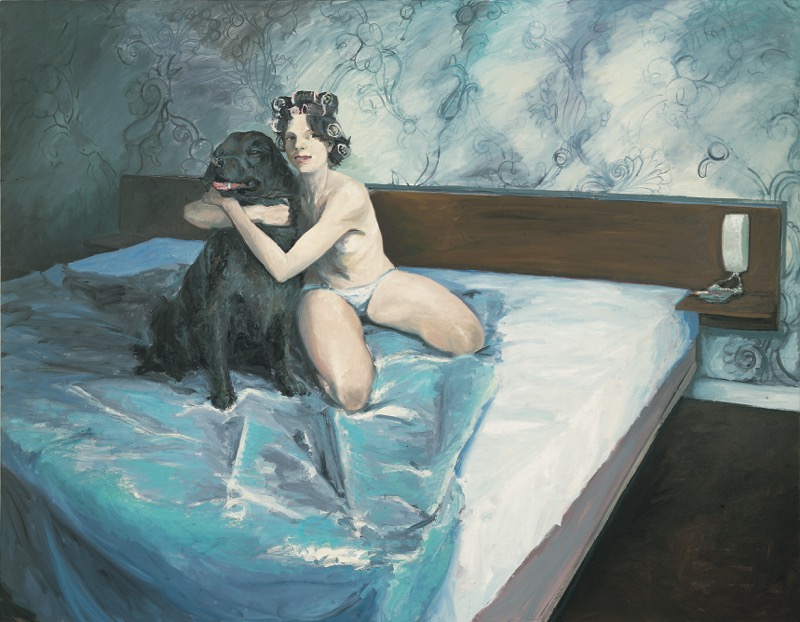
And so, it was only natural for their work to also share a deeper connection, which can be seen starting Sunday in the joint exhibition “Unfinished Business” at the Parrish Art Museum in Water Mill, featuring 23 large-scale canvases and 17 works on paper that follow the trajectory of each painter’s growth in the 1970s and 1980s.
“Being that we all came of age when neo-liberal—i.e. Reagan—cultural norms were being questioned, all our work deal with aspects of anxiety, ambiguity and dissolution, as well as the formal concerns of painters in uniquely different ways,” Mr. Bleckner explained, adding, “We all have tried to make work that is both emphatic and biographical, and our work exists on a continuum from abstraction to representation, and vice versa.”
It is difficult for Mr. Bleckner to pinpoint exactly when they crossed paths— “floating around the same hallways, studios, offices and cafeteria,” he said—considering Mr. Fischl and Mr. Salle were already sharing a studio when he arrived as a graduate student.
The art scene at the time was bare bones, he recalled, outside some artists who were experimenting with fiberglass resin and Plexiglas. Moving to New York was, clearly, their only option—which they all did immediately after graduation, except Mr. Fischl, who took a brief hiatus in Chicago and then Nova Scotia College of Art and Design for a teaching position.
But, eventually, the lure of Manhattan was too strong—as was his wife April Gornik’s desire to move to the city—and he found himself arriving at a very exciting time in 1978, reconnected with Mr. Salle and got back in touch with his art.
“LA was shiny and sunny. New York was dark and depressed,” Mr. Bleckner said, “but there seemed to be a lot of places to live and work cheaply—even calculated in ’70s dollars.”
Their social scene ran in the same circles of bars, restaurants, galleries and museums, Mr. Fischl explained in the exhibition’s official catalogue. They were all speaking the same language. There formed a sense of camaraderie, as well as competition.
[caption id="attachment_54195" align="alignleft" width="283"]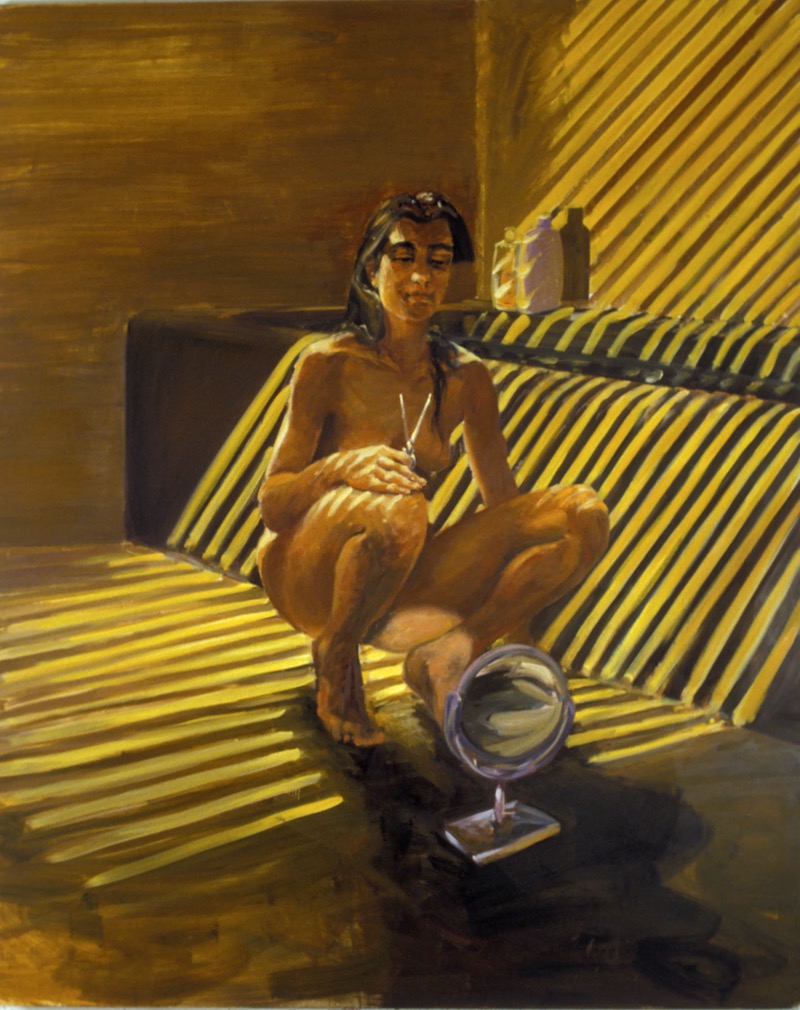 "Haircut," 1985, by Eric Fiscal, Oil on linen, 104 x 84. Collection of The Broad Art Foundation, Santa Monica, CA.[/caption]
“Back then, it was pretty unspoken, but there was—for me, anyway—a competitive relationship to David’s work,” Mr. Fischl said. “I remember when I was living in Nova Scotia; I had just started working with figures on transparent paper. When I ran into David in New York, I told him what I was doing, and he said, ‘Oh, I’m doing the same thing. I’m layering, working with transparency.’ It felt like a zeitgeist thing on one hand, and it also made me feel competitive—looking to see if he was doing it better. Both of us were concerned with ‘Is this going to really make the big impression?’ Ross was outside that, because he was coming much more out of abstraction.”
When Mr. Bleckner moved to New York, he said he was extremely ambitious. He moved into a building buzzing with artists, including Chuck Close, John Walter and Jake Berthot. His first show would be just a year later, and while he didn’t sell any work, he had officially landed and his voice was being heard.
“In ‘Tunnel of Love,’ 1981, I thought I could put a little indentation in a minimalist oval and make it a romantic ‘heart’ with disruption, like a gay Frank Stella,” he said of one of the pieces in the exhibit. “In ‘In the Forest,’ 1981, I had read that poplar trees had to [be] cut down on highway medians in France because the pulsating light was causing strobe-induced epilepsy. I thought, ‘If only a painting could do that, it would be very cool.’”
Mr. Fischl and Mr. Salle’s times would come not long after, and the three artists all joined Mary Boone Gallery, and eventually settled—or, at the very least, spent significant time—on the East End, while still maintaining their separate identities, Mr. Bleckner said.
“I don’t think that any one of us has a philosophy, per se,” he said. “We all deal with our own emotional, political and social realities in a very intuitive and personal way. Our ‘styles’ are a function of that and how we see the world.”
“Unfinished Business: Paintings from the 1970s and 1980s by Ross Bleckner, Eric Fischl, and David Salle” will be on view from Sunday, August 7, through October 16 at the Parrish Art Museum in Water Mill. A book signing of the exhibition’s official catalogue will be held on Friday, August 19, from 6 to 8 p.m. at the museum. Admission is $10, or free for members, children and students. For more information, call (631) 283-2118, or visit parrishart.org.


 gavinmenu on Aug 3, 2016