


 3 Photos
OLYMPUS DIGITAL CAMERA
In the middle of the Pacific Ocean floats a mass of plastic garbage the size of Rhode Island, maybe larger. The North Pacific Gyre, also known as the Great Pacific Garbage Patch, swirls lazily between the coasts of California and Hawaii. Four other massive gyres, or slow-rotating garbage vortices, adorn earth’s other oceans.For most people, the idea of that much floating garbage is at least vaguely disturbing, though not an immediate enough presence to cause actual alarm. But then there is the patch of garbage that formed in Gardiner’s Bay two springs ago. Jason Walter, the head of maintenance at the Montauk Point lighthouse, recalled it being two miles long, 100 yards across, in the middle of the Twin Forks—at least until its components dispersed and drifted out to sea. Finding garbage in Gardiner’s Bay is typical after the snowpack on the Connecticut River melts, according to Mr. Walter, but the regular occurrence was especially pronounced in 2014 due to the volume of snowfall that winter.
Plastic garbage in waters near and far is the inspiration for “Plastic Ocean,” an upcoming exhibition at the Montauk Oceans Institute featuring the work of local artists—and schoolchildren—to draw attention to the lasting and far-reaching environmental hazards posed by littering.
Greg Donohue, a self-described “skinny hippie,” arrived in Montauk in search of “surf, girls and work, in that order,” 40-plus years ago. One thing led to another, and another led to a spot on the board of directors for the Montauk Point Lighthouse, where he has been the go-to guy for erosion control since 1990. Mr. Donohue learned from the best: Georgina Reid, a Montauk local who patented the cedar and phragmite-based terracing system that has kept the ocean from encroaching on the lighthouse grounds since she began working on it in the 1960s.
But erosion isn’t uppermost in Mr. Donohue’s mind these days. Those floating plastic garbage patches are, and he’s hell-bent on finding a way to use the Oceans Institute at the Montauk Lighthouse to begin chipping away at them.
The Oceans Institute, housed in the old fog signal building on the lighthouse grounds, launched last summer to celebrate the surf culture that has drawn water rats to the legendary point break near the lighthouse for generations. One driving force behind the surf exhibition was Rusty Drumm, the late East Hampton Star columnist and longtime Montauk surfer. When Mr. Drumm died in January of this year, his friends, including Mr. Donohue and Bettina Stelle, another surfer and benefactor of the lighthouse, decided to raise the bar in honor of his lifelong devotion to the ocean.
“When Rusty died, Bettina called me and said, ‘You know what we need to do. We’re going to spearhead a campaign to notify the world about what’s happening to our oceans—about the plastic in the oceans,’” Mr. Donohue said.
“There’s a huge island of plastics in every ocean on this planet, and nobody’s talking about it,” he added. “We are going to become a forum for educating people about what man is doing to the oceans. Our kids do not deserve to live with this mess that we’re making.”
Administrative director Michelle Swavely explained, “My hope for the museum is that each year we can highlight a topic that’s important to the local community, but can also be translated to a more global community. We really haven’t had a place where these conversations could live, where these conversations feel safe and natural. I think this is something that people at the local level have been looking for.”
The institutes’s board envisions its upcoming exhibition, “Plastic Ocean,” as a fusion of art and science that will both entertain and engage visitors, ideally motivating them to take action.
Local artists Scott Bluedorn, Cindy Pease Roe and Billy Strong will have works on display showcasing both the history of the lighthouse and the ocean’s current state of peril. Displays are planned to educate visitors about the most common plastic poisons in the oceans, and videos on related topics will run on wall-mounted monitors. “Plastic Ocean” is tentatively scheduled to open July 1.
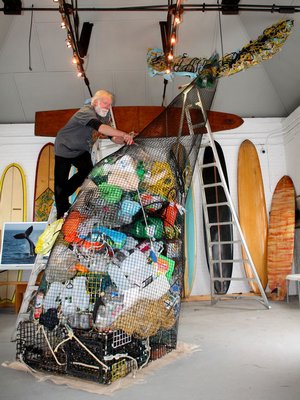
Mr. Donohue, a landscaper and stone setter, is flexing his creative muscle with a wire sculpture of a humpback whale, 27 feet long and filled with plastic garbage. His motivation? Earlier this year, more than 30 whales washed up dead on European beaches. Necropsies showed that many died with plastic in their stomachs, such as a fishing net, a car engine cover and a bucket.
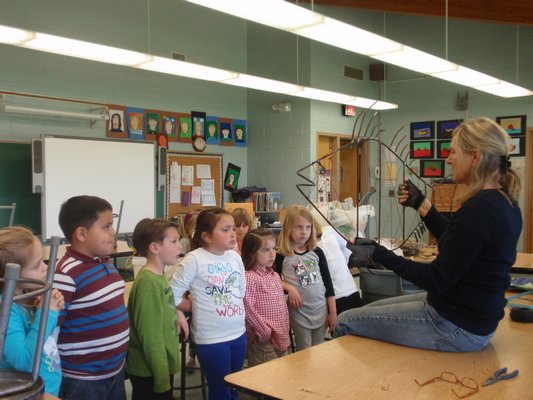
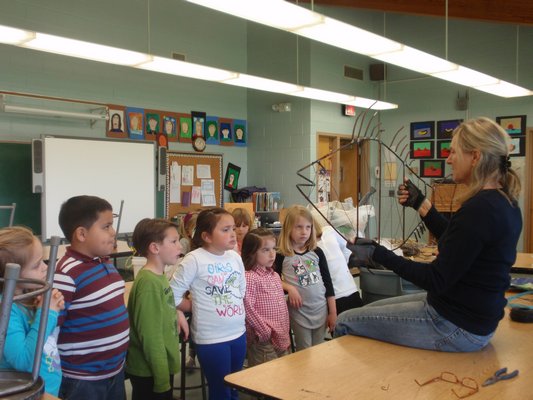
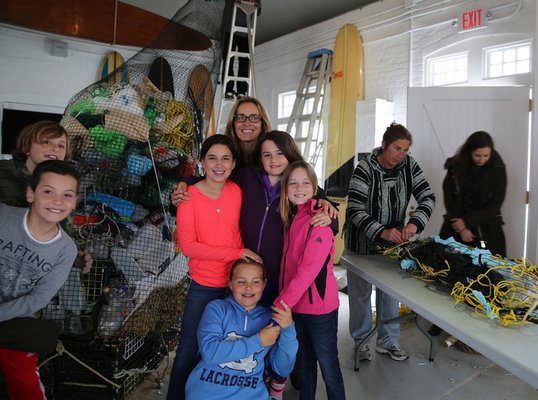
Two fourth grade classes from Montauk Public School joined Mr. Donohue at the Oceans Institute recently to help fill the whale—named Drummbeat in honor of the late Mr. Drumm—with bottles, balloons and other debris he collected on Montauk beaches over the winter.
“People say, ‘I didn’t know you were an artist,’ and I’m not, I don’t think of myself as an artist. I think of myself as someone who loves his mother earth, and we need to get this message across. A report just came out saying that by 2050 there will be more plastic than fish in the ocean.”
For the 92,000 visitors who come to the lighthouse annually, the new exhibition is a free addition to their visit. Mr. Donohue is counting on the visual power of the displays to move those visitors to get involved.
Henry Osborne, an assistant site manager and historian at the lighthouse, foresees great success with the new venture. “I think it’s a natural fit for us. The Oceans Institute was founded to focus on the ocean and the life that’s in it. This exhibit is really going to bring home the enormity of the pollution problem our oceans are facing.”
Literature and displays from several organizations involved in saving the oceans will give visitors ideas of ways they can help.
One of those organizations is Take 3, an Australian nonprofit with a simple message: “Take 3 pieces of rubbish with you when you leave the beach, waterway or ... anywhere and you have made a difference.”
The 5 Gyres Institute, named for the five gyres of plastic circulating in oceans worldwide, has set itself the task of figuring out how to remove plastics—especially microplastic—from the oceans. Their display will include a construction brick they’ve patented, made from recovered marine plastic, that is more durable than traditional bricks.
The museum will also house information about Bureo, founded by three Americans, David Stover, Ben Kneppers and East Hampton native Kevin Ahearn Jr. They learned that off Chile it was common practice for fishermen to simply dump their old nets overboard. Bureo collects the nets from fishermen, then renders the used nets into plastic pellets, which are then remanufactured into skateboards and sunglasses. Jobs are created, pollution decreased.
That simple positive step is what the people driving the Oceans Institute want to see repeated.
“It’s not about blame,” Mr. Donohue said. “It’s about getting people involved in finding a solution. Where are we going to live if we poison this planet?”


 on May 16, 2016