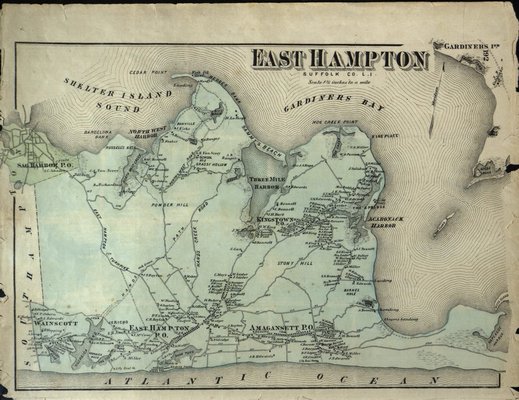
East Hampton is a town rooted in history—so much so, in fact, that a debate concerning public access to a beach stranded in southern Gardiners Bay features a local beach rights enthusiast using century-old maps and royal patents to prove his point.
Rod Richardson of Amagansett was arrested on July 25, after an incident on June 30 on Cartwright Island—the southern tip of Gardiners Island—during which he took down signs claiming the island is private land.
Mr. Richardson has since maintained that Cartwright Island is not owned by the Goelet family, who own the entirety of Gardiners Island, but by the people of New York. He pleaded not guilty to charges of criminal tampering and trespassing at an arraignment at East Hampton Town Justice Court last Thursday, August 9.
On Monday, he presented research to the East Hampton Town Trustees implying that Cartwright Island is not owned by the Goelets and suggested that the Trustees investigate the matter.
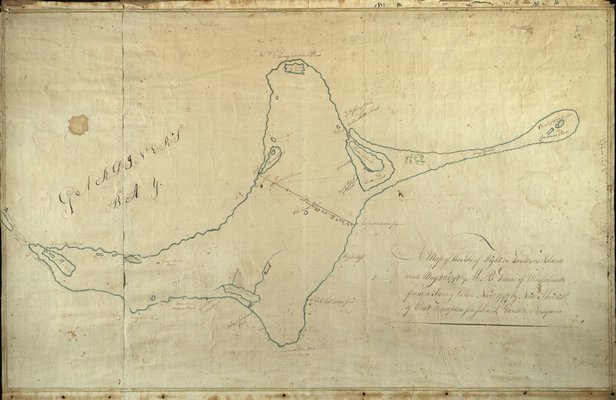
Mr. Richardson has taken the position that Cartwright Island is a distinct island rather than a part of Gardiners Island, and, as such, is not included in the original patent that granted Robert Lion Gardiner the land now known as Gardiners Island.
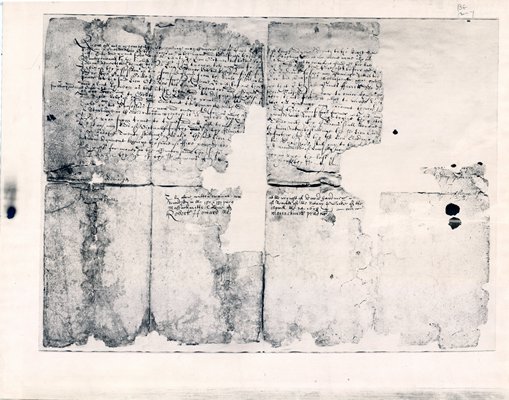
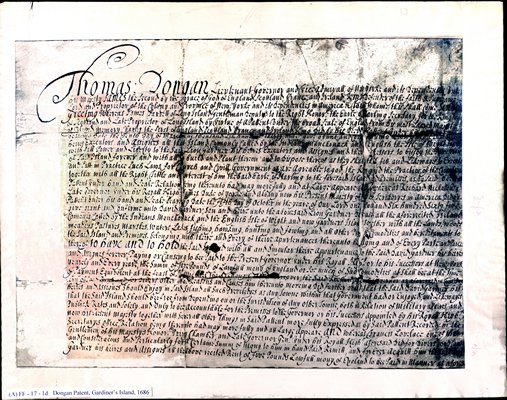
Dated December 9, 1686, the Dongan Patent has for more than 325 years granted management responsibilities of East Hampton Town’s beaches to the East Hampton Town Trustees. One of the earliest documents to outline a system of representative government in the Americas, the patent predates the current Town Board and establishes the Town Trustees as the town’s original governing body. The patent, in doing so, also upholds a royal deed granted by the Earl of Stirling in 1639 that gives Mr. Gardiner the island bearing his name “to have and to hold.”
Whether the Dongan Patent grants the public rights to the foreshore of Cartwright Island, however, is uncertain.
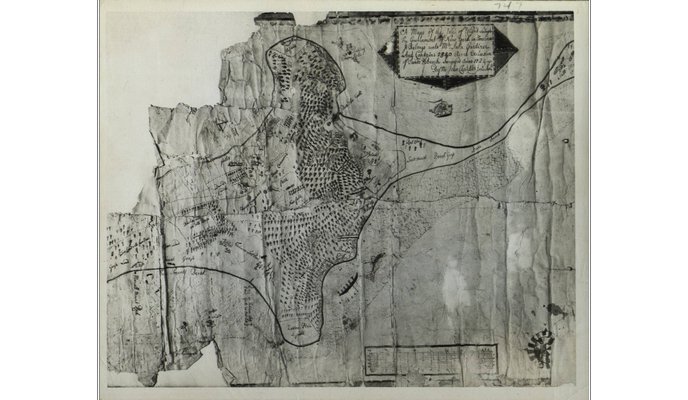
Mr. Richardson, meanwhile, cited several old maps of the region portraying Cartwright Island as separate from Gardiners Island in his presentation to the Trustees, and he argued that the Gardiner patent did not give ownership of Cartwright Island to the Gardiners.
Steve Russell Boerner, archivist and real property consultant, as well as a case manager of the U.S. Board on Geographic Names, said on Tuesday that the “Gardiners claim goes back to the very first State Constitution.” Mr. Boerner was part of a team that determined, through investigation, that Gardiners Bay is the correct term for the body of water that separates Springs from Gardiners Island. The water had previously been called Napeague Bay.
When the New York State Constitution was drafted, its creators “recognized that wealth and stability directly tied to sound land titles, both municipal and private,” said Mr. Boerner, and so they “honored all feudal grants,” including Mr. Gardiner’s. “That’s Section 215 of the New York State Constitution,” said Mr. Boerner.
Larry Penny of Noyac, a nature columnist for The East Hampton Star and former director of the East Hampton Town Natural Resources Department, explained the importance of both Gardiners Island and Cartwright Island as a sanctuary for endangered species, including piping plovers. “Rosette tern is a federally endangered tern that has bred on Cartwright and other shores of Gardiners Island,” he said on Monday.
Mr. Penny added that, thanks to erosion, some of Gardiners Island’s eastern and western beaches are starting to dissipate. “That material has to go somewhere,” he said, adding that the northern tip of Gardiners Island and the southern tip of Cartwright Island are expanding. “The island is becoming thinner,” he said, while also getting longer.
Citizens for Access Rights, a nonprofit committed to preserving public access at East End beaches, recently released a statement supporting Mr. Richardson and his efforts.
“[Cartwright] Island itself is underwater for some of the year, and when it is not under water, it appears that the island is owned by the State of New York,” the organization’s president, Tim Taylor, said in the statement released Monday.
At their meeting on Monday night, the Town Trustees indicated after Mr. Richardson’s presentation that they would study the situation further. Francis Bock, the Trustees’ clerk, did not return messages, nor did an attorney representing the Goelets, nor the Goelets themselves.
Mr. Richardson said he will present his research findings at an East Hampton Town Board meeting on Thursday, August 16.