


 2 Photos
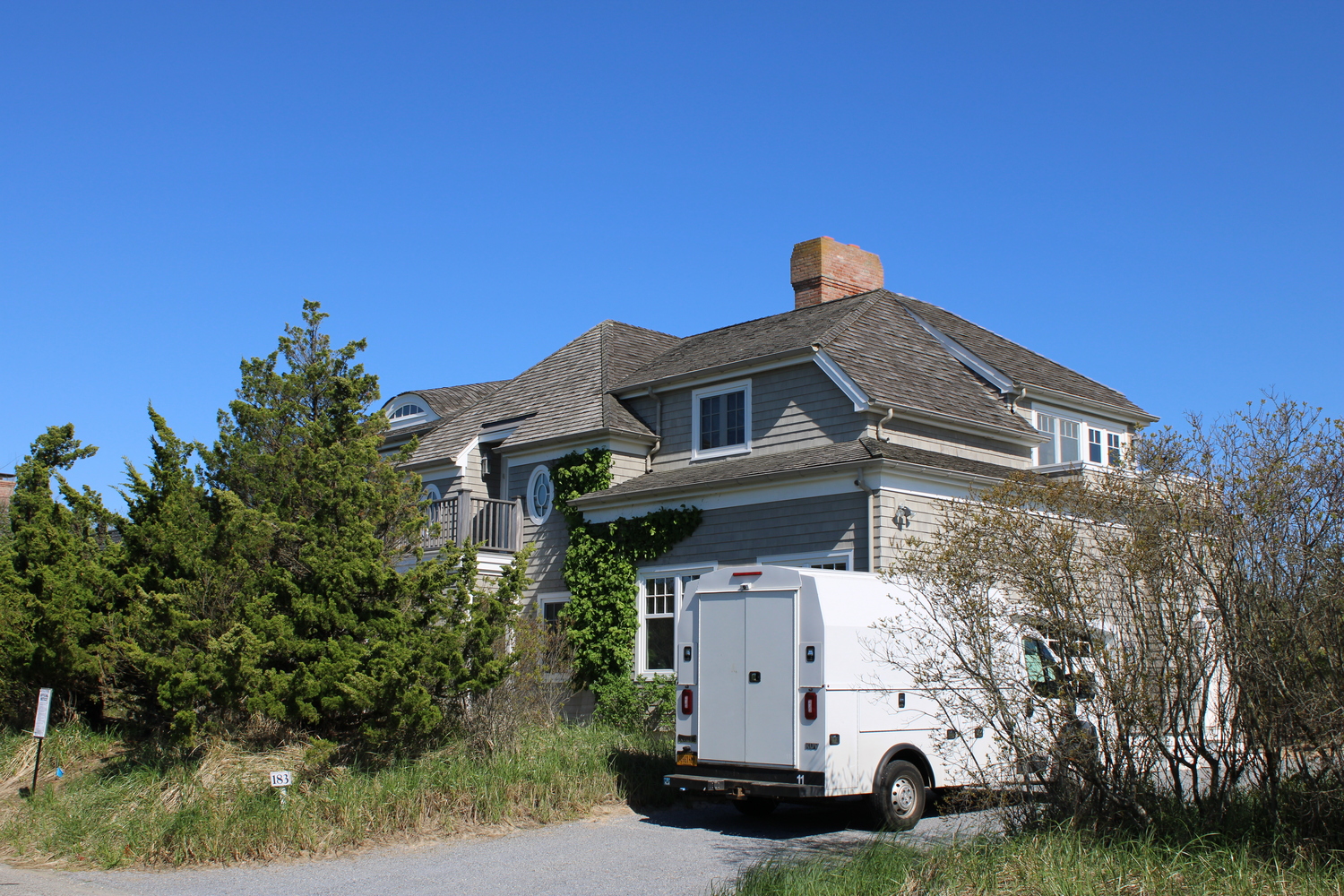
An application for a house on Marine Boulevard appeared before the East Hampton Zoning Board of Appeals recently. Several neighbors have reacted negatively to the application , but the property owner maintains that the goal of the planned construction is to bring the house into compliance with Federal Emergency Management Agency regulations. JACK MOTZ

A controversial application to bring a house into compliance with standards set forth by the Federal Emergency Management agency was slated to appear before the East Hampton Town Zoning Board of Appeals on Tuesday, May 20. JACK MOTZ
An application to renovate and expand the size of an Amagansett house, in part to make it compliant with disaster regulations, recently sparked push-back from Beach Hampton residents who worry that approval could set an unwelcome precedent for the neighborhood.
The Marine Boulevard property owners — the Belsky family, who own the house through a limited liability company — are asking for seven variances and a special permit for work on their house. The application states the purpose is to make the property compliant with Federal Emergency Management Agency regulations.
In all, the project would raise and renovate the existing house on the property with respect to FEMA guidelines.
As it stands, the maximum allowable house size on the property is 4,522 square feet, but the family hopes to build a 5,082-square-foot house, which would require a 560-square-foot variance. As it stands, the house is slightly over the maximum allowable house size, according to a diagram.
The house last sold in 2014 for $11 million, according to Out East, a real estate company owned by Zillow. On Tuesday, May 20, the application appeared before the East Hampton Town Zoning Board of Appeals.
Beach Hampton resident Rona Klopman wrote to the ZBA to lobby for denial of the application, and in a separate conversation, she discussed the issue further.
The character of the neighborhood on Marine Boulevard stands to be “irreparably changed,” Klopman wrote to the ZBA, with the area having previously been known for its “charm and modest scale.”
However, Klopman also addressed the “feasibility of alternatives” pertaining to FEMA compliance, that is, other routes the applicant could take to achieve the same end. With that, Klopman requested “thorough review” of the application.
Klopman, in a phone interview, noted that she lives directly across the street from the house.
“I’ll be looking at a wall when I walk out of my house,” Klopman said, describing the proposed renovations as “monstrous.”
With that, she said the house doesn’t fit with the character of the neighborhood, so she is hoping the ZBA winds up doing the right thing by the community.
In her letter, Klopman noted the risk of contributing to overdevelopment in an area that already faces challenges from flooding and the natural environment.
Overall, Klopman concluded by stating the project could have adverse impacts on the community, environment and neighborhood character.
A handful of neighbors wrote to address what they saw as a possible precedent that could be set within the community, if the application were to be approved.
One neighbor, Jill Danis, in a letter, argued that approval of the request to exceed pyramid regulations would not be justified. The pyramid regulations are in place to maintain the character of the community, she said in the letter.
If granted, the variance could set a concerning precedent that undermines the intent of the town code, she went on.
In March, the Town Board approved a measure that would further curb maximum house size. The formula knocked the maximum house square footage of a house down from 10 percent of lot area plus 1,600 square feet to 7 percent of lot area plus 1,500 square feet.
In her letter, Danis brought up the house size variance. Granting the variance, she said, “could lead to overdevelopment” and could “negatively affect” the surrounding area.
“With money, you get honey,” Danis said. “Why have laws anyway if lots of money can simply make the rules for everyone else go away for you?”
The property owner is trying to turn a small oceanfront cottage into a multi-acre estate similar to houses on Further Lane in East Hampton, she said.
Another neighbor, Jack Hassid, also opposed the proposed renovations in a letter.
Since 1979, he has lived in the neighborhood, he wrote, and he has not altered his house at all since it was built in 1972.
“We strenuously oppose these variances, which, if granted, would result in virtually two skyscrapers totally out of character with the Beach Hampton area,” he wrote.
Being a 42-year resident of the area, Hassid said the dunes have accreted and grown larger over the years, citing the application’s technical analysis memo, which states that the stretch of shoreline home to the house has not experienced severe or chronic erosion since the 1970s and 1980s.
Like Danis, Hassid noted that granting the variances could lead to an unfavorable precedent in Beach Hampton, which he said would be devastating to the unique and special neighborhood.
Hassid concluded by calling for the Zoning Board of Appeals to deny the application in its entirety.
Planner Britton Bistrian said she did not have many comments on the neighbors’ assertions, though she did state that she doesn’t find them relevant since the intent is to make the home compliant with FEMA regulations.
Further, she said the face of Marine Boulevard is changing and what has already begun will continue. Specifically, old houses on the dune — like this one — will be replaced with taller, FEMA compliant structures.
In mentioning the visual impact of the proposed renovations, Bistrian said the community is headed in the direction outlined by this project, as the area adjusts to environmental changes.
Bistrian summed up the project, noting that the changes will comply with flood plain regulations and coastal resiliency directives. Further, the geography of the low-lying street is such that a guest house on the property has been plagued with water intrusion from street flooding, she said.
Additionally, if approved, the house will not get any taller despite being raised some 9 feet, she went on, which is due to modifications to the roof line.
Right now, she continued, there is an attached garage on the first floor of the residence. Once elevated, the garage will no longer be accessible. Because of that, the space needs a new use, Bistrian said, so the property owner is requesting the gross floor area variance.
As for the neighbors, others wrote letters to the Zoning Board of Appeals in favor of the application.
Gary and Iris Posternack wrote the ZBA to voice support for the efforts of their neighbor regarding FEMA regulations.
“We understand that there is no increase in lot coverage as a result of this work,” Richard Plepler said in support. “We also appreciate the efforts to further vegetate the area and avoid the impact of coastal erosion on their home.”
At the most recent ZBA meeting, the issue of FEMA compliance was brought up after the board requested clarification on the issue.
After taking questions about the project’s necessity, attorney Andy Hammer said on behalf of the applicant that the property is not required to be elevated to fit current FEMA standards, which is very different from the issue of FEMA compliance.
Right now, Hammer clarified in response to a question, the house is not compliant with FEMA regulations — though it had been when it was first constructed.
“FEMA is not an arbitrary statute,” Hammer said. “It was based on scientific evidence.”
Erica Belsky, who owns the property with her husband, took to the lectern to address the board.
“We’re here today because we want to protect our home, not just for us, but for the future,” she said, noting that her family is concerned with the long-term viability of the house.
When working through the planning, the family took care to incorporate the charm and scale and feel of the neighborhood into the designs, she said, adding that a lot of thought and care went into the plan.
ZBA member Jaine Mehring has recused herself from this application — a fairly routine move done when there is a conflict or appearance of bias. The recusal marks her 10th voluntary recusal since joining the ZBA. In this case, Mehring said she informed counsel of her decision before a formal request came in.
In 2024, Supervisor Kathee Burke-Gonzalez appointed Mehring, an advocate, to the ZBA. For this case, an alternate took Mehring’s place on the board.
At the end of the hearing, the ZBA agreed to close the hearing but leave the record open for 30 days for additional comments.


 Jack Motz on May 21, 2025