


 8 Photos
Rebecca Alexander
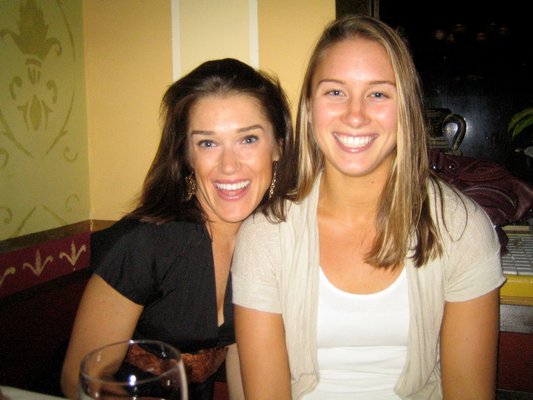
left
and Caroline Kaczor
an East Hampton High School graduate
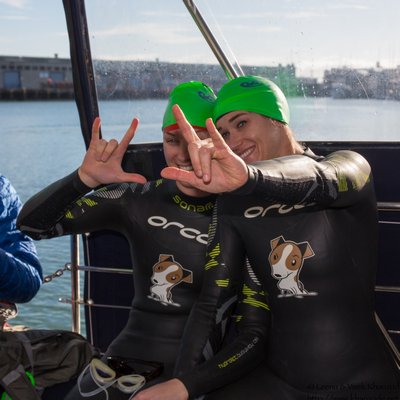
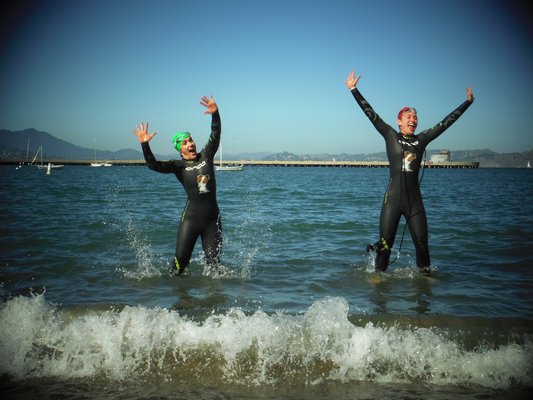
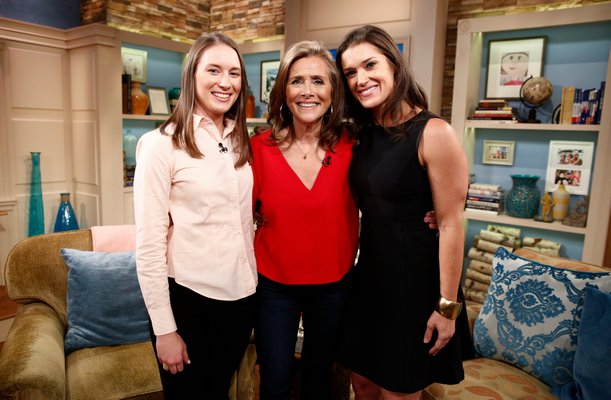
have developed a decade-long friendship. They completed a swim from Alcatraz Island to San Francisco
with Ms. Koczar helping to lead Ms. Alexander
who has Usher's Syndrome
a genetic disorder that leads to deafness and blindness over time.
It is a notoriously difficult and challenging open-water swim: Alcatraz Island to San Francisco’s Aquatic Park, 1.5 miles of ocean water with strong currents, frigid temperatures, and plenty of marine life, including sharks. It attracts strong swimmers, and athletes who like a challenge. In November 2015, it attracted friends Rebecca Alexander and Caroline Kaczor, New York City residents who made the trek across the country to try it out—and they had an added challenge that most other swimmers don’t face.
Ms. Alexander, 39, has Usher’s syndrome, a rare and incurable genetic disorder that leads to deafness and blindness over time. Ms. Kaczor, 30, a 2006 graduate of East Hampton High School, guided her friend on the swim, and over the course of nearly an hour, she helped lead Ms. Alexander to the mainland.
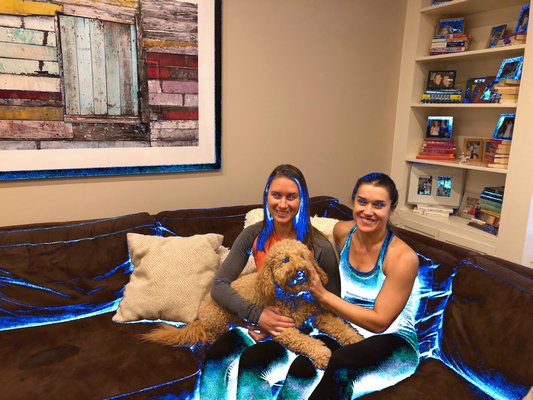
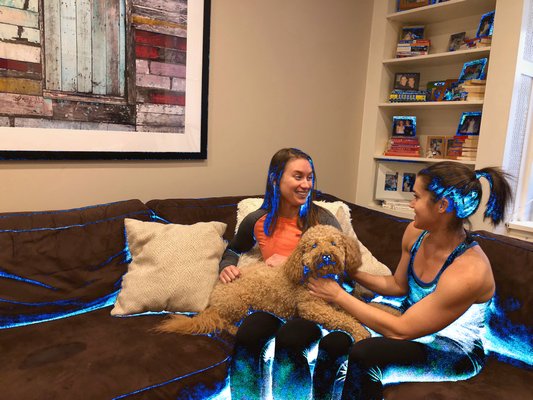
Sitting in Ms. Alexander’s ground-floor apartment on the Upper East Side of Manhattan last month, the friends spoke about the swim, their friendship, and their penchant for involving themselves in physically and mentally demanding activities for “fun.”
On the surface, their friendship falls into the category of unlikely in many ways—Ms. Alexander is nine years older than Ms. Kaczor and is outgoing and spontaneous, a natural and charismatic leader, while Ms. Kaczor is more reserved, a planner and organizer by nature, who described herself as a “quieter force,” while still being direct, effective and driven.
Ms. Alexander’s condition necessitates, ironically, a role reversal in terms of where their personalities would naturally lead them. But they’ve developed a thriving friendship through shared interests and a desire to lift each other up.
In the process, they’ve redefined what a friendship can be.
Rising To The Challenge
“No one said, ‘That sounds like a great idea!’ People were, like, ‘That’s the worst idea!’”
Ms. Kaczor recalled the reactions when she and Ms. Alexander told friends and family they were going to embark on the swim from Alcatraz Island to San Francisco.
In many ways, it was, of course, a bad idea. Ms. Kaczor was part of East Hampton’s ocean lifeguarding program as a teen, and worked as both a swim instructor and, for a time, as the aquatics director at Sportime for several years when she was younger. But beyond that, neither had spent much time swimming, particularly in open water.
But taking on a challenge has become a theme in their friendship. Ms. Alexander, who now has cochlear implants in both ears, cannot hear at all when she is not wearing them. At the time of the swim, she had a cochlear implant in one ear and was still using a hearing aid in another, but she had to remove them both for the swim, because they are not waterproof. Her vision, already narrow and hampered by her condition, was made even worse because the sun happened to be in their eyes during the time of the swim, and goggles fogged up for nearly the entirety of the swim.
Essentially, Ms. Alexander said, she was deaf and had very limited visibility during the swim. Ms. Kaczor swam just ahead of her friend and tried using sign language—while swimming—to communicate with Ms. Alexander at first. But they quickly realized that was a futile effort, and simply soldiered on, with a kayaker nearby helping to keep them on the right path.
They laugh while recounting the story. Ms. Alexander says, “I didn’t know what she was trying to tell me!”
They were up against the clock as well, needing to reach the entrance to the aquatic park before the tide changed and threatened to sweep them back out into the open water. Ms. Kaczor said that when the kayaker told her she needed to communicate to Ms. Alexander that they needed to hurry up, she waved her hands at Ms. Alexander, attempting to communicate the urgency to finish.
Ms. Alexander interpreted it a different way, at least at first. “I thought she was trying to tell me to push it harder, and I was like, [screw] you, I’m going as fast as I can!”
Just Plain Fun
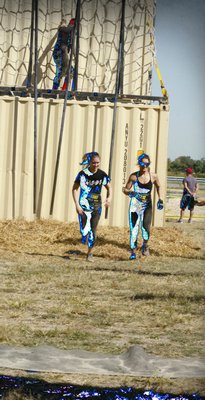
Ms. Kaczor admits that moments like that can be extremely frustrating. But their motivation for the swim, and for other physical challenges they’ve taken on together, with Ms. Kaczor serving as a guide—including a tandem bike relay in New York City, and civilian military combine races, which include military style obstacles—remains the same: to prove that people with disabilities can still achieve great things.
Also, they say, it’s just plain fun.
Ms. Alexander is an outspoken advocate for people with disabilities, dedicated to raising awareness about Usher’s syndrome and also determined to prove that disabilities don’t have to define someone.
She is certainly a perfect poster person for that: Ms. Alexander—who climbed Mount Kilimanjaro a few weeks before taking on the Alcatraz swim—is in impeccable shape, and has worked for years as a group fitness instructor at Equinox in New York City, teaching both indoor cycling and boot camp classes, with a huge following both in New York City and on weekends in East Hampton at various studios. When she’s not on a bike, she has a thriving private practice as a psychotherapist.
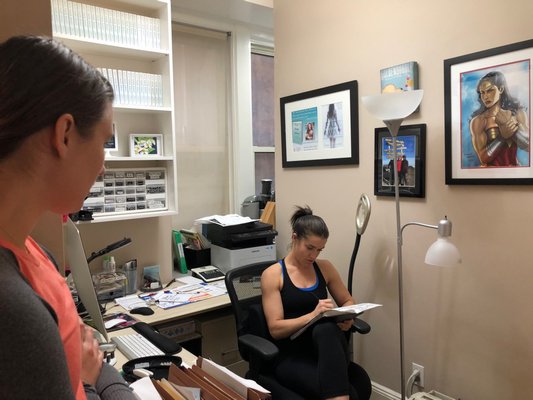
Ms. Kaczor is in the same exact lines of work, as a psychotherapist in private practice and also teaching classes at Equinox, and has looked at Ms. Alexander as both a mentor and friend over the past decade. The give-and-take of their relationship and the role Ms. Alexander’s condition plays in that friendship is documented in Ms. Alexander’s 2015 memoir, “Not Fade Away.” The movie option rights to the book have been sold, with a screenplay in the works to make it into a feature film.
Opposites Attract
Ms. Kaczor and Ms. Alexander became friends 10 years ago, when Ms. Kaczor was working behind the desk at the indoor cycling studio Zonehampton, also known as “Ride the Zone,” located in East Hampton at the time—it ultimately went out of business, and the space was then purchased by Flywheel—and Ms. Alexander was an instructor. Ms. Kaczor was interested in becoming an instructor, but was unsure she’d be comfortable in the spotlight, leading a class.
They found themselves together in a training session for new bikes. Ms. Alexander was impressed by Ms. Kaczor’s “impeccable” form on the bike; Ms. Kaczor was drawn to Ms. Alexander’s natural charisma and comfort being at the front of the room.
They would teach classes together on weekends in East Hampton, taking the Jitney out together from the city. As they became friends, Ms. Alexander would stay overnight at Ms. Kaczor’s parents’ East Hampton home, and they would drive together—with Ms. Kaczor behind the wheel—to the studio to teach. They realized they had similar senses of humor, and Ms. Alexander encouraged Ms. Kaczor to find the confidence to teach.
They had become close by the summer of 2009, and one day, before heading to teach a class, Ms. Alexander casually handed her friend a copy of New York magazine, dog-eared to a page with a feature article about her and her condition.
“I said, ‘Here, read this,’ and then I went in and taught class,” Ms. Alexander recalled.
The revelation of Ms. Alexander’s condition only strengthened their friendship. Ms. Kaczor ultimately learned American Sign Language, which she uses when Ms. Alexander doesn’t “have her ears in” as she says. If it’s dark and vision becomes a challenge, they will reach for each other’s hands and use tactile signing.
Preconceived Notions
At a quick glance, in the comfortable and familiar environment of Ms. Alexander’s apartment living room, she and Ms. Kaczor are like any close female friends one might see in New York City: young, fit, clad in Lululemon athletic gear, sharing inside jokes, finishing each other’s sentences.
Out in public, they are accustomed to attracting attention, when they use sign language on a crowded subway, or when Ms. Alexander jokingly pokes her cane through Ms. Kaczor’s legs as she leads her through a busy airport for another stop on her book tour. They view those moments as a chance to expose people to something they might not see every day.
“People see us in the airport, she’s holding a cane and we’re signing,” Ms. Kaczor said. “And people are seeing something different. People get to see what it’s like to deal with a deaf-blind speaker, and what that really means.”
Ms. Alexander added to that.
“It’s just about trying to be a leader in the movement, if you want to call it that, of just owning whatever your circumstances are, and living openly with a disability,” she said. “And developing your own sense of comfort. We can’t allow other people to be comfortable with our circumstances if we’re not comfortable first.”
Along the way, Ms. Alexander and Ms. Kaczor hope to dispel certain ideas about their friendship—namely, the idea that there’s any kind of imbalance.
“Initially, people would say, ‘Caroline, you’re such a good friend—I can’t imagine how you’re so patient and how you would be so giving and generous with your time.’ And that always made me feel like a charity case, and she was my friend out of guilt or something,” Ms. Alexander said.
“I think when you see someone with a disability, you assume that person needs help or is incapable, or that they’re not reciprocating. We do need to ask for help when we need it, but we also need to be able to reciprocate and offer what we can, not only because that’s what friendship is, but you also need to know your value and purpose, and that you matter.
“Some people think this is just a friendship where she’s leading me around, and she’s my Annie Sullivan,” Ms. Alexander added, referring to the woman who taught Helen Keller to communicate.
Ms. Kaczor said she gets just as much, if not more, than she gives in the relationship.
“People see the tangible things I do,” she said. “I find things, I read things to her. But they don’t see the support she gives me. If I have a problem with a patient related to my practice, or how I navigate things with an insurance company, she’s my first call.”
Ms. Kaczor added that in addition to encouraging her to become an indoor cycling instructor, Ms. Alexander also helped boost her confidence when she was ready to take her clinical exams. The morning before her test, Ms. Alexander presented Ms. Kaczor with a card, insisting that she open it before going to take the test.
It said, “Congratulations on passing your exam.”
A few hours later, she did.
Staying Connected
While their friendship is stronger than ever, both Ms. Alexander and Ms. Kaczor know that challenges lie ahead. Eventually, Ms. Alexander will be fully blind and deaf, and will need even more help navigating the world around her.
“With a condition that is progressive, there is a lot of sadness with it too,” Ms. Kaczor said.
“A lot of mourning,” Ms. Alexander said.
“It feels like I have this great friend that is sort of being taken away from me,” Ms. Kaczor continued. “And pulled away from our world.”
While there may be functional changes in their relationship, it’s hard to imagine anything breaking the bond they’ve developed.
“We’re always opening doors for each other,” Ms. Kaczor said. “Our friendship has lasted 10 years now, because we’re always trying to encourage each other to be our best selves. We just want each other to make the biggest impact possible, especially on the disability community.
“Everyone has something—you don’t know what people are walking around with. So we try to be kind and just spread that.”


 Cailin Riley on Aug 10, 2018