


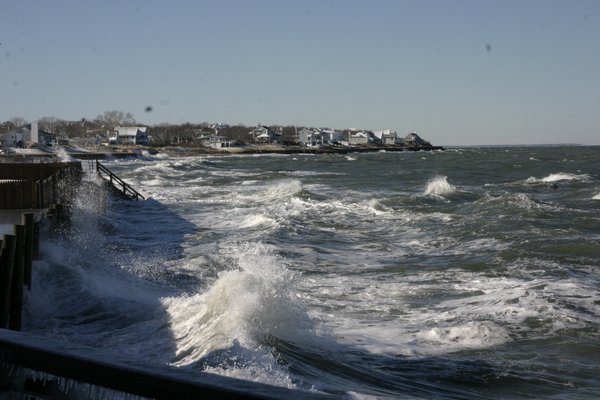
 1 Photo
A Lake Montauk Harbor coastal erosion study is being discussed.
The U.S. Army Corps of Engineers pitched a $10 million proposal to town officials and residents on Tuesday for rebuilding and stabilizing the shoreline west of the inlet to Montauk Harbor.
The plan would pump thousands of tons of trucked-in sand to create a 10-foot-wide beach along the entire shoreline from the inlet jetty to Culloden Point, which is mostly bulkheaded, and erect three perpendicular groins to slow the loss of the sand to erosion over time.
Army Corps officials said the project, and regular nourishment with sand dredged from the inlet, would stabilize the beach and provide protection to the waterfront houses along Soundview Drive and Culloden Shores for 50 years. It would also fund the regular dredging of the inlet, navigation channel and main basin of Montauk Harbor, with the sand added to the beach west of the inlet.
If approved, the project could begin construction in September 2018.
But the inclusion of groins in the project design puts it out of conformity with the town’s Local Waterfront Revitalization Plan, the federal officials noted, and a requirement to provide public access to any federally funded beach could pose additional hurdles locally, since the shoreline in the area is densely developed with private property.
The construction cost of the recommended approach would be about $9.9 million. The Army Corps would pay 80 percent of the cost, the state about 15 percent and the town about 5 percent.
The three groins proposed in the designs would be made from geotextile bags, essentially giant sandbags, rather than the granite boulders groins and jetties are typically made from. Army Corps planning chief Stephen Couch said the groins were intended to be temporary for the first 10 years of the project, to determine the efficacy, and would then either be removed or replaced with more permanent stones.
The Army Corps also presented the town with several other versions of the project, one of which called for four times as much sand and no groins, though all but one were more expensive than the one recommended by the Corps and would require the town and New York State to make up the millions of dollars difference in costs.
The federal officials also said that the timing of the project being endorsed by town residents and lawmakers could be a critical factor in getting the project funded with money from a pool of federal money directed to shoreline stabilization following Superstorm Sandy. Ideally, they said, the town would endorse the project by the end of next month.
“It’s not binding, you’re not signing a contract, no money is changing hands, but our folks in Washington are not going to spend the money without knowing there’s support for the plan,” Army Corps planning chief Stephen Couch said.
“There’s lots of projects competing for the same money, from Virginia to the coast of Maine and the money gets parceled out on a first-come-first-served basis,” explained Army Corps Deputy Chief of Planning Gene Brickman. “The time to act is now.”


 Michael Wright on Mar 22, 2016