


 1 Photo
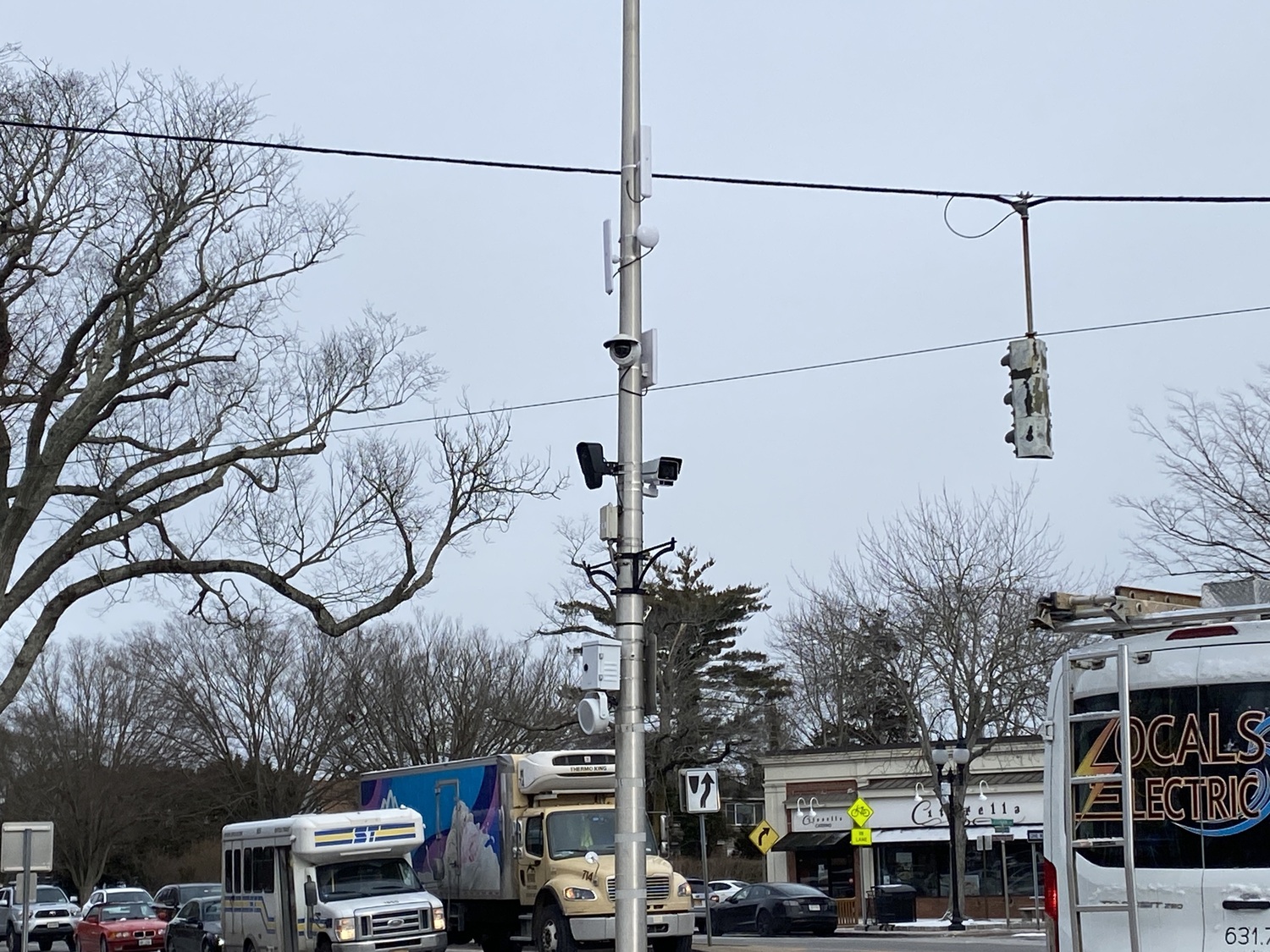
License plate reader systems are unobtrusive but far-reaching, as demonstrated by this fixed unit at the intersection of Main Street and Newtown Lane in East Hampton Village. CHRISTOPHER WALSH
Police chiefs on the South Fork say that the license plate reader technology that is quietly proliferating both in fixed locations and on police vehicles does not raise privacy concerns, despite the technology’s ability to track the precise movement of motorists across multiple jurisdictions.
The use of license plate reader, or LPR, products has drawn attention since East Hampton Village announced, last month, the acceptance of a $30,000 donation from the East Hampton Village Foundation to fund Flock Safety LPR technology for one year.
“We exist to eliminate crime and keep your community safe,” according to Flock Safety’s website. “Our holistic public safety platform is comprehensive and intelligent. That means you have the actionable evidence you need to solve, deter and reduce crime across neighborhoods, schools, businesses and entire cities.”
The company calls its offerings an “all-in-one technology solution to eliminate crime and keep your community safe.” Whether a business confronting retail crime or a law enforcement agency “looking to multiply your force, we have the end-to-end solution for your needs,” its website says.
Marcos Baladron, the East Hampton Village administrator, said at the Village Board’s December 18 meeting that Flock Safety’s LPR products are “an incredible piece of technology,” able to quickly detect when a motorist is entering the municipality from any roadway. “It’ll allow a police officer immediately to know that if someone is coming into the village that should be arrested, that they be arrested immediately.” He described LPR technology as “another added layer of security for village residents.”
Suffolk County Police have long used the technology, Mayor Jerry Larsen said at that meeting. “When we had this stolen car ring operating out here, we could actually track the car at what time it left East Hampton, what time it crossed Southampton, all the way through the county,” he said.
He referred to a plan to install LPRs “at every entrance and exit to the Village of East Hampton,” which would create “a log of every single plate that enters our village. When something bad happens, we’ll have every single plate that was in the jurisdiction at the time, which is an amazing, amazing thing to be able to do.” Such technology is in use across Long Island, he said.
Chief Jeffrey Erickson said at that meeting that “we can track cars going over the Verrazzano Bridge,” in New York City, and that stolen cars are often taken to Newark. He cited larcenies that had recently occurred at the Louis Vuitton and Gucci stores in the village. “Within a half-hour, the detectives were able to get a description,” he said, and arrested a suspect in Springs.
With scant information, Erickson said this week, the Flock system was able to locate the vehicle traveling north on Springs-Fireplace Road. With jurisdictions able to share data from their respective LPR systems, police were able to determine the vehicle owner’s address. “We knocked on the door, the subject admitted to it,” and upon going inside officers “found other proceeds from the Gucci store,” Erickson said. “Also, it will be able to tell us if the car is stolen, things like that,” he said.
The donation from the East Hampton Village Foundation “is going to be a huge help for us,” Erickson told the Village Board. “It’s better to know, a lot of times, if you’re stopping that car … how bad that individual is.” He said that he hoped that the use of LPR technology would even serve as a deterrent, should the public be aware of it.
“The data is valuable in hit-and-run or burglary/larceny cases wherein the vehicle type and description may be caught by a witness or security camera,” Chief Michael Sarlo of the East Hampton Town Police Department said, “so that the data from the LPR can be queried to narrow down vehicles possibly fitting the description of a suspect vehicle, or in the use of hot lists for vehicle registrations which are wanted in connection with a crime or flagged as stolen, suspended or revoked registration or similar criminal offenses.”
The town, he said, has 14 patrol vehicles equipped with in-car video systems which also capture license plate reader data, along with two traffic control vehicles with mounted LPRs. In addition, there are four pole-mounted LPRs on county and state roads within the township.
There are fixed LPRs at locations throughout Southampton Village, said Police Chief Suzanne Hurteau, with more having been added last year through a state grant.
“We have also purchased LPRs that we will be affixing to our vehicles,” she said this week. “We have benefited greatly since we started placing them in and around our Village. They have assisted our officers with everything from larcenies, hit-and-run, motor vehicle accidents and major case investigations within our Detective Division.”
The Westhampton Beach Village police have used LPRs “several times” to assist in solving cases, said Chief Steven McManus, who added that “it’s safe to say that without using the LPRs, we would not have been able to solve several cases.”
He cited cases including an art show theft in which the suspects stole more than $200,000 in jewelry from a vendor. “Using both our in-house security cameras and LPRs, we were able to identify the vehicle and track it back to [New York City],” McManus said. “From there, we were able to work with the NYPD and identify the suspects.”
The department made an arrest in the case, he said.
LPR technology “expands the reach of our officers,” said Chief Christopher Isola of the Quogue Village Police. Its use has led to locating missing and wanted persons, he said, “and it has been a useful tool in advancing criminal investigations.”
LPR technology is advancing rapidly, the chiefs agree. “The technology has continued to improve,” Sarlo said, “as the ability to capture vehicle registrations and access the data has evolved.”
The chiefs who spoke with the Express News Group said that no concerns or complaints with respect to privacy have been raised to date, “nor do we see any significant concern,” Sarlo said, “as we are not actively searching this data for anything other than criminal cases, or being alerted in the patrol vehicle of a suspended or revoked registration, or wanted in connection with a crime. There is no invasion of privacy or use of the data the public should be concerned with.”
“We have not received any negative feedback from the public over the department’s use of LPR technology,” Isola said.
Erickson said that he has heard no complaints or concerns about privacy. “You’re riding on a public highway, with a license issued by a state,” he said. “There are guidelines with that.”


