


 2 Photos
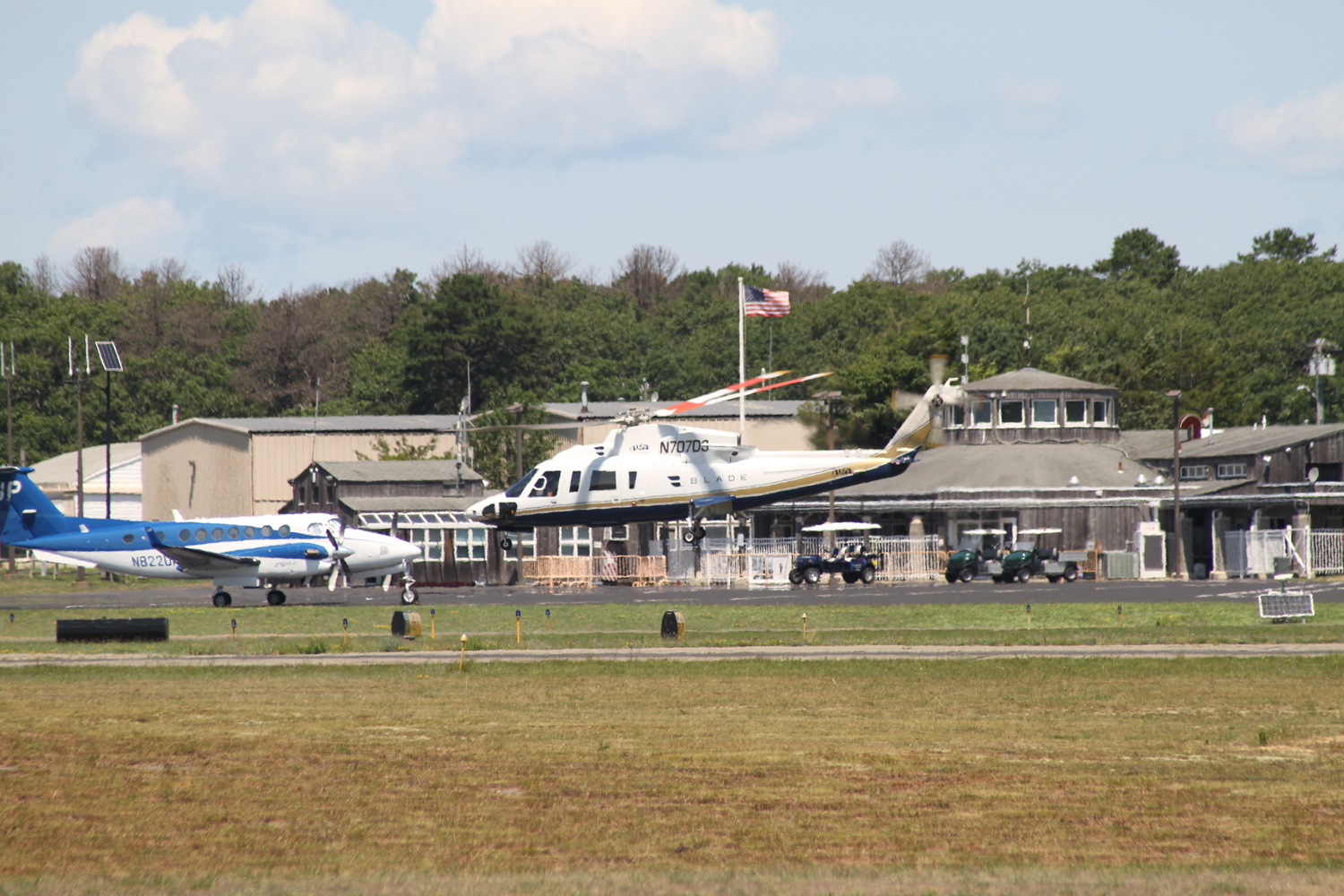
Blade at East Hampton Airport. MICHAEL WRIGHT

Blade at East Hampton Airport. MICHAEL WRIGHT
An attorney for Blade Air Mobility, which allows users of its app to book seats on scheduled helicopter and airplane flights, has accused East Hampton Town of effectively closing East Hampton Town Airport to Blade by stripping it of its ability to operate there and ensure the safety of its passengers.
The carrier is seeking a temporary restraining order enjoining the town from restricting its employees’ access to the airport, including the tarmac and ramp areas, and taking any other steps to close the airport to Blade’s business.
The action follows the town’s notice terminating the lease allowing Blade to use a counter in the terminal and, the attorney for Blade alleges, a town official preventing a Blade employee from accessing the airport on October 11 and threatening to call the police if the employee did not leave the site.
The town issued a 30-day written notice, effective September 30, of its decision to revoke Blade’s license “for nonpayment of the license fee during the period of January 1, 2021 through July 31, 2024 amounting to $217,413.00 plus 18 percent interest.”
According to the notice, Blade was to vacate the town-owned airport and cease using the area it leased on or before the revocation date, with the notice adding that failure to do so would result in the town removing Blade’s equipment, signage and property and precluding its agents or employees from accessing the area.
The desk occupied by Blade was vacant and unmanned this week, but the company continues to book flights from Manhattan to the airport, with two scheduled to arrive today, October 31.
Rob Wiesenthal, Blade’s chief executive officer, wrote to Jim Brundige, the airport manager, on October 10. “I understand that you instructed the airport’s [fixed base operator], Sound Aviation, perhaps at the request of the town, to no longer allow Blade representatives on the ramp” — the tarmac where passengers board an aircraft — “as required by our operators and Blade’s own Safety Team to ensure the safe operation of our flights.”
Blade’s trained safety officers, he wrote, perform essential duties at the airport including confirming that passengers are in specific seats to ensure correct aircraft weight and balance, that correct luggage is on the aircraft and no unsuitable items are in the cabin, that seat belts and headsets are properly set on passengers, and that all door and baggage compartment seals are closed and locked.
“Given that by-the-seat operations require much more comprehensive operating and safety protocols, our operators and safety team require us to perform these duties,” he wrote. “Please understand that JFK International Airport, Newark International Airport, LaGuardia Airport, and Westchester County Airport require us to perform the very duties that we are prohibited from performing at East Hampton Airport.”
Blade “has agreed to pay the full amount of ‘back pay’ that the Town has demanded of Blade to resolve the issue of its desk license at the airport,” Edward Burke Jr., an attorney representing Blade, wrote on October 15 to Nicholas Rigano, outside counsel for the town. “Blade is anxious to end this dispute, as the Town is no longer allowing Blade to conduct its customary operations there as it has been doing for the past 10 years.”
New York State Supreme Court Justice Thomas Whelan has set a November 12 hearing at which attorneys for East Hampton Town are to show cause as to why Blade employees should be barred from the airport.
The town’s action with respect to Blade’s license agreement comes amid a years-long struggle in which it has tried, without success, to impose restrictions on flight activity at the airport, citing quality-of-life issues for residents, many of whom point to helicopters as among the most offensive aircraft type. In May 2022, on the eve of the planned imposition of a suite of restrictions limiting aircraft operators to one takeoff and one landing per day and other noise, size and curfew-based limitations, a now-retired Supreme Court justice issued a temporary restraining order blocking the town’s plan to briefly close the airport and reopen a “new,” private airport with those restrictions in place.
That judge, Paul J. Baisley, repeatedly sided with plaintiffs who sued the town over the plan to impose restrictions on flight operations. Last year, he ruled that the town was in contempt of court for failing to comply with the 2022 TRO barring it from privatizing the airport and implementing restrictions. While the town did not impose the hoped-for restrictions, an attorney for the plaintiffs argued, and Baisley agreed, that the town remained noncompliant with the court order because its attorneys continued to seek legal pathways to the airport’s permanent closure while also adopting some new requirements for pilots using the facility.
The town “is once again displaying a blatant disregard and contempt for the orders of this Court and the Appellate Division requiring the Town to maintain the status quo at the Airport and take no steps to change its operations as a public airport accessible to all,” Randy Mastro, an attorney representing Blade, wrote in an October 16 memorandum to the Supreme Court. The court’s language could not be clearer, he wrote, citing Baisley’s May 2022 order. “The Town is prohibited from ‘deactivating or closing [the] Airport,’ including ‘taking any steps’ towards ‘closing, implementing any of the new use restrictions. Respondents have announced they intend to implement, or otherwise [restrict] public access to the Airport.’” Nonetheless, the town “is restricting Blade employees responsible for passenger safety from being present at the Airport entirely,” he wrote.
Mastro also asserted that Blade’s license agreement had expired on December 31, 2020, with no renewal or extension, but it continued to use its counter space in the terminal “without comment or interruption from the Airport or the Town.” Despite an active license agreement, in April and June, the town “sent Blade’s counsel a letter demanding hundreds of thousands of dollars in backpay,” followed by the notice revoking its license. A Blade official speaking on background seconded those statements.
Mastro accused the town of incrementally restricting Blade’s operations and “doing everything short of saying that it is ‘closing’ the Airport to Blade’s use.” Blade, its passengers and the public at large will suffer irreparable harm if the town’s actions are allowed to continue, he wrote. “There is no compelling urgency for the Town to restrict Blade’s access to this fully-functioning, public airport just because the parties disagree about counter space.”
Rob Connelly, the town attorney, said on Wednesday that as the matter is actively being litigated the town has no comment.


