


 1 Photo
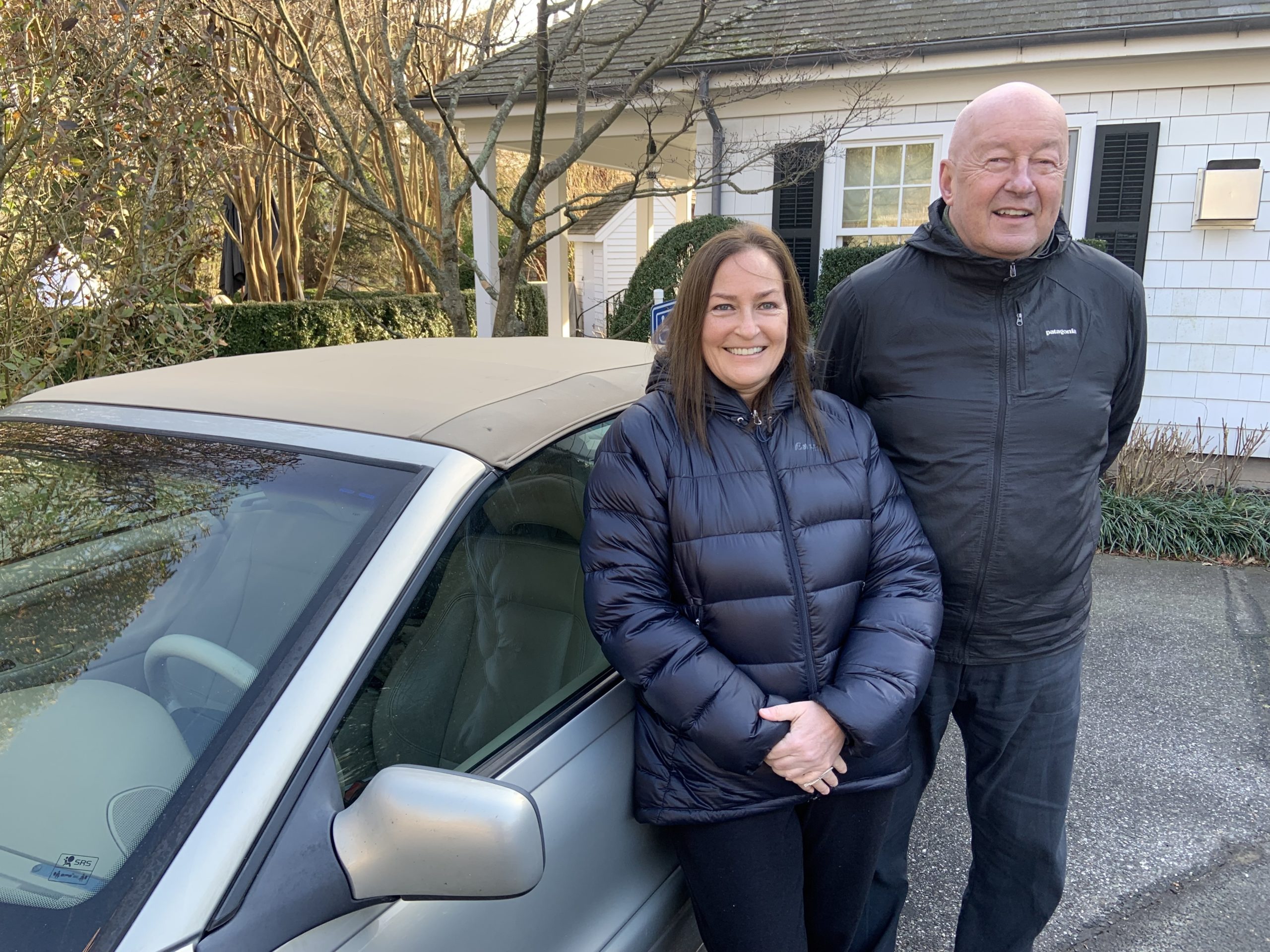
Sarah Bonnier and Michael Mallinen have been touring New England by backroad for three months. STEPHEN J. KOTZ
January would hardly seem to be an ideal time of year to be taking a meandering road trip across New England, especially if you are driving a Volvo convertible.
But that’s what Sarah Bonnier and Michael Mallinen, who live in Ketchum, Idaho, are doing.
The couple, who were staying at The 1770 House in East Hampton last week, said they had no idea where they were headed next, other than it would involve taking the Cross Sound Ferry back to New London, Connecticut.
“Literally every day, we ask ourselves, ‘What do we want to do today? What is today going to bring? What do we want to learn?’” Bonnier said during a January 19 conversation in the inn’s library.
Up to then, their visit to East Hampton had involved sightseeing in the village, with day trips to Southampton Village and Sag Harbor. And lots of chatting.
“This trip has truly been about people,” Bonnier said. ‘It has been about conversations that have created a quilt of connections. All along this trip, we’ve met complete strangers. It’s amazing how conversation truly connects us.”
The couple began their trip in mid-October, after first having driven to Albany in August, where they met Mallinen’s son and took him to St. Lawrence University in upstate Canton.
During the early days of that trip, they whetted their appetite for getting off the beaten path by following back roads through much of Wyoming and into South Dakota, where the looming deadline of the new school year forced them onto the interstate.
Mallinen and Bonnier left their car in Boston and flew back to Idaho for a few weeks to prepare for their New England jaunt. When they returned to Boston, they hit the road straight away.
There were a few ground rules, including keeping the top down whenever feasible — which, with the recent cold spell, is no longer the case.
More importantly, the couple have chosen to drive on back roads as often as possible. Bonnier estimated they have driven less than 90 miles on interstate highways during a trip that so far has taken them up through Maine and back west across northern New Hampshire and Vermont.
They followed the Seaway Trail in upstate New York to St. Lawrence, where they visited with their son, before heading south through the Adirondacks, back to Vermont, and through Massachusetts, Rhode Island, and Connecticut, where they caught a ferry in New London for Long Island.
Back roads are inviting, Bonnier said, because often they follow the paths and trails that the earliest settlers and Native Americans used. Plus, they take you into, not around, historic villages along the way, offering views of architecture and natural features that a traveler might not otherwise see from the interstate, she added.
“You can really pick up on the flavor of the history of the people in the different regions, from early settlement to the present,” she said.
Bonnier said they had enjoyed driving through old mill towns — “How incredible New England was at the end of the last century,” she said — and fishing ports and seaside towns as well.
Bonnier, who traces her family’s ancestry to the Mayflower, has done a little family tree research searching on the trip. Using old maps she found in a Vermont town hall and Google Maps, she tracked down the ruins of a cabin her great-grandfather had built in the woods outside of Winhall. Later, she tracked down distant cousins, who live in St. Albans, who showed her his Civil War sword.
Later in the trip, Bonnier learned that she was descended 12 generations from the Reverend Peter Bulkeley, one of the founders of Concord, Massachusetts.
With no deadlines, Bonnier said she and Mallinen are simply trying to keep an open mind as they travel “because no two places are the same, and that’s how you find enjoyment.”
Neither is there a set end date, she added.
“Here it is January, and we are still on the road,” she said. “We had no idea. We thought it was going to be a two-week journey, maybe a month. But we don’t know because we have no itinerary, no set plans, no expectations.
“It has become this incredible creation in and of itself, and it has presented itself through our experiences, which continue to this day.”


 Stephen J. Kotz on Jan 25, 2022