


 1 Photo
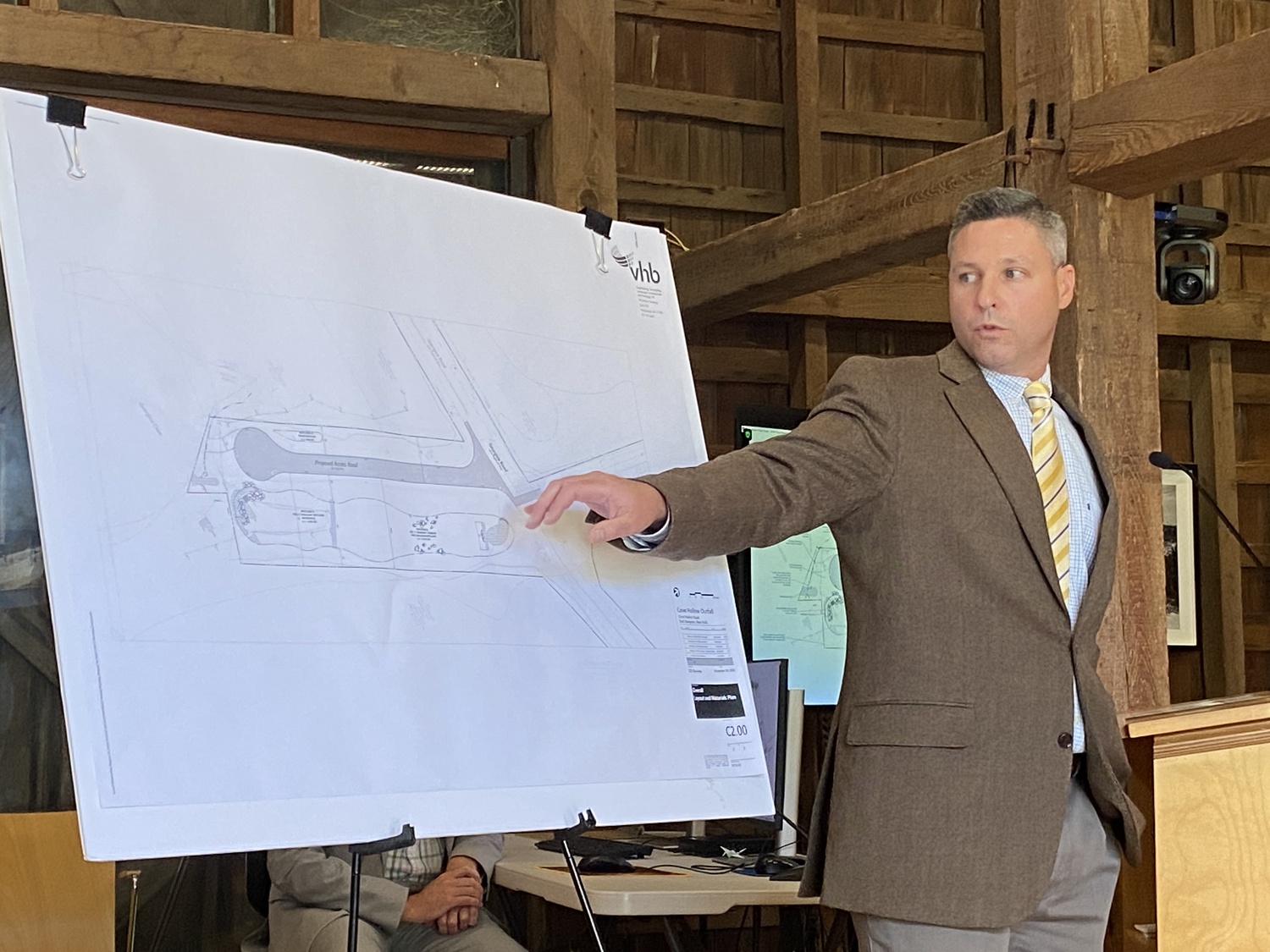
Andrew Kelly from the VHB consultancy detailed a plan to treat stormwater at the Cove Hollow stormwater pipe outfall. CHRISTOPHER WALSH
Final design of a long-planned stormwater treatment system at the outfall of the 7,300-linear-foot Cove Hollow stormwater pipe, which empties into Georgica Pond, was presented to the East Hampton Town Board this week.
The Cove Hollow stormwater pipe was constructed in the 1930s as a drainage project to alleviate flooding from farmland runoff. It runs from the railroad trestle at the northern end of Cove Hollow Road, near Route 114, to the outlet at Georgica Cove, emptying into the pond. Half of the pipe is located within the town, and half within East Hampton Village.
Stormwater flowing to the pond is a source of nutrients, sediment and bacteria, among other roadside contaminants, Mellissa Winslow, principal environmental analyst in the town’s Natural Resources Department, told the board.
The pond has been beset with macroalgae and blooms of cyanobacteria, or blue-green algae, nourished by excess nitrogen and phosphorous loading. “That’s what makes this project important in moving forward and trying to alleviate some of these issues,” she said. The goal is to reduce the volume, and improve the quality, of stormwater flowing into the pond.
A camera inspection and engineering review led to a recommendation to capture and treat stormwater exiting the pipe before entering Georgica Cove. The town sought proposals in 2022 and hired the VHB environmental consultancy to design and create a wetland.
The 1-acre site where the existing outfall is situated, at the end of Cove Hollow Road east of the pond and north of Georgica Cove, is “somewhat overtaken by phragmites on the southern edge,” said Andrew Kelly from VHB, and the invasive species should be addressed as part of the proposed improvements. He described “a meandering design through the parcel” that integrates passive pedestrian use and a small parking area.
Stormwater improvements primarily consist of “daylighting” the existing pipe, which Kelly defined as opening it to a “best management practices,” or BMP, structure so that water can flow freely out of it. This structure is typically a bioswale or rain garden, he said.
The existing 24-inch pipe comes down Cove Hollow Road into an existing structure before turning to Georgica Cove. “We are proposing to turn that pipe and spear it off into our BMP systems,” Kelly said, starting with a sediment forebay or plunge pool. That, he said, will slow drainage and allow for larger solids to “sort themselves out.”
A dam structure would then overflow to a shallow constructed wetland area, allowing water to pool and work its way south to a secondary structure, a gabion weir, which would further slow and filter stormwater as it passed through the system. Flow would continue to another shallow wetland or micro-pool, the last infiltration area before water exits to the outfall.
The system is designed to treat a 1.5-inch rain event, he said, but an overflow is built into the design, so anything more than 1.5 inches, such as the rain in East Hampton Town on Sunday night into Monday, would follow the same route as the existing pipe but be “upsized” to a 30-inch elliptical pipe.
“In terms of the actual outfall into Georgica Cove, we are proposing to replace the existing structure that’s there today,” Kelly said, citing its deteriorating condition.
An upland buffer area will comprise native and adaptive plant species, Kelly said, capable of absorbing varying degrees of inundation from storm events and aid in filtering and slowing stormwater.
He also proposed an excavation method to remove phragmites, through mowing or hand removal, toward the southern half of the site. “We will also look to integrate a root barrier installation around the perimeter” aimed at preventing phragmites outside of the parcel from re-establishing.
An initial submission to the New York State Department of Environmental Conservation and the U.S. Army Corps of Engineers yielded comments and subsequent revisions to the plan, said VHB’s Ryan Winter.
“We are preparing to make submission back to them within the next week,” he said. “We do anticipate potentially one more round of comments, especially with the DEC” regarding phragmites removal and the existing outfall. “There may be a bit more back-and-forth with those, but otherwise all the comments have been addressed,” he said.
Plans will then advance to construction documents and further detail on the cost estimate, currently $2.1 million. A post-project water quality analysis will assess impacts of the improvements. A monitoring and adaptive management plan will also be created. The DEC and Army Corps, Kelly said, would likely shape that plan. “Our recommendations are here today,” he said, “but they are likely to change based on the final permit conditions that we receive from the DEC.”
Before the presentation, Sara Davison of the Friends of Georgica Pond Foundation told the board that the foundation enthusiastically supports the plan. “Although it’s a unique location and situation with an extremely long stormwater pipe, it is our hope that this project can serve as a model for other road ends that discharge stormwater into our surface waters,” she said.
Rainstorms such as the event on Sunday and Monday are “a very large source of bacterial contamination to our surface waters,” she said, “and projects like this that intercept the stormwater, slow it down, meander it and use traditional engineering and green engineering to affect the solution are very worth considering, and I hope you will consider it favorably.”


