



 3 Photos


The cost of an improved public transportation system, one linking the North and South Forks, will most likely cost tens of millions of dollars less than originally expected, according to the results of a study presented during a forum held last week at Suffolk County Community College’s Riverhead campus.
The study was conducted by the Volpe National Transportation Systems Center, a federally funded intermodal transportation research firm in Massachusetts. It was commissioned on behalf of the five East End towns and was conducted to determine the feasibility of building a coordinated rail-bus public transportation system serving the region.
The system, if it is ever approved, would integrate local shuttle trains with connecting bus service and replace most of the current transit services. The entire project would take about a decade to complete, according to experts.
According to a copy of the final report, the project would cost between $117 million and $148 million to build, and about $44 million a year to operate. Sean Pierce, who attended the forum on behalf of Volpe, noted that the estimated cost of the capital project came in lower than the original $247 million figure.
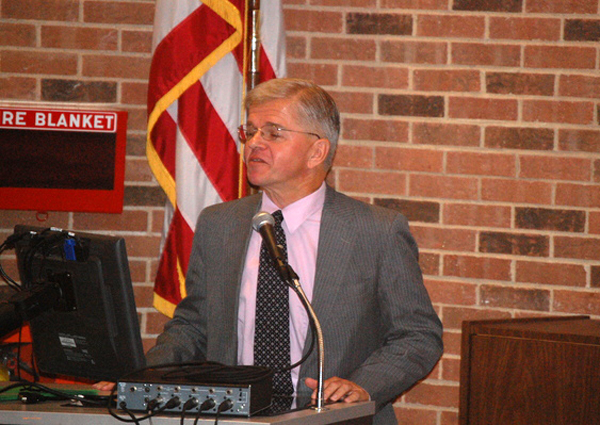
New York State Assemblyman Fred W. Thiele Jr., who hosted the forum on September 23, attributed the reduction in price to the fact that residents living on the North Fork are in favor of a different, less costly, option.
The assemblyman also said that the project would most likely be funded through New York State and Suffolk County taxes, and be supplemented with federal grants. Mr. Thiele stressed that local towns and villages would not subsidize the project.
Southampton Town Director of Public Transportation and Traffic Safety Tom Neely explained that Volpe presented two different concepts during a forum in April. The first option called for a complete overhaul of public transportation on the East End, including new shuttle trains and connecting buses, and the other called for a smaller-scale and more gradual approach, with increased bus service and no immediate major rail improvements. Residents on the North Fork seemed to prefer the latter option, while residents on the South Fork preferred the former.
“It is much more capital intensive for the South Fork,” Mr. Neely said.
The approach presented during last week’s forum integrated the two methods on the North and South forks.
If it is ever built, the transportation system—known as a dual concept, because it includes different approaches to public transportation on the two forks—would feature small shuttle trains that would run between Montauk and Speonk every 30 minutes during peak times. Those trains would be coordinated with shuttle buses and seven demand response vehicles that could possibly transport residents from their homes to train stations.
Mr. Neely estimated that riders would pay a fare of approximately $2.50, if the system is ever built.
On the North Fork, there would be more frequent bus service and an express bus from Riverhead to the Long Island Rail Road’s Ronkonkoma train station, and another to Long Island MacArthur Airport in Islip. There would also be a shuttle bus connecting the North Fork with the South Fork. Currently, Suffolk County’s S-92 bus route runs from Montauk to Southold.
“The final details still have to be worked out,” Mr. Neely said on Tuesday.
During the forum, Mr. Neely explained that the next step in the process would be for the five East End towns to adopt resolutions supporting the initiative. Once that happens, Mr. Thiele said that elected officials from the towns would then meet with the Metropolitan Transit Authority and the LIRR to determine whether or not those agencies would support the initiative.
Mr. Thiele said it is not clear what entity would oversee the proposed bus and rail system. He said that, ideally, it would be under the jurisdiction of both the LIRR and MTA, but added that it was also possible to create a new authority to oversee it.
Many of the 50 or so audience members who attended the forum seemed enthusiastic about the plan.
Southampton Town Councilwoman Anna Throne-Holst, who is running for town supervisor, noted that transportation systems like the ones discussed at the forum are already implemented in other countries. She said that improved public transportation would allow students to travel for school and work, when they otherwise might not have been able to do so.
“So many of our kids can’t get jobs,” Ms. Throne-Holst said. “They can’t get themselves to activities.”
Edvin Stromsten, the chairman of the Planning and Governance Committee for the American Institute of Architects Peconic, said he would like to see an aggressive timetable for the project. He also wants organizers to do a better job at spreading the word about the plan.
“One of the keys to success here is the public needs to be much more aware than it is now,” he said.
Mr. Neely added that how fast the project moves forward depends on a variety of factors, starting with the availability of funding. “The reality of the world [is that] it comes down to financial resources,” he said.
Though potential ridership numbers must still be studied, Mr. Thiele maintains that the need for improved public transportation system will only increase in the next few years.
“I think the demand is there,” Mr. Thiele said. “If you make it cost-effective and convenient, people would use the service.”


 Bryan Finlayson on Oct 13, 2009