


 1 Photo
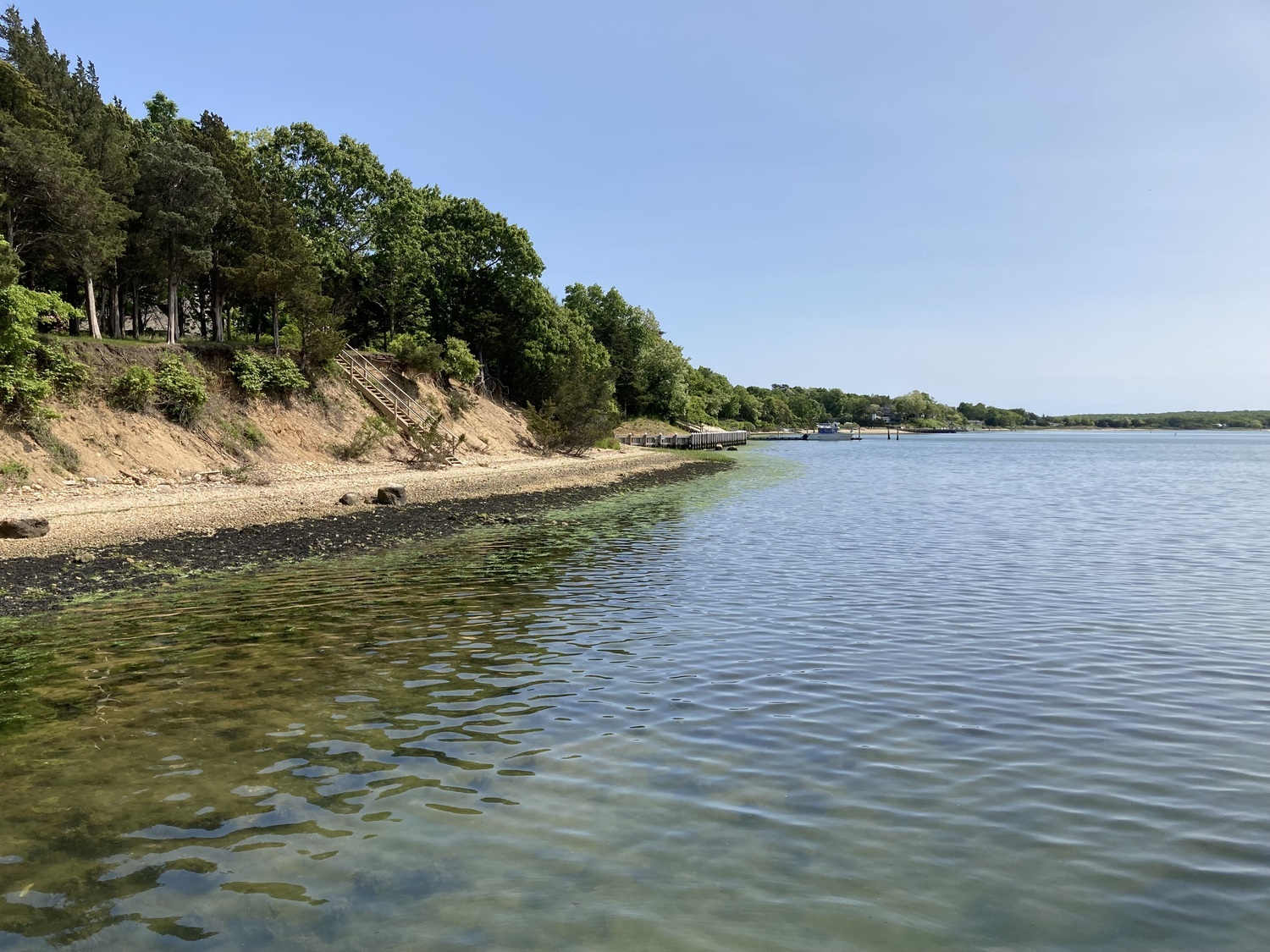
The East Hampton Town Trustees are considering banning the construction of new docks along the last section of shoreline in the town where they are technically allowed, on the eastern side of Three Mile Harbor. The Trustees said they have heard no objections to the idea over the last two years of examining their current dock policies. KYRIL BROMLEY
Members of the East Hampton Town Trustees this week leaned toward expanding the board’s prohibition on new docks to the sliver of town shoreline in Three Mile Harbor, where they technically are still allowed.
The Trustees heard no direct objections to the idea at a recent public hearing on a package of proposed updates to the board’s dock policies, or through nearly two years of the drafting process.
“It seems like the whole town has just been of the opinion that no docks have been allowed anyplace, and they are cool with it,” Trustee Bill Taylor said at Monday night’s meeting. “You can make a good argument for consistency.”
Trustee John Aldred said that he agreed that a consistent policy across all water bodies made the most sense.
Taylor said he has never understood why the Trustees had left the eastern shoreline of Three Mile Harbor available for the construction of docks, when the board banned them in literally every other stretch of waterfront under its purview in 1984 and 1987.
The allowance had never been an issue, until 2021, when the new owner of a Three Mile Harbor Road property submitted the first application for a dock in the town in more than 35 years. The Trustees were bitterly divided on whether to approve it, but a 5-3 majority ultimately decided they had no grounds to deny the application based on the conscious decision of their predecessors on the board to leave the eastern shoreline of the harbor open to docks.
But they immediately, and unanimously, resolved to examine the continuance of the policy and imposed a moratorium on new applications. The town Zoning Board of Appeals, meanwhile, attempted to block the construction of the proposed dock, but was overruled by a county Supreme Court justice earlier this year.
Over the past two years, the Trustees have conducted an exhaustive inventory of all the docks in the town and examined all of its policies regarding existing docks. As that process comes to an end, and the board considered the recommendations for how to update the policy, the matter of simply extending the ban and doing away with future dock proposals has found few detractors.
“There has been zero comment on a total ban of docks,” over the entire two-year process, Trustees Clerk Francis Bock said. “All the comments come from people who already have docks and are concerned what our policy is going to be.”
Aldred said that one of the motivations for the original dock bans was the protection of bottomlands as shellfish harvesting areas — something that he said could be considered an even more ripe concern now in Three Mile Harbor in light of the extensive efforts the East Hampton Town Shellfish Hatchery program has put into improving shellfish supplies in Three Mile Harbor in the decades since.
Also within the new policy discussion was “the Georgica Pond loophole,” as the committee that has been reviewing the docks policy dubbed a wrinkle in how the Trustees imposed the dock ban over the years. Some properties on Georgica Pond have been allowed to install staircases with platforms as the bottom step, or some with a floating platform at the shoreline.
While the platforms have not, to date, been used as docks. Trustee Jim Grimes noted that photos in the inventory show that the platforms do not have cleats with which to tie off a boat. But some are used to store kayaks by the shoreline and some members of the Trustees board said they thought that allowance should be ended, heading off expansion or bastardization of the policy to back into what would otherwise be considered a dock.
“As soon as someone next door has one of these, the neighbor is going to want the same,” Trustee Susan McGraw-Keeber said. “If we’re trying to avoid additional things on Georgica Pond that are ‘docks’ … then we should say, yes, let’s close the loophole.”
“These structures are, in effect, docks, just called another name, and if we want a consistent policy I’m in favor of calling them docks,” Aldred added.
Grimes said he did not “see the evil” in docks on the pond. He noted that many of the platforms are employed along sections of shoreline where there is a steep drop from pond edge to the water and that not having the staircases and platforms would simply mean a footpath would soon be worn into the shoreline, degrading its integrity.
“I don’t think these were an effort to try to get a dock. They were placed to try to get access to the pond that was safe for users,” he said.
Trustee Ben Dollinger said he would be in favor of whatever is best for the environment — even if that means that having a small structure on the shoreline is better than broken foot paths and kayaks resting on the pond bottom or marshlands.
The Trustees also plan to introduce a number of new amendments that will give those who have expanded existing docks without Trustee permission, or do so in the future, an avenue to legalizing or rectifying the violating improvements within a reasonable time period — or face revocation of all permits and compelled removal of the structures.
Another new policy that came directly from the comments received at the public hearing on the proposals would allow the pilings that support seasonal floating docks to be left in through the winter months, rather than requiring they be removed as they are now. Dock owners had said that the current policy means more environmental disruption in removing and reinstalling the pilings, when leaving them in would have minimal disturbance — especially since iced-over harbors that can lift pilings out of the bottom and cast them asunder have grown increasingly rare.


 Michael Wright on Nov 29, 2023