


 1 Photo
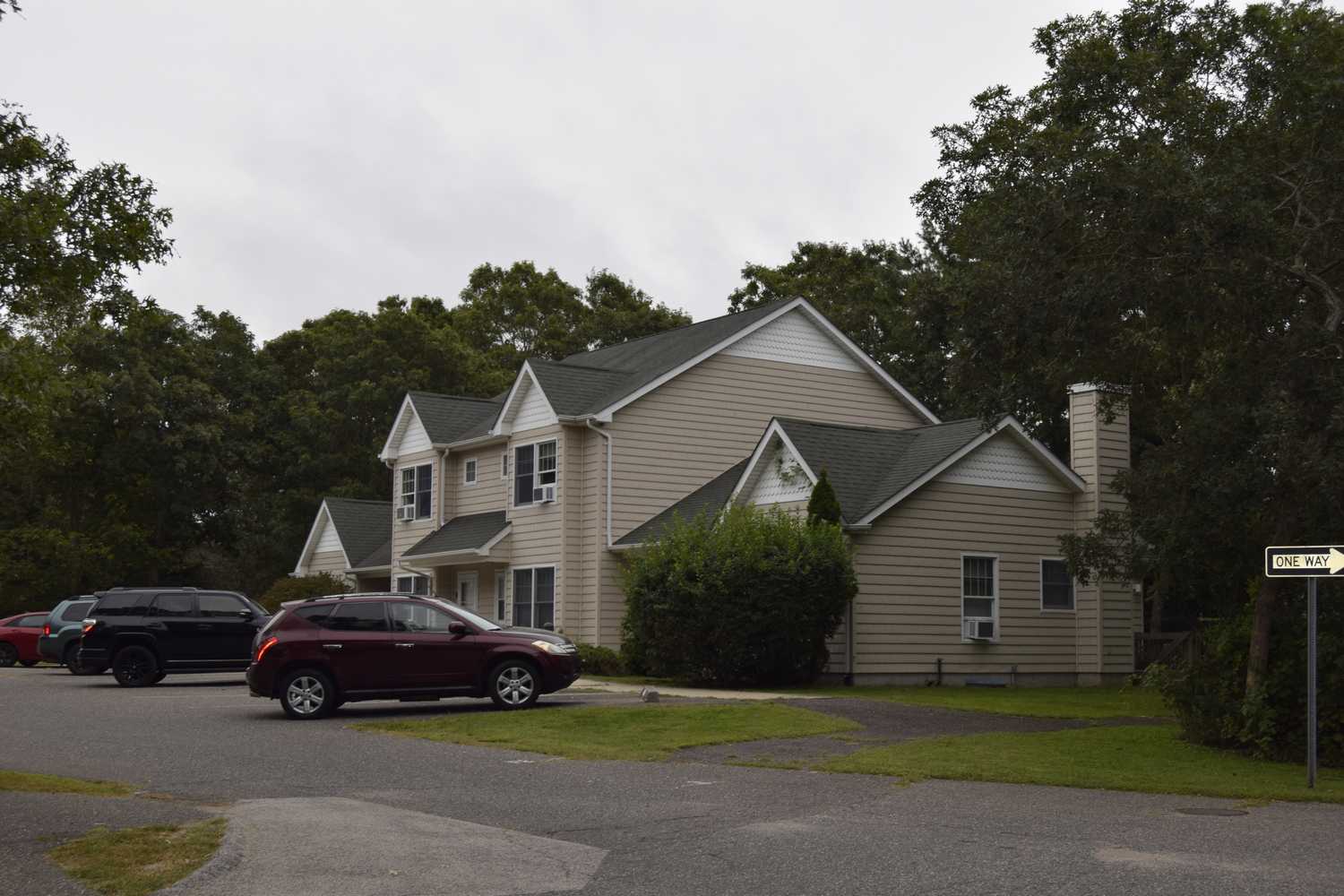
The Springs-Fireplace Apartments in East Hampton is one affordable housing complex that could accommodate more units, should the Town Board opt to allow greater density. CHRISTOPHER WALSH
Having recently amended the town code to allow up to 12 units per acre for senior citizens affordable housing, where previously only eight units per acre were permitted, the East Hampton Town Board considered increasing the allowable density for all affordable housing developments from eight to 12 units, as well as creation of a new use for employee housing, which could also see a 12-units-per-acre allowance, during a long discussion on Tuesday, September 17.
Eric Schantz, director of the town’s Office of Housing and Community Development, told the board that the Suffolk County Health Department will permit density of greater than eight units per acre where sewage treatment is provided, and that a traffic analysis conducted for senior citizens affordable housing developments concluded that nonsenior housing would be unlikely to see significantly greater traffic should the density allowance be increased.
An increase to 12 units per acre would permit additional units on sites already appropriate for affordable housing developments, he said.
The discussion was the latest in the Town Board’s efforts to confront an acute scarcity of affordable housing that has created shortages in staffing — among the businesses catering to the tourism that is the town’s economic engine, in the town’s volunteer fire departments, and in the town government itself.
It also followed a proposal by a resident who with investors has pitched a privately developed housing complex in which units would be owned by businesses in the town and provided to employees. That need is even more critical given the ongoing construction of a freestanding Stony Brook Southampton Hospital emergency room at 400 Pantigo Place in East Hampton.
There are 24 sites with an affordable housing overlay designation in the town, Schantz told the board, three of them currently vacant. Six do not have the required lot area for an affordable housing development, and three have senior-only affordable housing developments where 12 units per acre is already permitted. Seven have nonsenior affordable housing developments now, and of those, three — Whalebone Village, the Springs-Fireplace Apartments, and Gansett Meadows — could collectively accommodate an additional 29 units, he said.
Three more sites are vacant. Should they be developed with affordable housing — one of them, on Route 114 in Wainscott, is expected to see such development — allowance of 12 units per acre would allow 25 units more than permitted under the current code.
While 160 additional units could conceivably result across all affordable housing overlay lots, the 54 units that could be created on the above mentioned properties is a realistic figure, Schantz said. It is not a substantial number given the need, he said, “but every little bit helps.” An environmental assessment considering the potential additional yield on all affordable housing overlay district sites will be prepared, he said.
All new affordable housing developments require site plan approval from the Planning Board, and Schantz proposed that any new development of greater than eight units per acre also require a special permit from the same entity. Such developments would also require sewage treatment, studies of impacts on the school district from increased enrollment and on traffic on adjacent roadways and intersections, and conformance with the town code’s dimensional requirements. The board indicated a desire to eliminate another proposed requirement, of additional buffers and screening.
A code change would not affect the maximum number of units permitted on any one site, which is 60.
“We aren’t necessarily creating opportunities for massive development that would change community character,” said Councilman Ian Calder-Piedmonte. The town tries to limit development and intensity of use, he noted, but “affordable housing is a worthy exception to that.”
He asked that the community offer feedback on the proposal. “If this might encourage more projects,” he said, “we want to do it.” His colleagues on the board were similarly supportive.
Regarding the proposed employee housing development land use, Schantz said that the concept is to add a mechanism in the code that similarly allows higher than currently permitted density but in multiple-residence developments at which ownership is restricted to local businesses, with tenants being their employees or others who work and live in the town. It is, he said, an effort to encourage private development of a needed form of housing.
Owners would have to be local businesses doing business in the town and with at least four employees, a physical location of business in the town or a valid contractor’s license. Unlike the proposal by Kirby Marcantonio, who with investors seeks to develop the property at 350 Pantigo Road in East Hampton for workforce housing, under this proposal units could also be sold to a moderate-income family.
Increased density would be allowed, Schantz said, with the “give back” being the restriction on ownership. This use, he said, does not meet the definition of affordable housing in the town code, as the housing would not be available exclusively to those of moderate income.
The initial sales price of a unit would exceed the affordability threshold, with proposed prices of $355,550 for a studio, $406,250 for a one-bedroom unit, $507,650 for a two-bedroom unit, and $588,900 for a three-bedroom unit.
But an employee housing development would be required to meet the maximum rent requirement for affordable housing, with rent not exceeding 130 percent of area fair market rent, which was listed as $2,220 for a studio, $2,787 for a one-bedroom unit, $3,260 for a two-bedroom unit, and $4,219 for a three-bedroom unit.
As the use does not meet the definition of affordable housing, such developments should not be permitted in the affordable housing overlay district, Schantz said. Rather, the board should create an employee housing overlay district, though some properties would likely have both designations. “The idea here is employers owning it, employees living in it, regardless of how much they make,” he said.
As with the proposal allowing greater density for affordable housing, any new employee housing development would require a special permit from the Planning Board, sewage treatment, a traffic study and analysis of the impact on the school district.
Units would be required to be residential condominiums, Schantz proposed, allowing ownership of individual units as opposed to a single owner of the entire site, with the developer required to set up a condominium board and enabling and restricting documents required to be reviewed and deemed acceptable by the Planning Board before a special permit is issued. Units would have to be the tenants’ sole legal residence, and subletting of units would be prohibited.
The developer would be required to cap the future resale price of a unit at the initial sale price as adjusted by the Consumer Price Index plus 2 percent, effectively rendering them more affordable over time, assuming current trends in real estate prices continue. The proposal also includes a provision allowing units to be sold directly to or rented to a moderate-income family.
Board members were intrigued by the proposal but emphasized the need for guardrails and restrictions to preclude “gaming the system,” in the words of one. It is “a new idea worth deep discussion,” Calder-Piedmonte said, voicing the hope that the idea would be discussed again at an upcoming board meeting. Councilman Tom Flight said that certain businesses should be prioritized for the good of the community, where there is presently no mechanism in the proposal to do so.
Councilwoman Cate Rogers wondered about the effect of an employee leaving a business, voluntarily or through termination, on their housing and children’s enrollment in the school district.
“It’s not ideal to have somebody’s job tied to their housing,” Calder-Piedmonte said, “but it’s our reality in the town already. Unfortunately, I don’t think there are a lot of viable alternatives.”


