


 2 Photos
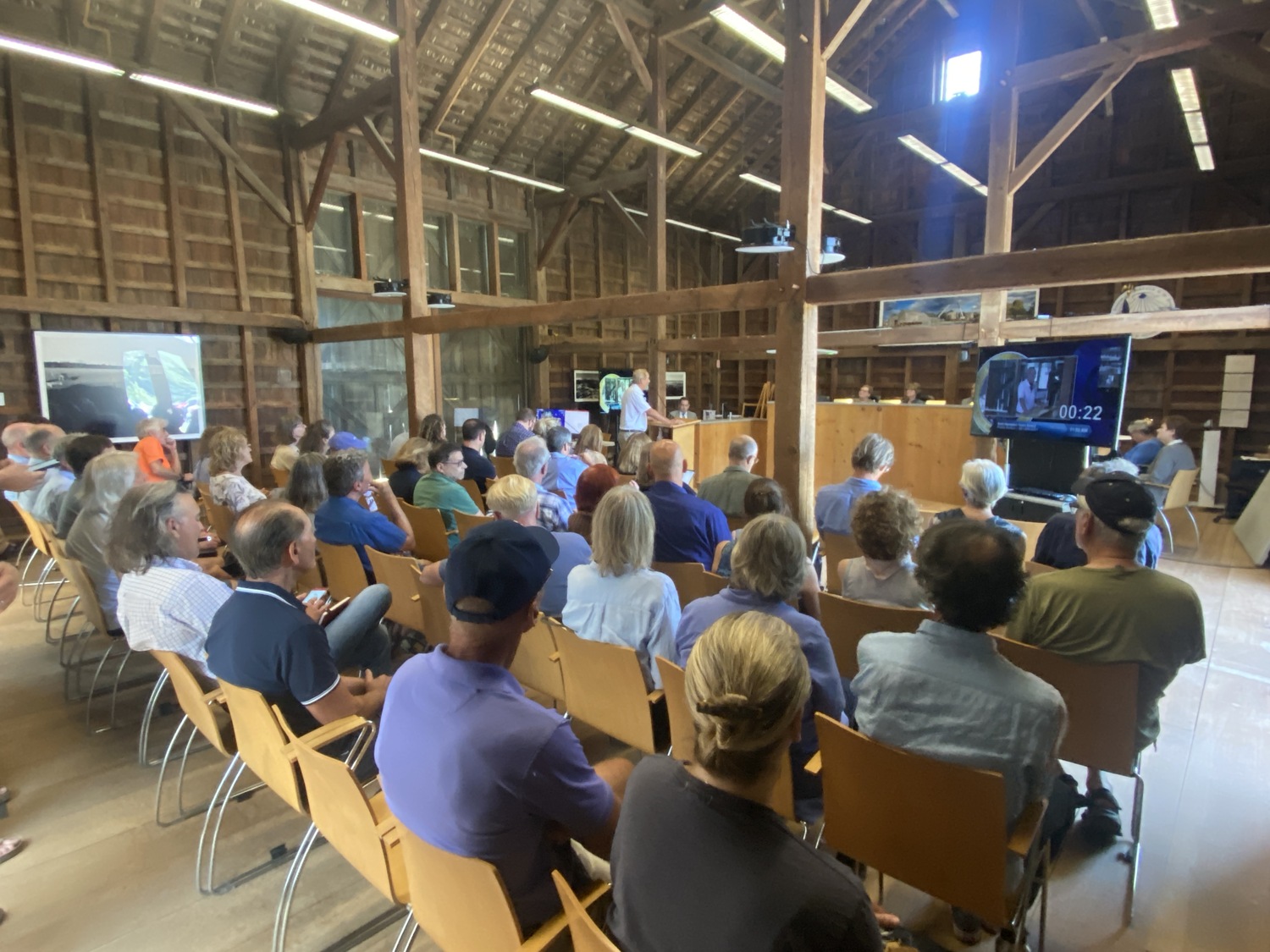
The meeting room at East Hampton Town Hall was full for a discussion of proposed zoning code changes to rein in rampant development. CHRISTOPHER WALSH
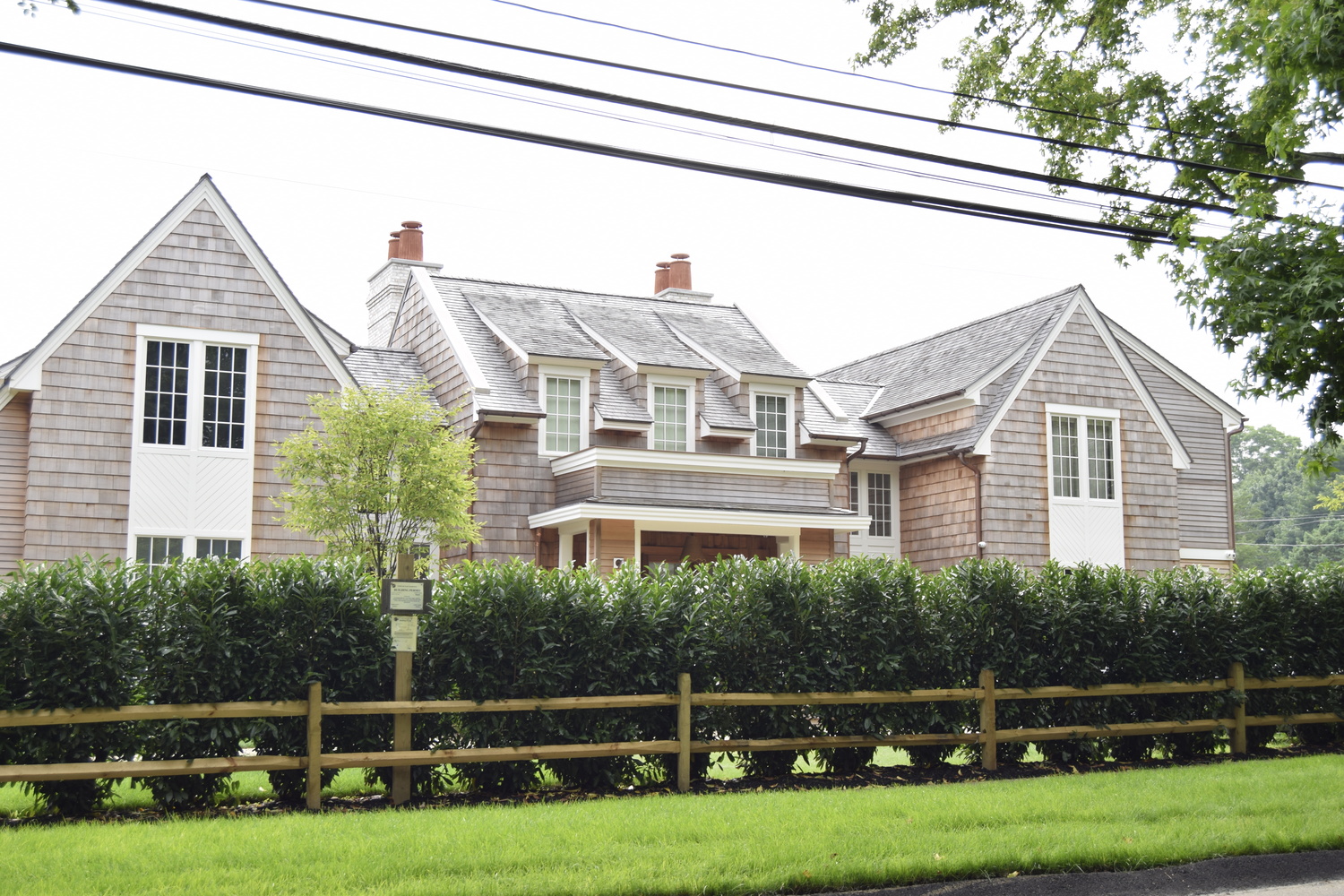
The recently-constructed house on a 0.84-acre lot in Amagansett uses all but five feet of allowable gross floor area but adds a more than 2,000-square-foot lower level and 1,035-square-foot attached garage. CHRISTOPHER WALSH
History repeated itself at East Hampton Town Hall on Tuesday, when residents spoke for an hour before the discussion they’d come to hear — an update of the Zoning Code Amendments Working Group’s proposed changes to rein in rampant development that is transforming both neighborhoods and the environment — had been held.
One year ago, dozens of residents implored the Town Board to rein in a building boom characterized by oversized houses that circumvent existing code to create the appearance of three-story structures — when the entire side of a foundation is dug out — and basements that extend multiple stories underground and beyond the house’s foundation, as well as garages of thousands of square feet.
A sense of urgency was palpable as one resident after another decried not just huge houses priced far beyond most year-round residents’ means and attendant increases in density and traffic, but relentless habitat loss and ecosystem collapse, as manifestations of climate change are closely observed for a second consecutive year.
The working group is tasked with ensuring that the zoning code complies with the town’s comprehensive plan, which emphasizes sustaining natural resources, rural character, open space preservation and environmental protection. “Future development should be harmonious with the existing character of the community,” is part of its vision statement.
Tuesday’s discussion followed a May 7 presentation at which it was acknowledged that the existing code allows workarounds and loopholes enabling construction that egregiously contravenes the goals as set by the code’s purposes and the comprehensive plan, enabling what Councilwoman Cate Rogers called “chaotic development.”
At that presentation, the working group proposed that attached garages and finished basements be included in gross floor area, or GFA, calculations; that the maximum house size be reduced from 20,000 to 10,000 square feet, and that accessory buildings be limited to 15 feet for a flat roof and 20 feet for a gabled roof, and a lower allowable height for pool houses. The code currently calculates maximum house size by a formula of 10 percent of lot area plus 1,600 square feet.
Also proposed on May 7 were a 15-foot vertical limit to basement depth, a prohibition on basements extending beyond the first story’s exterior wall, a prohibition on buried tunnels without a story above them, and a minimum of 2 feet of separation from groundwater for all buildings and swimming pools.
On Tuesday, after the group had consulted with builders, surveyors and land-use attorneys, some proposals were softened. To disincentive sprawl on a property, it was proposed that attached garages be allowed 600 square feet of floor area, the same as is allowed for a detached garage, and count only additional square footage toward GFA.
“What we are seeing is five, six, seven-car garages,” Rogers said. “You can build a 1,000-square-foot garage, and we don’t see it” in GFA calculations. “The idea is to give the first 600 square feet to make sure we’re not incentivizing people to push out farther on their property, incurring more clearing, but also count the very maximum-size garages that are well over 600 square feet.”
It was also proposed that 600 square feet of a finished basement be exempted from GFA calculations and only 50 percent of additional square footage counted toward it.
“It’s obviously a less desirable area to have a portion of your residence,” said Tyler Borsack, the town’s principal environmental analyst, “but we did feel that it was still important to start including some of that into your [GFA] because that is an intensity of use on the property.”
Unfinished portions of basements would not count toward GFA.
Board members were generally supportive of the proposals, but worried aloud about damaging some residents’ livelihoods, namely builders.
More striking than the dry recitations of numbers and formulas for calculating allowable GFA, however, were comments from nearly 30 members of the public, who, with the exception of a handful of builders and those specifically complaining of traffic congestion, were of the opinion that the working group was not going nearly far enough.
Leonard Green spoke of his once-affordable neighborhood that is now characterized by swimming pools and “prestige lawns,” and said that land use is responsible for one-third of climate change, according to the United Nations Intergovernmental Panel on Climate Change.
“What we do with our residential land makes a difference,” he said, citing destruction of habitat for the insects and microorganisms that are essential to healthy ecosystems. “Now our systems are massively failing. Do we have the courage to confront overclearing and habitat destruction? Our young people are waiting for us to act.”
Overuse of pesticides, inappropriate use of irrigation systems, the loss of pollinators — all were tied to “inappropriate house sizes,” in the words of other speakers.
The “supersizing of houses, over-clearing of land, viewsheds forever lost” and the “colossal waste of natural resources” were lamented by Irwin Levy, who said it is happening even in his hamlet of Springs, all contributing to the affordable housing crisis.
The town “seems to be changing at a breakneck pace,” he said, quoting the late Sag Harbor resident William Pickens: “Are we a community or a commodity?”
We need “a development hard stop now,” said Andrea Kuenzel, “if we want to leave this beautiful place in shape for future generations.” She spoke of “4,000-square-foot homes squeezed onto small lots,” adding that there is a “moral obligation to control overdevelopment to preserve our way of life.”
Lou Cortese decried the “airline terminal-size houses” on each of four 1-acre lots at Ditch Plains in Montauk, which he called an “oversized aberration on an iconic scenic landscape” that is “a direct, blasphemous stain on the goals of the comprehensive plan.”
The effects of density are “manifesting in severe environmental degradation,” he said, pointing to places where swimming is now off-limits due to polluted waters.
“Tweaking the code by adding basements and garages to gross floor area will not, in my opinion, meet the goals of the working group,” he said.
Lynn Blumenfeld, who prefaced her remarks by singing a snippet of Joni Mitchell’s “Big Yellow Taxi” — “Don’t it always seem to go that you don’t know what you’ve got till it’s gone” — told the board that “we need to do something yesterday. We need to do something 10 years ago, and we need to do something far more radical than what we’re doing now.”


