


 1 Photo
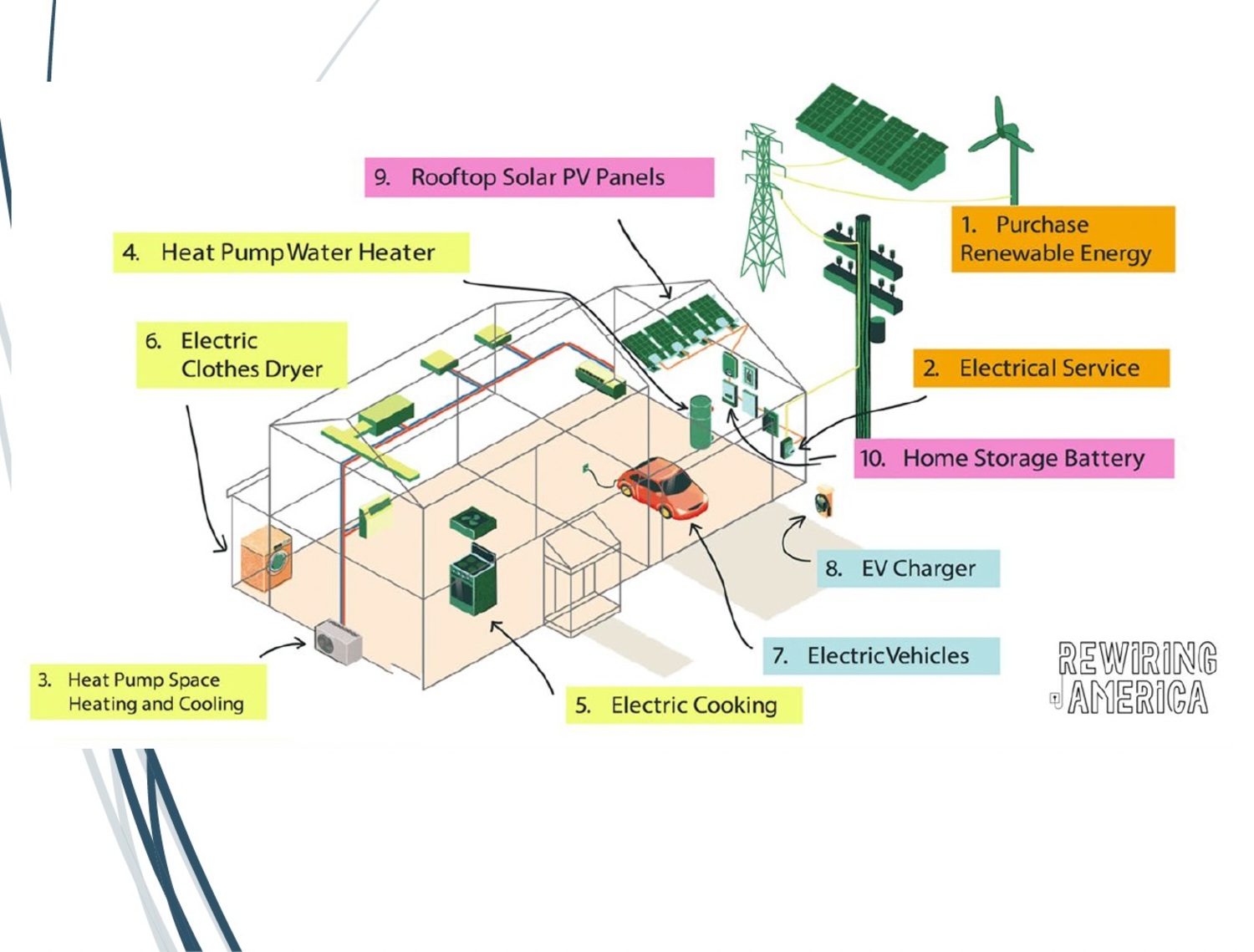
East Hampton Town's Renewable Energy Roadmap encourages renewable energy, electrification and energy efficiency to enable the town to reach its coal of deriving community-wide energy needs from green and renewable sources. REWIRING AMERICA
The East Hampton Town Board moved closer to setting a date for a second public hearing on a draft renewable energy roadmap plan this week after a first public hearing last month drew supportive comments from two members of the public, both of them members of the town’s Energy and Sustainability Advisory Committee.
Along with that committee, the draft roadmap was crafted by the consultants GDS Associates and Optony USA, the town’s Natural Resources and Planning departments, and the previous Town Board. It is to guide the town to achieving the goal of deriving communitywide energy needs from renewable sources by 2030.
On Tuesday, August 20, Samantha Klein, formerly of the town’s Natural Resources Department and now its intergovernmental relations coordinator, gave a refresher on the roadmap to the Town Board.
The roadmap is “a blueprint that takes you from a vision to that goal, and breaks down what projects, policies and codes can bring us to that goal,” she told the board.
Core concepts include electrification of buildings and vehicles and the pairing of renewable energy generation with electrification; energy efficiency and reduction strategies, and community engagement in the clean energy transition and reduction of greenhouse gas emissions.
Implementation of community choice aggregation, or CCA, in coordination with Southampton Town; community distributed generation of solar-derived electricity, and long-duration energy storage are among the intended programs. Municipal buildings and properties are to undergo energy audits, be upgraded to electrify space and water heating equipment, and add solar on rooftops and parking canopies and pair it with battery storage and electric vehicle charging.
The roadmap would also include support for adoption of onsite renewable energy, electrification, efficiency and vehicle charging for nonmunicipal buildings. The town’s building codes would be updated to move to electrification and net-zero energy consumption.
Solution-oriented planning around climate action, Klein said, requires two tracks that must be pursued in tandem: climate mitigation, which focuses on slowing the pace of climate change and reducing greenhouse gas emissions, and adaptation, reducing impacts and vulnerability to the community.
She emphasized both municipal and individual actions to transition from fossil fuels to green, renewable energy. The town, she said, is in a great position to set an example, with more than 30 municipal buildings and 200 vehicles, and should engage the community’s active participation in the clean energy transition.
Reducing greenhouse gas emissions is a global problem, she said, but also “a local problem and even personal problem — we’re talking about how we’re powering our own homes, how we travel, how we live, the products we’re consuming, the food we’re eating.”
Many decisions affecting sustainability are made at the kitchen table, she said.
“We play an important part as a municipality to help provide information to the community and to connect them to the resources and reduce hurdles along the way,” she added.
To that end, she pointed to the Energize East Hampton website, energizeeh.org, which offers both information on, and contractors specializing in, green heating and cooling, solar and storage, and energy efficiency.
Energize East Hampton, she said, could be expanded to include campaigns like community solar, in which participants can buy or lease a portion of solar panels in an array, allowing residents to participate in solar by removing barriers like upfront costs and rooftops that aren’t suitable for solar panels.
“This provides an option for someone to get their energy from solar without actually having to pay for the installation and do it on their property,” Klein said.
An electric vehicle campaign could also be implemented, she said, connecting residents with information as well as dealerships.
The town, she said, should also streamline the application, permitting and inspection process for renewable energy initiatives.
Supervisor Kathee Burke-Gonzalez and Councilwoman Cate Rogers said that they have discussed a new position in the town, sustainability coordinator. Other municipalities in New York have such an officer, Rogers said, though it is not among the list of Suffolk County civil service titles.


