


 1 Photo
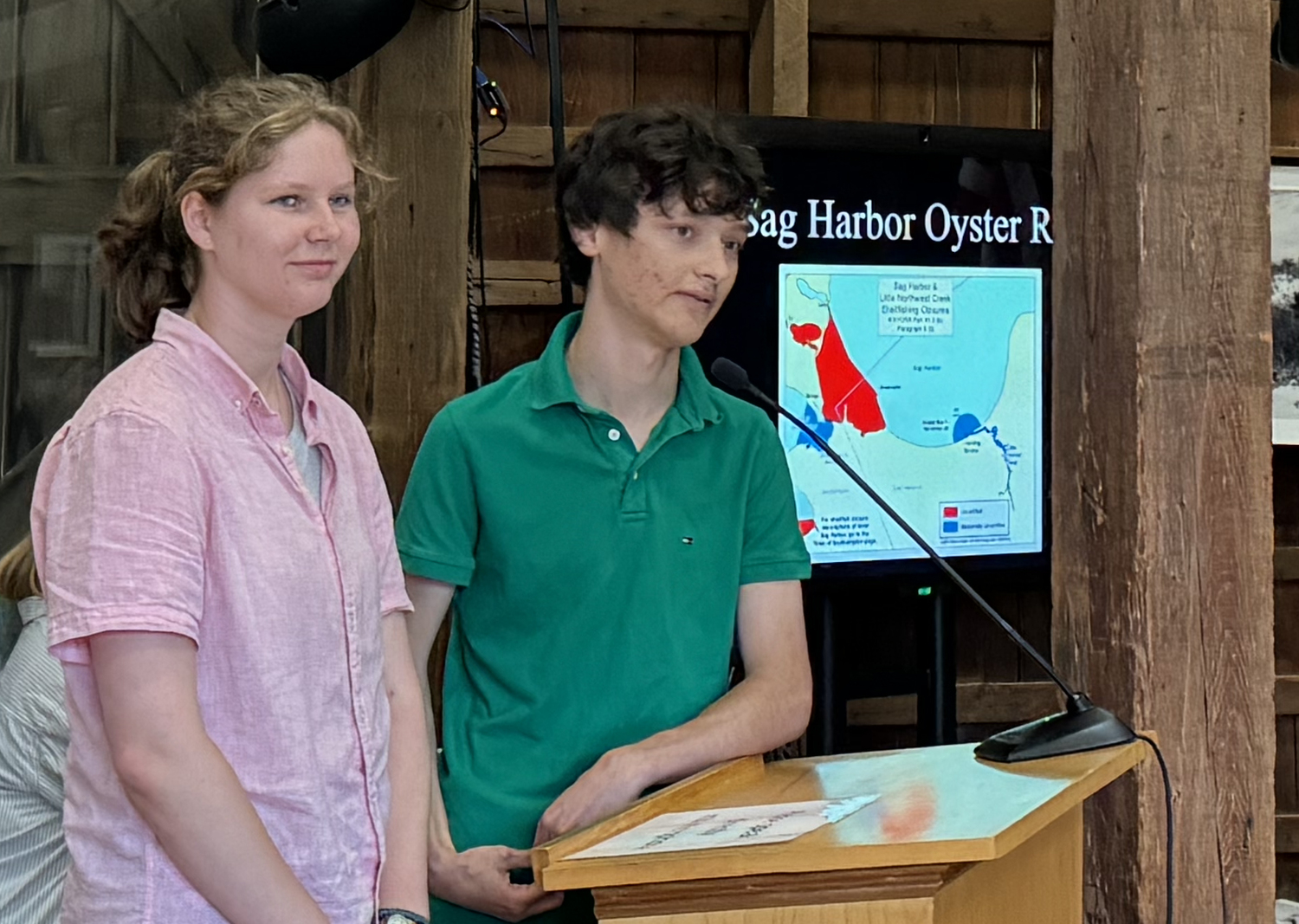
Annabelle Roussel and Kai Basseches, Pierson High School students, successfully pitched the East Hampton Town Trustees on an oyster reef off Barcelona Point. HELEN ROUSSEL
The East Hampton Town Trustees approved another student-constructed and monitored oyster reef when they met on Monday, August 26.
Annabelle Roussel and Kai Basseches, who are students at Pierson High School in Sag Harbor, presented a proposal for an oyster reef off Barcelona Point. They were accompanied by Bob Tymann, head of the Education Committee for South Fork Sea Farmers, the nonprofit educational arm of the East Hampton Shellfish Hatchery and the town’s community oyster garden program.
Filter-feeding bivalves, oysters are able to create strong reef communities and can mitigate eutrophication and harmful algal blooms by eliminating excess nutrients from the water.
Under Tymann’s guidance, students have constructed three oyster reefs in Accabonac Harbor. Tymann told the Trustees on Monday that a planned fourth reef, this one in Three Mile Harbor, was recently permitted by the State Department of Environmental Conservation. In addition to a Trustees permit, the proposed oyster reef off Barcelona Point would require a DEC permit.
On Monday, the students told the Trustees of their plan to situate the reef northeast of Little Northwest Creek, near waters that are uncertified for shellfishing, either seasonally or year-round, due to degraded water quality.
“By putting it near there, we’re able to positively affect the pollution in that area,” Kai said.
The location was also chosen for its solid bottom and distance both from the mouth of the creek and boat traffic. It is a remote area, a long walk from the nearest parking and accessible by vehicle only via a rugged dirt road.
“I went there the other day,” Annabelle said, “and it’s hard to access.”
Oysters, Kai said, take in algae and nitrogen and output clean water, mitigating algal blooms and increasing oxygen content. “Ultimately,” he said, “this is going to help prevent pollution in the water and clean up the pollution that’s already there.”
One oyster can filter 50 gallons of water per day, Annabelle said.
“A whole acre of oyster reef can filter up to 36 Olympic-size swimming pools,” she said, although the reef won’t be as large. “But once we start getting more in the future, that will start to be getting up to numbers like 36 Olympic swimming pools a day.”
The reef is to cover 50 square yards in a diamond shape, pointing toward the prevailing winter winds. It will be made up of a top layer of spat on shell in biodegradable mesh bags tied together with hemp twine, and a layer underneath of “blank” bags, filled with oyster or clam shells with no spat, the latter to monitor for natural reef growth.
“We’re hoping that as the spat on shell mature into oysters, they will reproduce,” said Kai, “and the bottom layer of shells will turn into the spat on shell. So, basically, it’s going to generate new oysters and grow as time passes.”
As the reef will be just 18 inches high, it will only be visible at very low tide, Annabelle said.
John Aldred of the Trustees called for a vote to support the proposal, which passed unanimously.
“Be prepared for this site to be more challenging than the other sites you’ve done,” he told Tymann. “It’s very active shoreline in the winter. It’s exposed to the north, so you’re looking at nor’easters and northwest winds that beat that shore up pretty good.”


