


 3 Photos
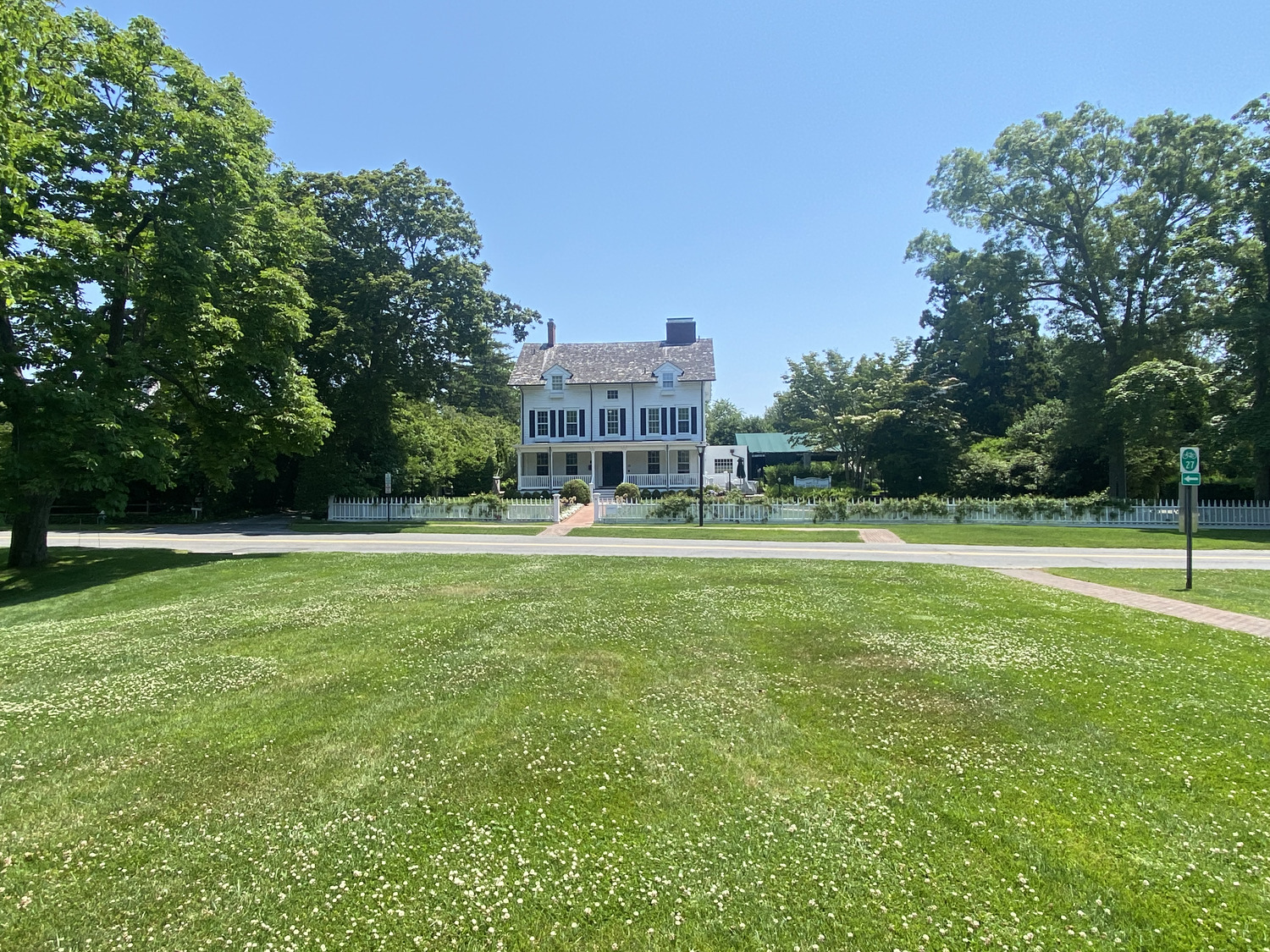
The East Hampton Village Board considered a barrier to prevent vehicles from overshooting Woods Lane, traversing the green space near Town Pond and possibly crashing into the Hedges Inn. CHRISTOPHER WALSH
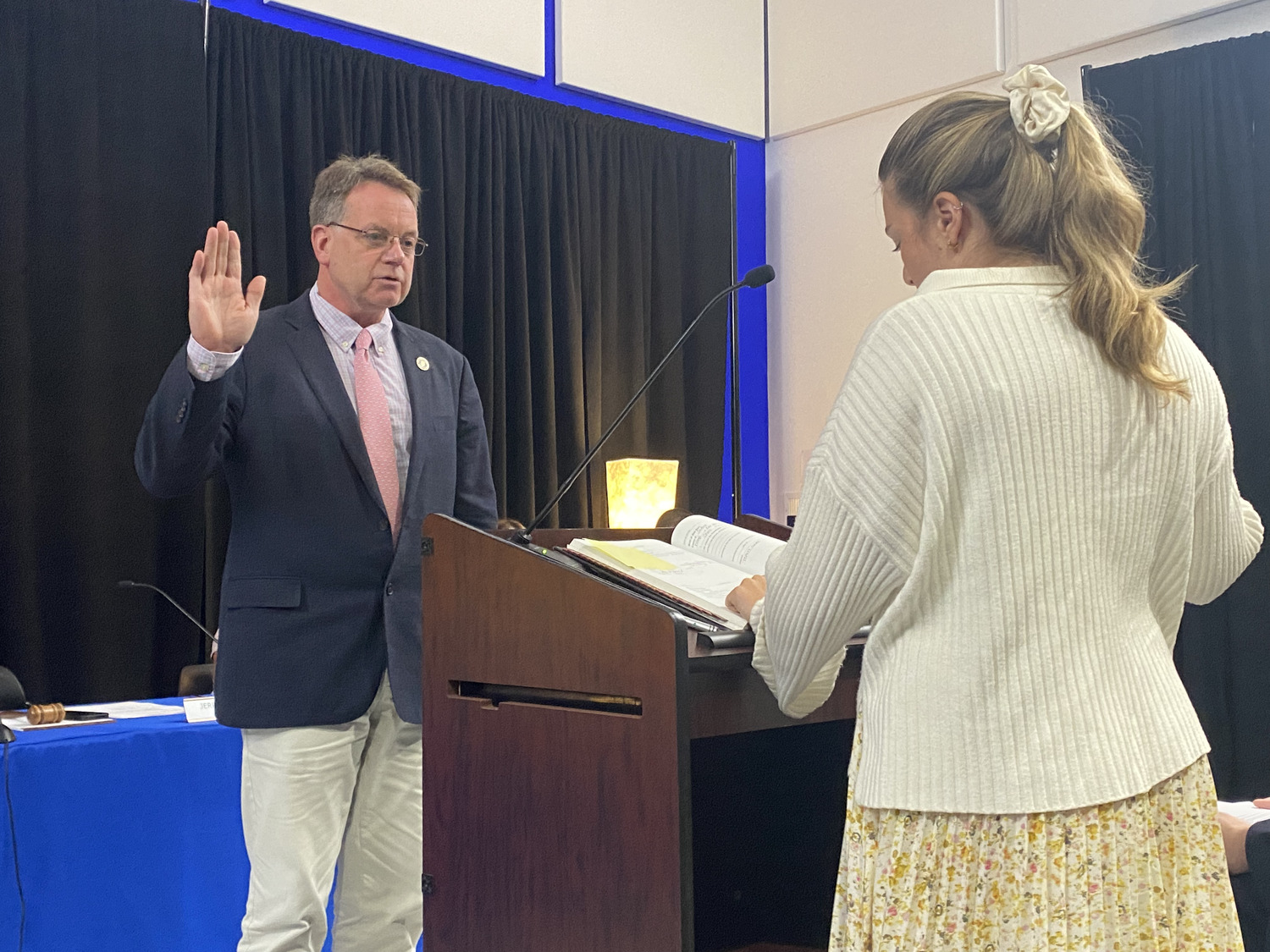
East Hampton Village Mayor Gerry Larsen was sworn in for a second term by Deputy Clerk Gabrielle McKay. CHRISTOPHER WALSH
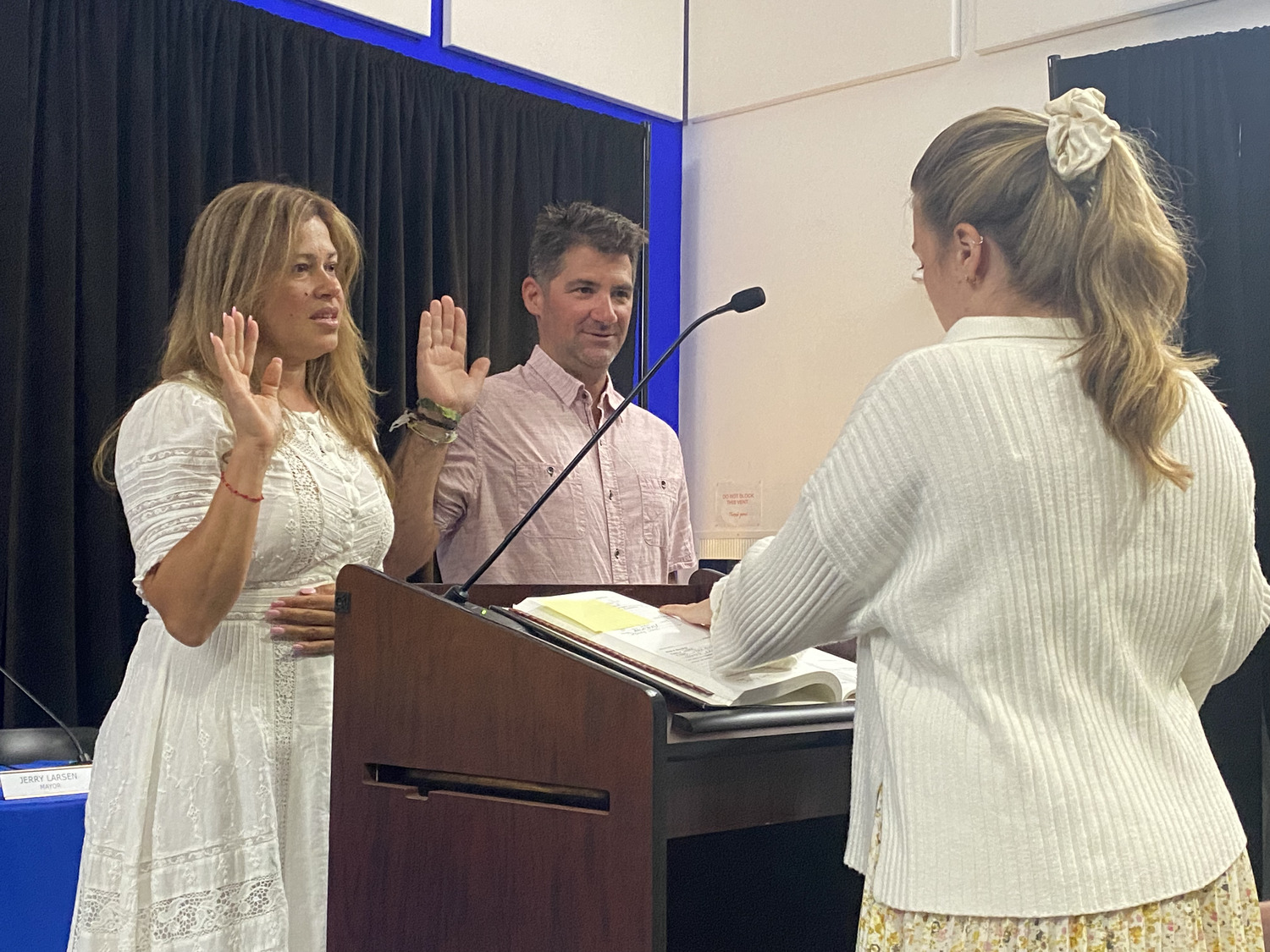
East Hampton Village Trustees Christopher Minardi and Sandra Melendez were sworn in for a second term by Deputy Clerk Gabrielle McKay. CHRISTOPHER WALSH
Five months after the latest incident involving a vehicle overshooting the left turn from Woods Lane to Main Street in East Hampton Village, a consultant presented the Village Board with options to address the accident-prone intersection.
In the early hours of January 15, a teenager traveling east on the section of Route 27 known as Woods Lane — he was fleeing a police officer who had tried to pull him over — skidded across the green space at the south end of Town Pond, across James Lane, and crashed through the fence at the Hedges Inn before smashing into the building’s front porch.
Prior to that incident, 12 other crashes in which eastbound drivers on Woods Lane lost control or left the roadway at the intersection were recorded between January 1, 2010, and August 31, 2023, Robert Bove of L.K. McLean Associates told the board at its meeting on Friday, June 21.
Of those, two vehicles struck the Hedges Inn, five landed in Town Pond, and five others came to a stop on the Village Green. Eight of those 12 incidents occurred at night. These were among a total of 209 crashes in that span, Bove said.
The speed limit on Woods Lane is 30 mph, but a March 2024 study by L.K. McLean concluded that the average speed there is 36.1 mph, with many of the eastbound vehicles exceeding 40 mph. Most eastbound motorists turn left onto Main Street at the terminus of the “T” intersection.
Bove presented three potential solutions. Landscaping features, such as bushes and shrubs, were one, “but if you’re going so fast that you’re going to go totally over two different roads and over some grass area,” he said, “that’s probably not going to stop the most severe of those crashes.”
Hard landscaping features such as boulders or bollards were also presented, but, he said, “If you do large boulders, that would definitely stop a vehicle from going all the way across — but you have a chance of increasing the hazard to the driver.”
“I would never go for that,” Mayor Jerry Larsen said, “because … you’re going to give somebody a death sentence. I wouldn’t go for that.
“But we do need to do something before we do have a fatality, where the timing is just perfect and there’s somebody walking on James Lane, or driving on James Lane,” he said, adding that such a collision “would be devastating.”
Bove then suggested a “vehicle arresting barrier,” described as a net used by the State Department of Transportation to slow vehicles up to 40,000 pounds and leave them in an upright position. At Woods Lane, such a barrier “would be used to stop the most severe crashes.”
Some of the existing signs are somewhat faded and could be refreshed, Bove also said. “We could also add flashing beacons on top of the signs — that would maybe prompt people to see them more.”
“Your recommendation is that catch net?” the mayor asked.
“That’s probably the best option, because it produces the least hard barrier but definitely will stop the vehicles,” was Bove’s answer. It could be screened with shrubbery, he said.
Anchors holding such a barrier are around 4 inches tall, the mayor said, “so if somebody went to the right or left of the main part of the net, they’re not going to hit something that’s not going to give.”
Larsen said this week that a meeting with a local manufacturer of the vehicle arresting barrier has been scheduled.
Mayor, Trustees Reelected
Also at Friday’s meeting, the mayor thanked “all the village residents for coming out and voting and giving us another four years” on June 18, when he and Trustees Christopher Minardi and Sandra Melendez were reelected. The three were unopposed in their first reelection bids.
Gabrielle McKay, the deputy clerk, administered the officials’ swearing-in.


