


 2 Photos
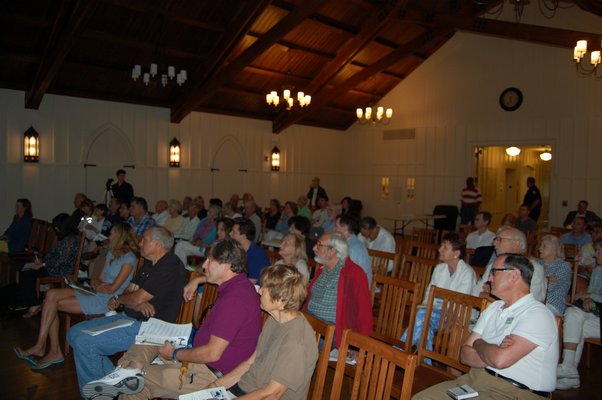
Residents of East Hampton Village pack Hoie Hall in St. Luke's Episcopal Church for a forum on the damages of deer overpopulation. JON WINKLER
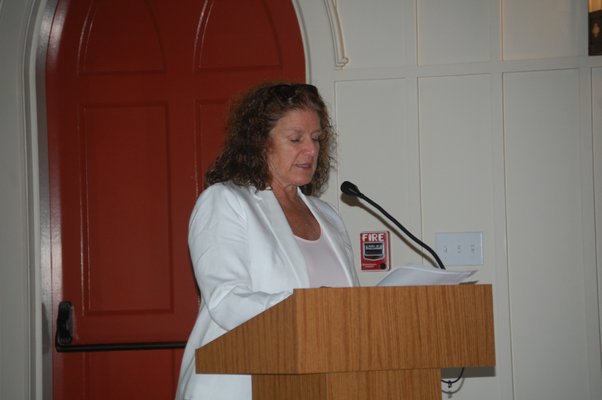
Kathleen Cunningham
Resistance seems to be brewing as East Hampton Village looks for input on how best to control the deer population.
Some residents are criticizing the way questions were phrased on a recent mailed survey and also expressing frustration that a community forum held on Thursday, July 27, did not leave time for questions and comments from the audience.
A number of people dispute the basic premise that the population of deer is too large, in fact. Among them is Bill Crain, president of the East Hampton Group for Wildlife, whose group has been following the issue since 2005.
“Some people have reached a state of hysteria, and the village seems bent on doing something to reduce the population,” Mr. Crain said on Monday. “I think the first step is to step back and think this out rationally. Do a new survey and find out where the deer are. We’re dealing with animal lives here, so it’s time to step back and see what the real problem is.”
Mr. Crain said he did note that more deer have been appearing in the village, which he said was due to hunting in the Town of East Hampton and deer looking for a place of refuge.
He also said that he has written letters to village officials in recent months proposing deer sanctuaries outside the village, including at the Jacob’s Farm Preserve in Springs and the former Duke Estate on Springy Banks Road.
After village officials sent out a questionnaire last month asking for community input on the impacts of the current deer population and how it can be managed, a forum was hosted by the Village Preservation Society last week to discuss the negative effects of deer overabundance in the mostly residential areas of the village. It featured Dr. Scott Campbell, director of the Suffolk County Department of Heath Services, and Dr. AnnaMarie Wellins of the Stony Brook University School of Nursing discussing the different types of ticks, the symptoms of tick-borne illnesses, and which ticks are commonly found on deer.
Thomas Rawinski of the U.S. Department of Agriculture’s Forest Service also discussed how deer could damage farm crops, residential vegetation and forest areas.
During Mr. Rawinski’s talk, a local wildlife advocate, Dell Cullum, who was sitting in the audience at Hoie Hall, made a sharp response.
“I said it was ‘bullshit,’” Mr. Cullum confirmed in a phone interview on Tuesday.
He said he thought Mr. Rawinski’s presentation put an unrealistic amount of blame on deer for damage to plants and trees, and also said he was frustrated that members of the audience did not have an opportunity to comment or ask questions.
Kathleen Cunningham, executive director of the Village Preservation Society, said the forum’s organizers ran out of time and had to clear out before the next event was scheduled to take place in the hall. In addition, she said, the goal had not been to discuss deer overpopulation and methods of curbing the population, but rather the effects that deer can have on humans and the ecology.
“The issue is too fraught with tension to discuss,” Ms. Cunningham said after the forum ended of controlling the number of deer, which the village tried to accomplish in the first two phases of a sterilization project, completed in 2015, for which it entered a contract with White Buffalo Inc. that has been stalled while officials decide which way to move in the third phase.
“A lot of people don’t recognize the ecological effects of the deer population in the Northeast region here,” Ms. Cunningham said. “The VPS are not decision-makers, but this is something to show that we can offer help to the community.”
Mr. Cullum said that while he thought the forum’s discussion about tick-borne illnesses was insightful and that he was thankful that the Preservation Society made the forum open to the public, he also “completely” disagrees that there is an overabundance of deer in the village and thinks there are unexplored options to solve problems with deer in residential neighborhoods.
Meanwhile, he said, the village’s survey was so off-base that he decided to rewrite the questions before sending it back—making his point clearly in doing so.
For example, the original survey asks, “How important is it to you that East Hampton Village continues another phase of the deer sterilization program as a means to control the deer population?”
Mr. Cullum’s revision asks, instead, “How important is it to you that East Hampton Village, after failing miserably the first time, continues another phase of the most inhumane method of deer sterilization that didn’t work the first time as a means to control the deer population?”
In answer to another question, about the degree to which the respondent has had problems with deer eating plants, the survey was revised to say, “Not much at all, because I’m intelligent and buy deer-resistant plants.”
Mr. Cullum said that he didn’t intend to send his survey out, but that after posting the survey on social media, he’s been told that people have been filling out his version and sending it back to the village.
“If it’ll cause them a little more work at the village to screen these, maybe it’ll give them a little more time to think how foolish it is, that they started this to begin with,” Mr. Cullum said.
On Tuesday, Village Administrator Becky Hansen said that more than 500 of the 2,040 questionnaires had been returned, but they have not yet been opened.
“I understand all the issues surrounding the deer, but I don’t understand this survey,” Adrienne Kitaeff of Springs, another animal rights activist, said on Tuesday. “The survey is unbelievably lopsided—every question is pointed toward ‘Let’s get rid of the deer.’
“I don’t believe in animal cruelty,” she continued. “I believe in living with nature.”


 Jon Winkler on Aug 1, 2017