


 1 Photo
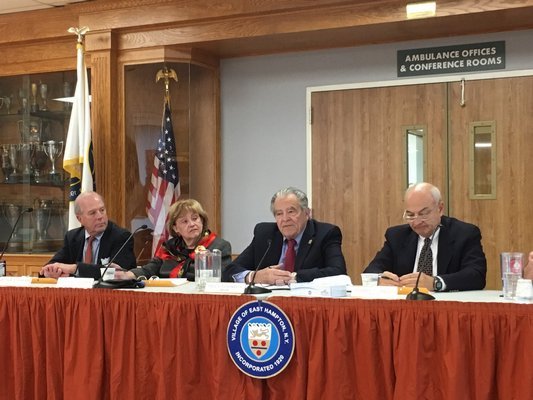
Mayor Paul F. Rickenbach Jr. and the East Hampton Village Board of Trustees.
East Hampton Village Mayor Paul F. Rickenbach Jr. criticized Governor Andrew M. Cuomo’s push to legalize the recreational use of marijuana at a recent Village Board work session, predicting a proliferation of new “head shops” in Suffolk County, as well as more impaired drivers on the roads.
In December, in outlining his agenda for the first 100 days of his third term, Mr. Cuomo had announced plans to seek the legalization of recreational marijuana this year, which he estimated could generate more than $1.7 billion annually in sales. Estimated state and local tax revenue for the first year would range between $248 million and $677million, depending on the tax rate.
Mr. Rickenbach told fellow board members, and others, at the end of a February 7 Village Board work session that he’d written a letter to Suffolk County Executive Steve Bellone conveying “strong opposition” to the legalization of recreational marijuana in Suffolk County and urging the county to opt out.
Although opposed to recreational use, Mr. Rickenbach made it clear that he supports the use of medicinal marijuana “under the purview of a physician’s care,” adding that it has shown to benefit healing.
He expressed appreciation for the governor’s initiative to develop additional revenue streams, but Mr. Rickenbach said there must be a better way.
“Do we have to do this to obtain money?” said the mayor, a former law enforcement official. “What kind of message are we sending when we are taking steps to legalize the use of substances that are highly addictive and are considered gateway drugs to much more dangerous substances?”
He added, “I must urge all of us to take a moment and consider the ramifications of such legislative actions on our local communities.”
Mr. Rickenbach said he was speaking only on his own behalf, not that of the entire Village Board.
He emphasized the negative effect that marijuana has on one’s ability to drive, noting that, according to the National Institute on Drug Abuse, marijuana significantly impairs judgment, motor coordination and reaction time, and that studies have found a direct relationship between blood THC concentration and impaired driving ability.
“Recreational use of marijuana has no health benefit, and the potential impacts to society are largely unknown and deserve more study before governments move ahead with any legalization efforts,” Mr. Rickenbach said.
Currently, 10 states and Washington, D.C., have legalized the recreational use of marijuana, and in 2016, New York State legalized marijuana for medicinal purposes. In January’s 2019 executive budget address, the governor directed the Department of Health to conduct a study, in consultation with other state agencies, to review the health, criminal justice and economic impacts of a regulated marijuana program in the New York State.


 Elizabeth Vespe on Feb 12, 2019