


 1 Photo
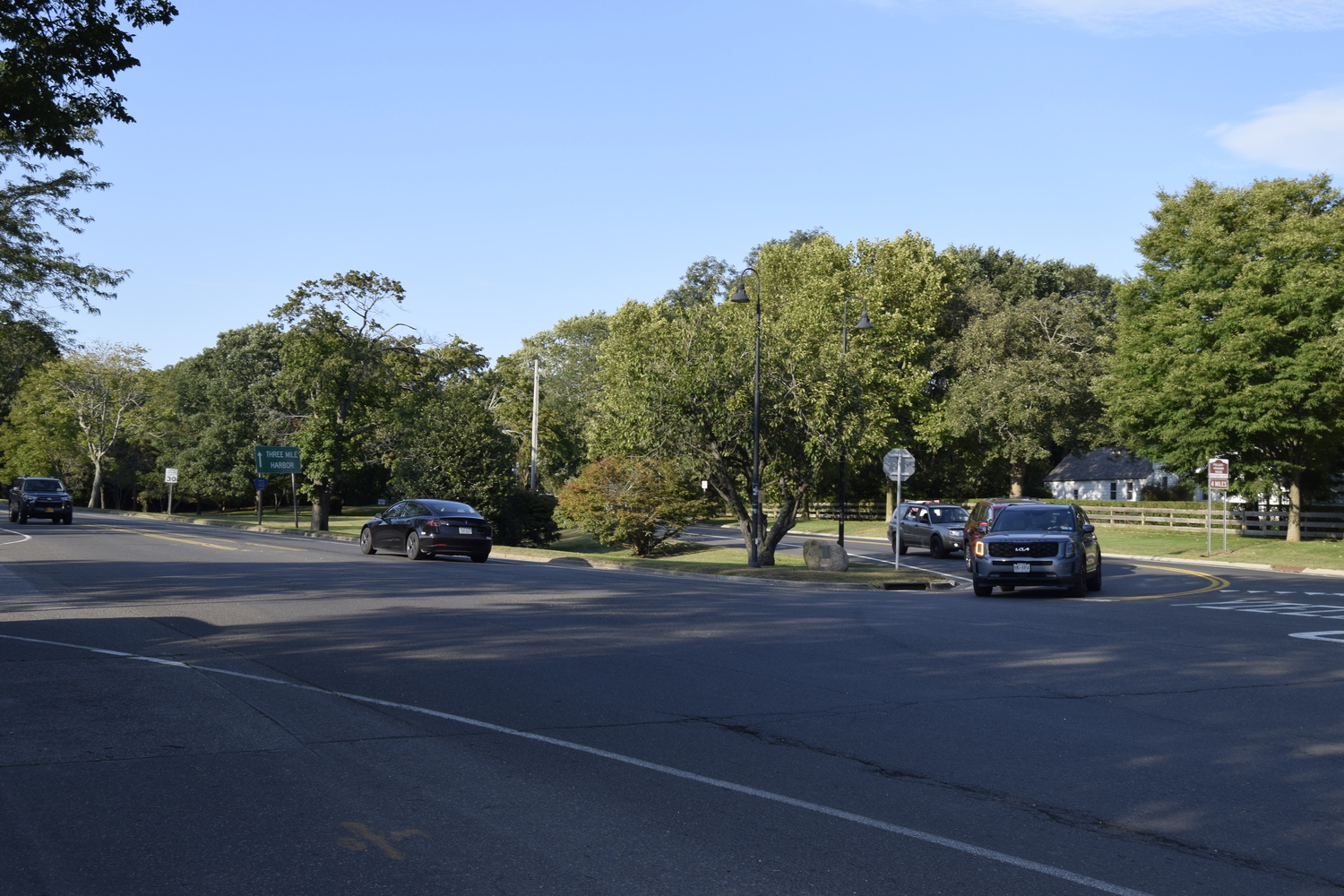
East Hampton voters appear to have approved the removal of a 2-acre parcel from the town's nature preserve holdings so that a portion of it can potentially be used in the construction of a roundabout where Three Mile Harbor Road, Springs-Fireplace Road and North Main Street meet. CHRISTOPHER WALSH
East Hampton Town voters appear to have approved a ballot referendum authorizing the removal of the triangular patch of land between the southern terminus of Three Mile Harbor Road and Springs-Fireplace Road in East Hampton from the town’s nature preserve holdings and its conveyance to Suffolk County.
Approval of the parkland alienation would clear the way for the county to potentially incorporate a roundabout at the awkward intersection, which also includes North Main Street and Indian Hill Road, into upgrades to County Road 40, as Three Mile Harbor Road and the portion of North Main Street north of Collins Avenue are officially known.
That work is scheduled for the spring of 2027. Construction of a roundabout would require use of at least a portion of the parkland.
As of 11:30 p.m. on Tuesday, the Suffolk County Board of Elections’ unofficial count was 7,375 votes in favor of parkland alienation and the land’s conveyance to the county against 5,600 against.
The ballot proposition referred to “longstanding traffic delays and public safety issues at the intersection” of Three Mile Harbor Road and Springs-Fireplace Road. Southbound vehicles on Springs-Fireplace Road must navigate through a busy intersection with both northbound traffic from North Main Street and southbound traffic from Three Mile Harbor Road, all with no traffic lights and challenging sightlines.
The town acquired the property known as the Sherrill Triangle from the East Hampton Lions Club in 1971, and an adjoining northerly parcel from Edwin L. Sherrill in 1972. They were later combined. The Town Board voted last month to remove the 2-acre parcel from the nature preserve holdings.
There was comment both for and against the proposal at an August public hearing. It was “an awful idea” that would “create more traffic problems and fundamentally reduce the quality of life for the people in this area,” said Jonathan Foster, Sherrill’s nephew. “This is a linear traffic problem you are trying to improve with a circular solution.” He recommended a traffic light system instead.
Jeff Bragman, a former councilman, also opposed the plan, criticizing a move that he said would prioritize vehicles at the expense of cyclists and pedestrians. He noted that a goal enunciated in the 2005 Comprehensive Plan is to “reduce reliance on the automobile” by encouraging “investment in sidewalks, bikeways, rails, buses, shuttles and shared cars” while maintaining existing scale and character.
Betsy Petroski also opposed removal of a natural landscape and replacement with “the ramp-up of climate change by over-paving the area, that studies show increase the heat and temperatures with a massive hardscape of this nature.”
But Katy Casey said that a roundabout would make life easier not for cars but for the neighborhood’s residents who cannot go anywhere without passing through the intersection.


