



 4 Photos
Rick’s Crabby Cowboy Café in Montauk. KYRIL BROMLEY

Rick’s Crabby Cowboy Café in Montauk. KYRIL BROMLEY
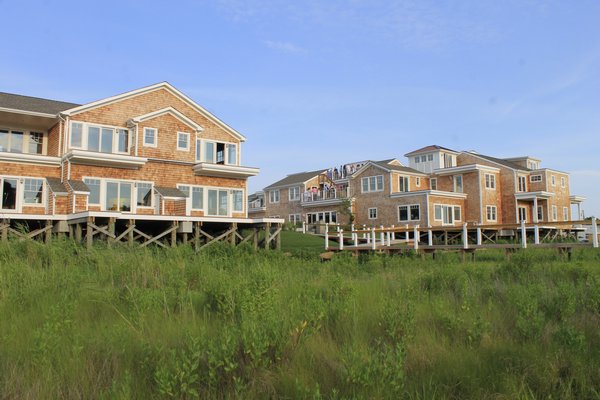
Ponquogue Point in Hampton Bays.
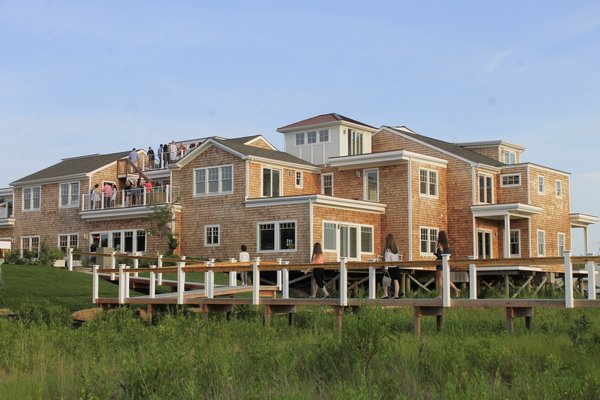
Ponquogue Point in Hampton Bays.
While nitrogen pollution of local bays has been tagged “public enemy number one” by politicians across Long Island and New York State, environmental advocates say Suffolk County’s Department of Health continues to allow decades-old septic systems to be used in numerous large redevelopment projects. The result: windfall profits for developers, with little or no dedication of capital to improving the impact that development of a property has on local waterways.
Even as nitrogen levels drive burgeoning algae blooms, sparking a swell of political support for proposals to upgrade septic systems in private homes, numerous condominium developments and restaurants in particular have been granted permits by the county to undergo multimillion-dollar renovations and expansions—with no changes to their waste management systems.
On the South Fork alone, more than a dozen wholesale redevelopment or broad expansion projects have been approved or are on their way to approval by Suffolk County with obsolete septic systems that would not be legal on a new development of the same scale.
In its permits for one of the largest such projects, the Ponquogue Manor condominiums in Hampton Bays, approved in June, the county specifically referenced grandfathering septic allowances assigned to the former Allens Acres, a 12-unit seasonal motel that sat on the site, in 1965.
The 23 condominium units in four buildings sit on a canal that empties into western Shinnecock Bay, where scientists say the waters have essentially been sterilized of reproductive life, and a “red tide” algae that can be fatal to humans has bloomed regularly. Yet the condos were allowed to be built with only septic tanks and cesspool rings beneath them, because the project was deemed to be “grandfathered” under the motel’s 50-year-old approval.
The potential daily flow rate listed in the Suffolk County Health Department’s files shows a lower daily amount than was shown for the motel, but critics say the difference is inconsequential when the septic effluent isn’t being treated or even remotely filtered before it reaches the bay a few feet away.
“That is a brand-new development—huge condos replacing a tiny seasonal motel. How can you even remotely say it is grandfathered?” said Kevin McAllister, founder of Defend H20, a water quality advocacy non-profit organization. “And my question to the county is: Where is the enabling legislation that says you can deviate from state law?”
State law requires that any project producing more than 1,000 gallons of waste water a day have a septic system that reduces nitrogen effluent to 10 milligrams per liter. County guidelines set the standards for developments over 450 gallons per day at the same level.
A septic tank and leaching pool system, like those employed at Ponquogue Point, typically releases about 50 mg/l into the ground—about five times the county’s standards, which do not come into play for grandfathered properties.
Neither the county’s Department of Health nor County Executive Steve Bellone’s office responded to requests for comment.
But county approvals are routinely issued with references only to grandfathered septic systems and flow rates. In 2014, the Health Department approved the expansion of the septic system at Rumba restaurant in Hampton Bays, to accommodate heavy use that was causing regular overflows of sewage. The existing septic system was rated for just 21 people, but the restaurant and bar was regularly stuffed with more than 100 customers. The county allowed a new septic system to be put in but didn’t require that it be upgraded to a nitrogen-reduction system. What was installed was simply newer and more of the same septic leaching pools that the property had previously. The property’s official occupancy thus was increased to 130.
Just last year, the county itself installed a new treatment system at the Beach Hut restaurant at Meschutt County Park in Hampton Bays—but Mr. McAllister maintains that the system does not conform to the required 10 mg/l standard either.
He and other critics say the county’s position of allowing “grandfathered” septic systems is an irresponsible remnant of the notoriously pro-development approach county agencies took for most of the 20th century. He also says it is an illegal sidestepping of mandates in the federal Clean Water Act that require upgraded septics in any large redevelopment project.
“The Clean Water Act at the federal level is delegated to the State [Department of Environmental Conservation], and Suffolk County is acting as an agent of the state, and they are obligated to comply with the state standard—but they are not applying the standard to redevelopment projects,” Mr. McAllister added. “It’s convenient to them not to have a financial impact on business. State statute clearly says that if it exceeds 1,000 [gallons of waste water per day], you have to have [advanced] treatment.”
At the residential level, the county has been slow—a decade or more behind many other regions of the country—to approve new septic treatment systems that can reduce the amount of nitrogen that is released into the environment via human feces and urine flushed down toilets.
But at the larger discharge levels of more than 1,000 gallons per day, known as “intermediate flow,” there are a handful of systems that can reduce nitrogen loads down to the trace levels that scientists have said will be necessary to stanch the expansion of destructive algae blooms in bays and ponds.
And yet the county has made no moves toward requiring, or enforcing federal requirements, that any redevelopment come with requisite septic system upgrades, essentially creating a roadblock even for local governments that would prefer to see improvements. Last fall, for instance, the members of the East Hampton Town Planning Board nodded to a desire to see more advanced treatment systems installed as part of a major expansion of East Hampton Indoor Tennis, which added a bowling alley, miniature golf and a 200-seat sports bar. But the board acknowledged that it had no authority to make an upgrade from the current system, approved in the early 1990s.
“There’s no ability on the part of the town to go back and ask that an upgrade to that septic system actually be required as part of the approval process,” Jeremy Samuelson, executive director of Concerned Citizens of Montauk, told the East Hampton Town Board recently. “The Planning Board is in this incredibly frustrating situation of being presented with this once-in-a-generation opportunity to take a fresh look at a property and really put the latest thinking of community standards into play. Parking, lighting, access, fire safety—all of those things get a fresh look. But we’re essentially prohibited from taking a fresh look at the septic systems in these cases.”
Mr. Samuelson asked that the Town Board make an official appeal to the county for a change in their approach to the permitting of intermediate-flow projects.
East Hampton Town Supervisor Larry Cantwell said the town would push the issue immediately. He also nodded to the replacement of single-family home septic systems: The town’s newly approved Water Quality Improvement Plan focuses on providing incentives to property owners with millions of dollars in subsidies.
Helping homeowners reduce their nitrogen footprint via subsidies is good, Mr. Cantwell said, but when developers are buying properties and expanding them at huge profits, regulation should mandate that they make the improvements on their own dime. “When there is a large infusion of capital being made in investment in a property, that’s the time to require an upgrade to the waste system,” he said.
East Hampton has been particularly rife with expansion projects under grandfathered septic allowances of late. Mr. Samuelson also nodded to a pending application by the owners of Rick’s Crabby Cowboy Cafe that uses 1978 Health Department approvals in an application to the town to expand the property’s restaurant from 75 seats to 230. The application is pending at the town and county levels.


 Michael Wright on Aug 23, 2016