



 2 Photos
East Hampton Airport was considerably less busy in 2022 than in year past, even though it didn't feel like it for some.
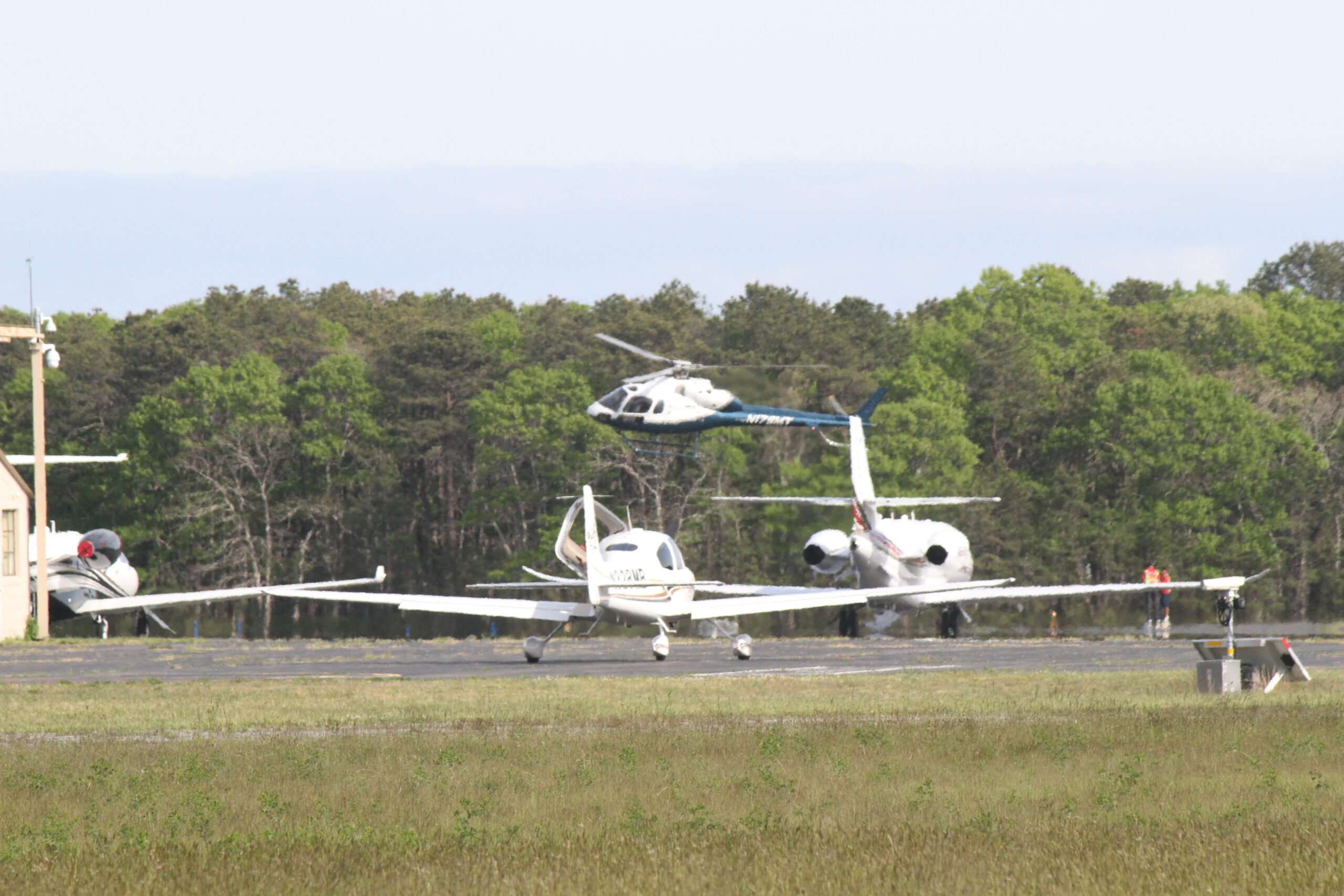
Fewer helicopter flights accounted for about half of the total drop in traffic at East Hampton Airport this summer, though traffic by jets and small propeller planes was also down.
Traffic at East Hampton Town Airport was down by a little more than 15 percent this past summer, compared to summer 2021, and by more than 23 percent from the prepandemic summer of 2019.
According to data compiled by the town, flights at the airport in June, July and August — so, excluding the busy Memorial Day and Labor Day holiday weekends — were lower than in both 2021 and 2019 across every type of aircraft, from helicopters to corporate jets to small private planes flown by amateur pilots.
There were 13,838 flights to the airport during the three busiest full months of this summer, compared to 16,306 in 2021 and 18,030 in 2019.
For the entire year-to-date, through the end of August, traffic at the airport is down more than 23 percent overall compared to the same time period last year, and the number of helicopter flights is down about 15 percent.
Flights by corporate jets were down considerably during the summer months from 2021, almost 25 percent, but only 2 percent lower than in 2019.
Helicopter flights were down slightly compared to last year, about 4 percent, but were nearly 30 percent lower from the summer before the pandemic, when the total number of helicopter flights had been growing to record numbers each successive summer.
“We’ve never recovered from the pandemic,” said Jeff Smith, a commercial helicopter pilot and vice-president of the Eastern Region Helicopter Council, an advocacy group for helicopter operators. “Heliports in the city are down, too, but not as much as East Hampton, so there has to be some correlation.”
The commuter helicopter industry that had been burgeoning since the early 2000s and had exploded with the rise of Blade and other booking services that offered by-the-seat fares for flights between New York City and East Hampton, all but disappeared in 2020 as the pandemic cooled demand on a variety of levels: aversion to being in enclosed spaces with others, fewer house guest invitations and the widespread shift to full-time residency at South Fork homes with offices in the city shuttered.
Smith also said that he believes the much-publicized plans by the town to significantly restrict the number of flights — especially commercial commuter shuttle flights and helicopters — also had a lasting effect on flight traffic even after a state judge issued a temporary restraining order that blocked the town’s restrictions.
“I do believe that because of the pending restrictions, operators and passengers were already planning other alternatives and that played a role in the numbers we saw at East Hampton,” he said. “If you look at Montauk and Southampton, I bet you’ll see that they were busier than they used to be.”
There are other possible factors at play as well, airport watchers noted. Both Smith and East Hampton Town Supervisor Peter Van Scoyoc nodded to the lifting of pandemic travel restrictions across Europe, which may have drawn away many of the same wealthy Hamptons visitors who commute to the South Fork by air — a correlation that many real estate agents have made for what was, anecdotally, a “down” summer for the rental housing market as well.
There were also some logistical hurdles related to the town’s partially-derailed plans to seize long-awaited control of the airport’s traffic capacity and impose new restrictions on flights that might have tamped down flights as well.
The town’s strategy had been to shutter the 70-year-old public facility known as East Hampton Airport for a brief period — 33 hours to be exact — and reopen it as a legally new, private airport to be called East Hampton Town Airport. As the May 17 date set for the temporary closure and transition to a private airport approached, the FAA set in motion technical processes to delete various official identification and instrument flight rules guidance information about the airport published on existing flight charts, and replace them with the new airport’s identification and guidance. But as a private airport, the instrument guidance had to be developed by consultants for the town and distributed to would-be users. With its anticipated new restrictions in mind, the town set up a system requiring pilots who wished to use the airport’s guidance data to file an application with the town that would be approved by consultants before the IFR guidance was shared.
When the TRO was issued by New York State Supreme Court Justice Paul J. Baisley on May 16, the town was blocked from imposing its restrictions, but the legal and technical wheels the FAA had already set in motion could not be reversed, the agency said, and the new flight guidance system had to be put in place as planned despite the court ruling. The application process put a speed bump in the path of many commercial operators and large jets, who insist on having IFR guidance regardless of weather conditions.
“The approaches and the proposed limits on jets might have played some role, as a practical matter,” Van Scoyoc said. “But it also could just be that some people are flying elsewhere in their jets this summer.”
The FAA just last week republished public IFR approach guidance for the new East Hampton Town Airport, or JPX as it is now officially referenced on aviation charts — effectively resurrecting the old airport — so that the technical hurdles of getting the flight info will not be delayed again.
Beyond the numbers, the summer of 2022 also saw other changes to the skies around the airport. It was the first summer that the bulk of helicopter traffic used a southern approach, flying up the South Shore of Long Island over the Atlantic and turning in toward the airport only after reaching Wainscott, where the waters of Georgica Pond lead nearly to the airport’s boundaries.
The shift to the so-called Sierra route, after years of following routes that mostly brought helicopters in from the north, over the North Fork or Noyac and portions of Sag Harbor — known as the November route — was a nod to the chorus of complaints and political lobbying those routes had engendered over the last decade.
While pilots are not legally bound to follow any particular route other than when the airport’s control tower dictates instruction to them, as the threat of airport closure has loomed larger and larger, groups like the Eastern Region Helicopter Council have worked to get pilots to comply with the preferred routes published by the town. This year, the only two approach-departure routes the town published were the Sierra route over Georgica Pond and the Echo route, which asks pilots to follow the waters of Long Island Sound, Plum Gut, Gardiners Bay and Northwest Harbor as they approach or leave East Hampton.
Smith said the ERHC and its pilots are dedicated to adhering to “all water” routes, to lessen the impact on residential neighborhoods and that the vast majority of pilots have complied — as well as maintaining a height of at least 3,500 feet until they are over the airport.
But while the shift away from the northern routes and the neighborhoods beneath them may have eased the noise there, it introduced it to a new population in Wainscott.
“The November route was not traveled so much, so that’s a whole population that saw some relief this year — but Wainscott got slammed,” Van Scoyoc said. “It’s interesting to see how people’s interest change. Folks who used to be in favor of modest regulations, keep the airport open and reduce the number of helicopters and may have even been very pro-aviation and flew in now and then, are now saying ‘close it down.’ The message is, no matter where you send the traffic, it’s going to have the same impact and the same result.”


 Michael Wright on Sep 21, 2022