


 1 Photo
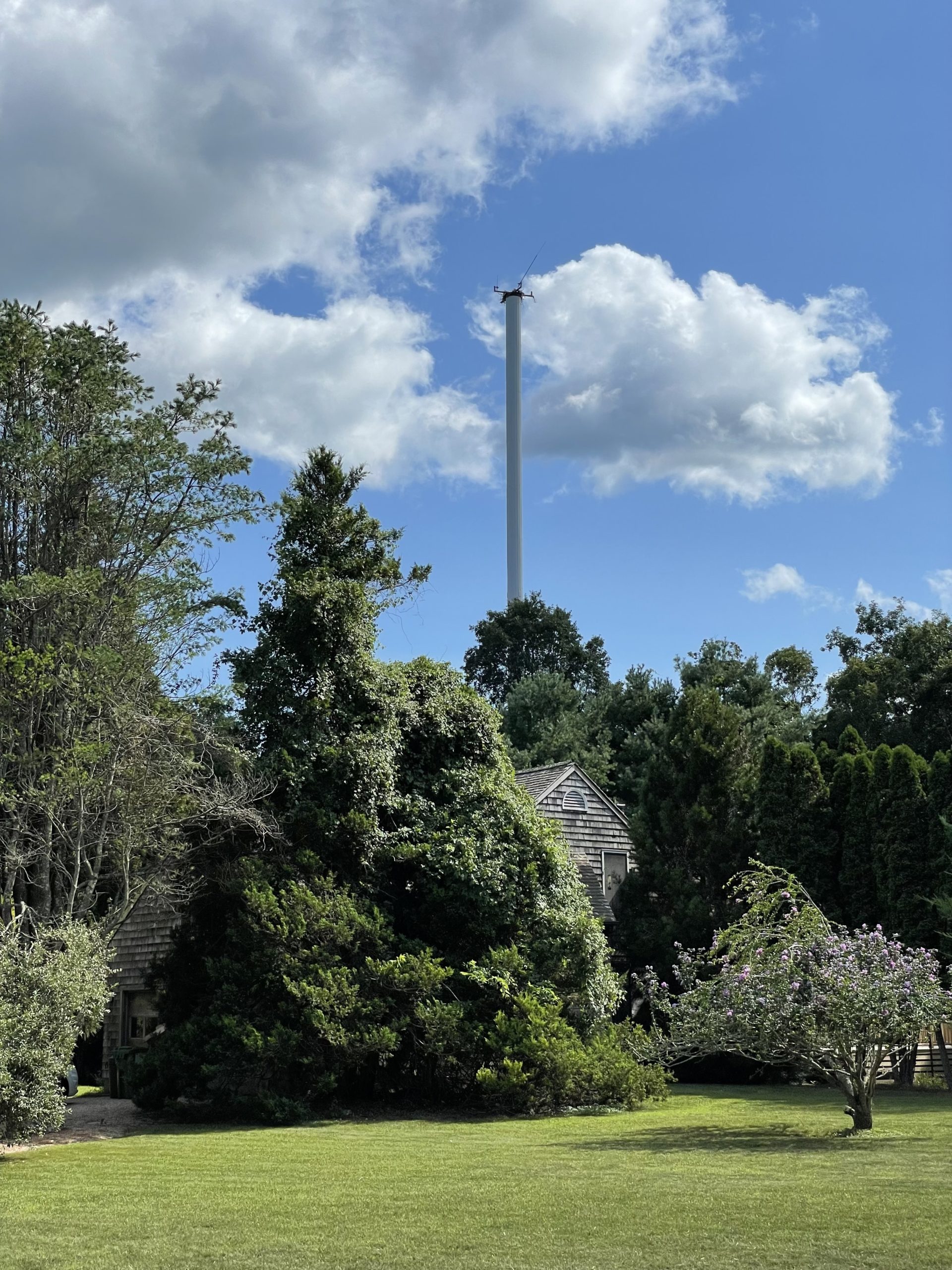
The existing communications tower at the Springs Fire District firehouse on Fort Pond Boulevard has been tangled in legal jousting for six years and town officials say they expect more challenges to come from neighbors who live in its shadow if an even taller tower is approved.
East Hampton Town officials are meeting with the owners of a 170-acre camp property in Springs this week to discuss resurrecting the possibility of a new communications tower being put at Camp Blue Bay on Flaggy Hole Road — an option seen as the least problematic of three sites being considered, but that officials had previously thought was off the table as a possibility.
At the same time, the town Planning Board has instructed the Springs Fire District that its own pitch for a 185-foot tower about a mile away at the district firehouse must include an examination and comparison of the Girl Scouts camp and a town-owned property on Lincoln Avenue as possible alternatives for a communications tower.
An attorney for the fire district objected to the requirement, saying that it will be an unwieldy burden for the district to try and analyze the possibilities at properties it does not own, based on proposals that are still only in vague preliminary stages. But most the board — save for one member — were adamant.
“We’d like to see all the alternatives consider what height is needed for emergency services, what’s a reasonable height that additional wireless antennas could be located at,” Planning Board Chairman Samuel Kramer said, “and then a summation of whether they can meet the fall-zone requirements and what variances will be needed.”
The fire district has pleaded with the town to see the firehouse as the most logical site for a tower hosting the emergency radio antennas that police and fire departments throughout the region use to communicate with 911 dispatchers and each other.
But town officials have repeatedly said they see the firehouse as fraught with legal hangups and posing a number of zoning code issues because of the close proximity of several homes to the fire department property.
The analysis the Planning Board was calling for would be part of an “environmental impact statement,” or EIS, that it has required the fire district compile exploring all of the impacts the firehouse tower could pose — from its visibility in other areas to the safety hazards posed to those living nearby should debris fall from it.
The fire district’s attorney, Carl Irace, argued to the board that the addition of two properties not owned by the fire district is an unusual and onerous requirement — on a project that has already been put through a wringer other similar proposals have not.
“As a practical matter, it doesn’t seem like information that we are in a position to obtain or provide,” Mr. Irace said in a message following the August 18 meeting. “The problem is we aren’t in a position to order a survey, or to evaluate possible siting on parcels we don’t own. We are a little unclear as to how the board expects us to obtain and review data. But we will do our best to comply with the board’s requirements.”
The need for a new communications tower — or monopole — somewhere in northern Springs has been tagged as imperative by the town’s emergency communications department because of several regions where topography blocks signals from the existing network of towers.
The town recently completed installation of a new radio system that cost it and its various fire departments more than $12 million to install and was delayed more than two years by logistical complications — including that many of the existing towers in the town were found to be inadequate to hold the newer equipment.
But the search for a suitable site to erect a tower in Springs has been a rocky one, with various legal limitations on most town-owned properties and objections by neighbors posing legal and political hurdles to other sites.
Most recently, the town proposed putting a 180-foot tower on a 7-acre parcel of land the town itself owns off Lincoln Avenue, between Crandall Street and Norfolk Street, about midway between the firehouse and Camp Blue Bay.
But that proposal was met with a fierce wave of criticism and attacks on Town Board members — including fiery accusations of racism and political favoritism — by residents of the neighborhood surrounding the town property who have said the tower would impact their property values.
Amid the outrage, a representative of the Girl Scouts told the board that the camp might still be an option — even though town officials had long thought that the camp’s owners were not willing to allow a tower of the height needed to accommodate the town emergency equipment.
Town Supervisor Peter Van Scoyoc said that he is meeting with the CEO of the Girl Scouts of Nassau County, which owns the camp, this week to explore the possibilities in detail. The Girl Scouts had previously given permission for a tower to be put up but had capped its height at 120 feet. The town equipment would need to be at least 150 feet high, its emergency communications expert has said.
“We’ll see if there’s some way forward there,” Mr. Van Scoyoc said on Monday.
Until recently, the camp and the firehouse had been seen as the town’s two main options for siting a new communications tower that is needed to support emergency radio antennas and could also host cellular telephone antennas.
Town officials had made clear that the camp was the preferred of the two options because of the likelihood of legal entanglements over a tower at the firehouse — where a 150-foot tower erected in 2015 has already been the subject of two legal challenges. That tower was determined to be too short and not stout enough to hold the town’s communications equipment, so the fire district proposed a new tower, in a different location on the property, in hopes of convincing the town to shift its thinking.
The existing tower was built after fire district’s board of commissioners took the position that they did not need town approvals since the fire district is technically it’s own municipality and other fire departments had erected towers without going through town review.
That decision was overruled by the town Zoning Board of Appeals after a challenge by residents of nearby Talmage Farm Lane, whose backyards lie within the “fall zone” of the tower.
The district then sued to undo the ZBA ruling, but lost in court. When the district acquiesced and brought an application to the town, the Planning Board quickly ordered that the proposal be required to conduct a long and costly analysis of all the possible impacts a 185-foot tower at the firehouse.
Supporters of the cash-strapped fire district — which stands to take in thousands of dollars a month in revenues from cellular companies if the tower goes on its property — have suggested that the town could have smoothed the way for the fire district tower and have accused elected officials of bowing to insider political pressure, because one of the firehouse neighbors who sued over the original tower is the brother of an East Hampton Democratic Party leader.
Mr. Irace noted that other fire districts were allowed to erect towers on their properties without benefit of a Planning Board review at all, and that the tower proposals at Crandall Street and the Girl Scouts camp have both been in line for a fast-tracked approval. In late 2019, the Planning Board issued an approval for a 180-foot tower in Northwest Woods in less than two months with no requirement that an EIS be done, after the town negotiated a court settlement with AT&T that put the tower on town land instead of Iacono Farms, which the Planning Board had previous rejected.
Mr. Irace said that despite the hurdles, the fire district is resolved to press forward and prove that its site is the best one for the tower.
“The fire department is committed and cooperative,” he said. “We first offered and agreed to pursue this proposal jointly with the town and designed the project to meet the town’s specifications. We are pursuing what the town agreed for us to pursue for their benefit.”


 Michael Wright on Sep 1, 2021