


 1 Photo
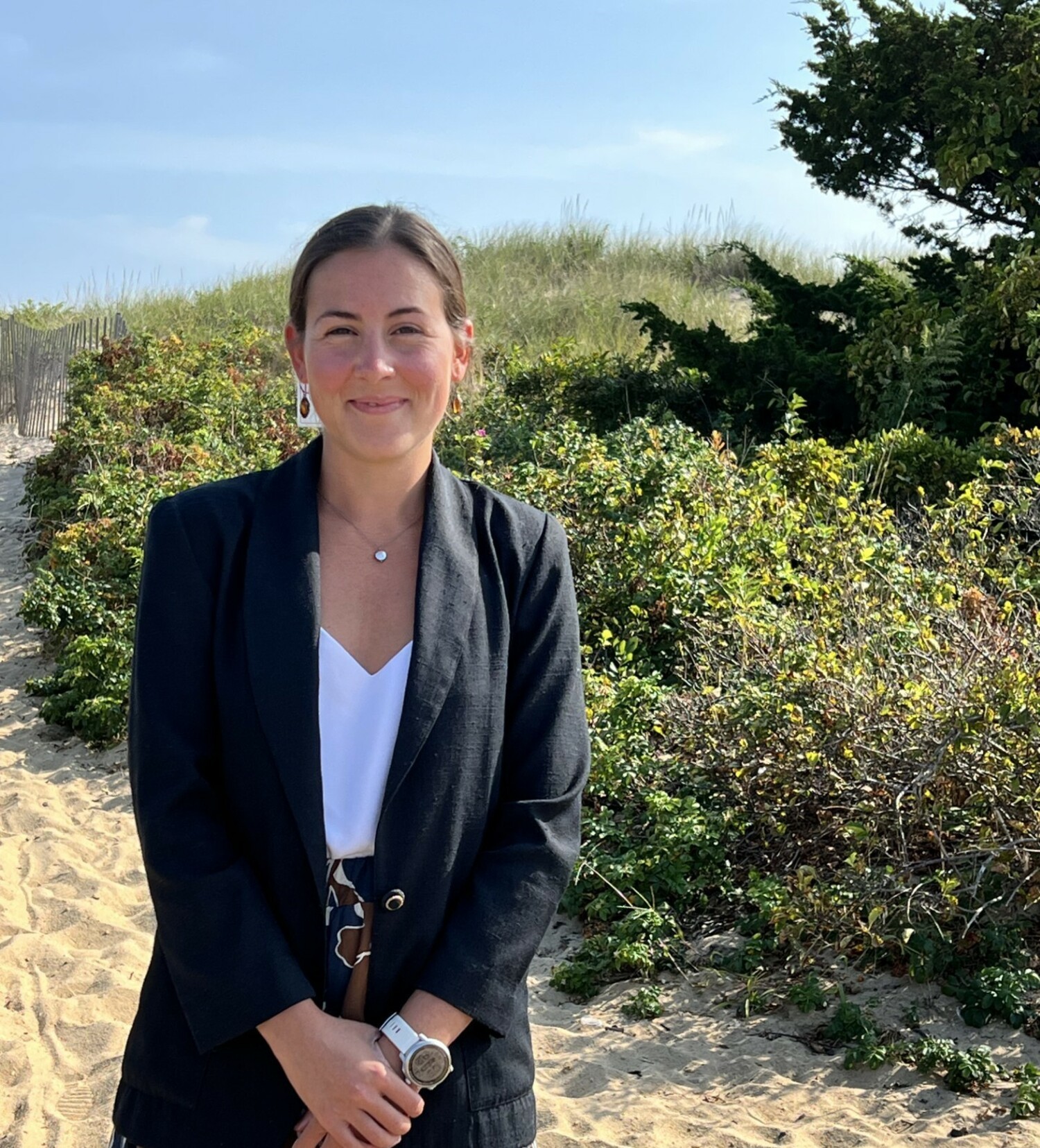
Rebecca Holloway brings a wealth of knowledge and experience to her new role as CCOM's manager of environmental advocacy. TKTK
Fifty-four years after Hilda Lindley founded Concerned Citizens of Montauk, the group continues its work to ensure a sustainable future — which in 2024 means a focus on environmental sustainability, coastal resiliency and water quality.
The group’s goals fit perfectly with those of its new manager of environmental advocacy. Rebecca Holloway, an earth and climate scientist who recently graduated from Barnard College with a degree in environment and sustainability, has been on the job for less than a month but brings an impressive wealth of knowledge and determination to her work.
A native of Sharon, Massachusetts, some 20 miles from the nearest coastline, Holloway “always found my way back to the ocean,” at Cape Cod or New Jersey’s coastline, she said last week. Her years at Barnard coincided with the inaugural year of Columbia Climate School, Columbia University’s school of climate research, and she took specialized courses designed to train professionals in sustainable development, adaptation and mitigation in the face of climate change. In her thesis research, she worked at the affiliated Lamont-Doherty Earth Observatory, studying the potent greenhouse gas methane in the Piermont Marsh, a tidal wetland on the western shores of the Hudson River. “I was so fortunate to be going to school there, and also to have the research experience at Lamont with my mentors there,” she said.
A class on energy and water policy with Paul Gallay, director of the Resilient Coastal Communities Program at the Center for Sustainable Urban Development, examined case studies and the complex interrelationship between environment and economy. Both can flourish simultaneously, she said. “It’s this balance and trade-off that is what I want to do. So bringing my marine science background to that seems like an amazing opportunity here at CCOM.”
While at Columbia, she studied local perspectives on climate change adaptation and climate migration on the Ganges-Brahmaputra-Meghna Delta in Bangladesh, the Earth’s largest and most populous delta system, which is threatened by rising sea levels.
“I was so excited by that work,” she said, “because I really feel that the community voices have to be elevated in the peer-reviewed science literature itself so that decision making from scientists and policymakers can use that information in the same way they’re using science, so that we can really weigh them both. Not to say that everything has to be published when working with the public, but in general, I feel like I, in my career, would like to elevate the local community voices.”
Her manuscript was recently submitted for review at the journal Climate Risk Management.
She also gained hands-on training during internships at the Scripps Institution of Oceanography, in California, and the Woodwell Climate Research Center in Falmouth, Massachusetts.
Shortly after graduating, Holloway arrived on the South Fork, where in 2023 she worked as a field research assistant for Vesta, a public benefit corporation that was conducting a coastal carbon capture pilot study at Southampton Town’s North Sea Beach. “Since then, I was just so inspired by the vast environmental nonprofit field here, and the natural environment, and really fell in love with it,” she said. “Specifically, my career goals are seamlessly aligned with CCOM’s, and they’re just such a storied organization.”
East Hampton Town’s government, she said, is also aligned with CCOM’s goals, as is the community at large. At last week’s Town Board meeting, at the Montauk Library, she observed “the level of commitment the local people have to the environment,” which she calls unparalleled. “So it’s an incredible opportunity. I am fortunate to be here in this position.”
The task, of course, is momentous: safeguarding a coastal community in the face of climate change while maintaining and improving people’s physical and economic well-being. In Montauk, this relies on the health of natural resources, from the hamlet’s beaches to its water quality. Sustainable development and environmental planning must be place-based, Holloway said.
“It can’t be applied to the whole U.S. or even all coastal regions,” she said. “What we do at Ditch [Plains] is going to be different than what we do west.”
It must be backed by the most relevant and current science, she said.
“I’m looped in with the literature and my colleagues at places like Lamont, and also I’m looking at Scripps Oceanography,” she said. “They’re doing great work with sustainable development.”
Finally, it must be highly collaborative, she said, “working in concert with other organizations that have the same goals to make this place the best it can be, to preserve it for future generations. So collaborating with the nonprofits and with government and all the stakeholders involved. That’s another thing that brought me to CCOM — I saw that storied high level of collaboration that we are continuing to grow.”
In the face of ever-more dire forecasts by climate scientists, Holloway is stubbornly optimistic. “We’re starting to see the impacts” of a warming climate, while “we still have ties with fossil fuels,” extractors of which funded decades-long campaigns to deny and obfuscate the science.
“But what I see, especially given my academic years and my peers there, I was super-inspired by seeing just how intelligent and dedicated my peers are,” she said. “And I know this is happening in many institutions around the world.”
Yes, she said, “it’s looking like in the next 50 years that we’re overshooting all of our targets for warming, and we’re still releasing fossil fuels. But I think that by utilizing nature-based solutions, we are going to be able to preserve as much of our natural beauty as we can. And it’s absolutely not a time for despair. I think it’s right to be afraid, but only to the extent that it’ll drive us” to implement nature-based solutions, which she calls a fast-developing field.
“I’m optimistic because I’ve seen the ability to make change at high levels,” she added. “Some people say that’ll never happen. I disagree with that, but I have that gritty optimism that I think it takes to take on our biggest challenge.
“It sounds like a lot of work, and it is,” she said. “But I’m excited about all of it.”


