


 1 Photo
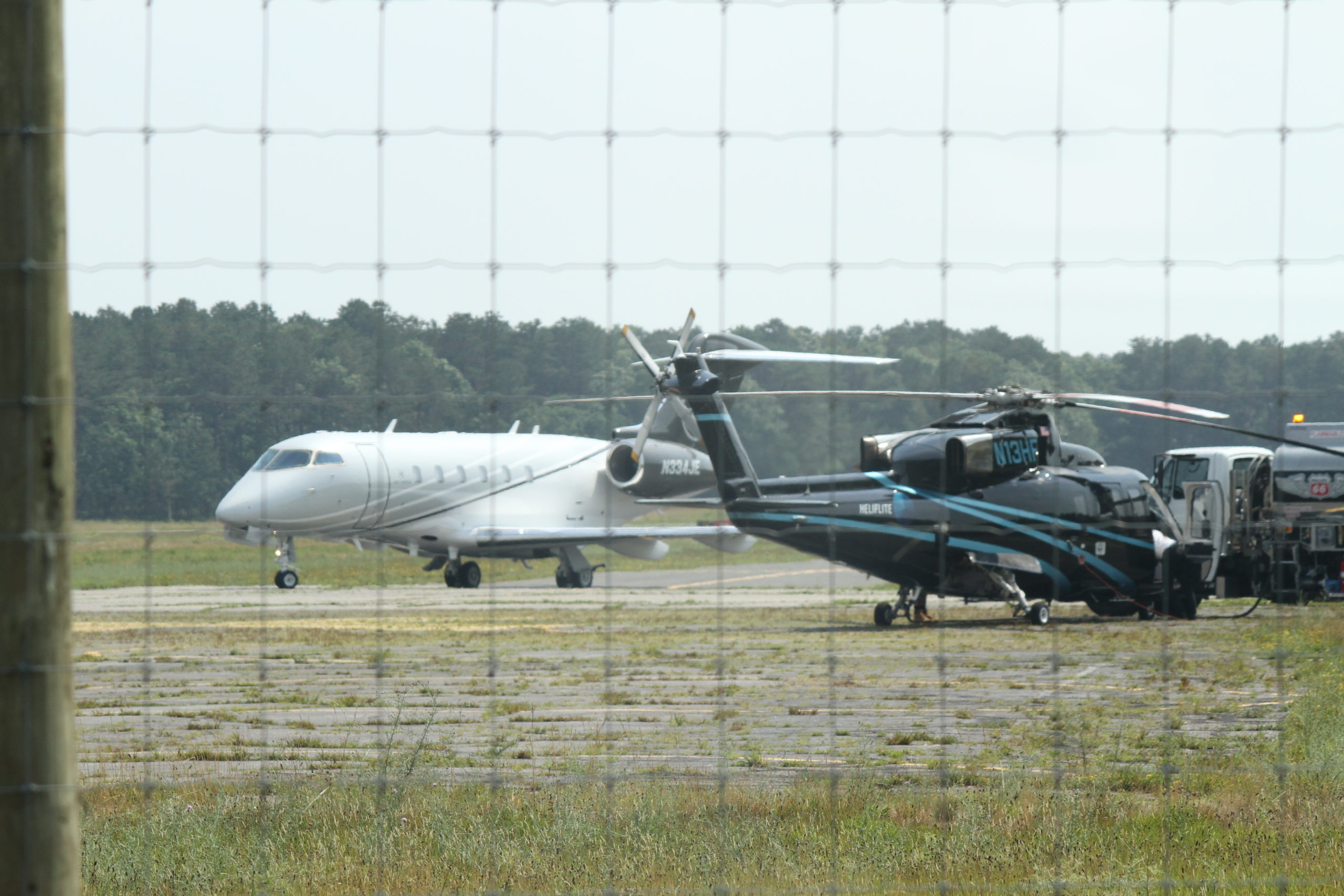
The town has proposed more than doubling landing fees for fixed-wing aircraft at East Hampton Airport this coming summer, and has introduced a new landing fee schedule just for helicopters.
A state judge last month refused to issue a restraining order that would have blocked the planned brief closure of East Hampton Airport, town officials say, albeit just hours after the town announced it would be delaying the closure by more than two months.
Justice Joseph Santorelli denied the temporary restraining order request by attorneys for three groups of plaintiffs who have filed lawsuits against East Hampton Town over its plan to close the airport for 33 hours and reopen it as a private facility with new rules intended to reduce the volume of flights, especially by helicopters.
The lawsuits, and requests for a court freeze of the town’s process, were brought by the charter flight booking company Blade, a consortium of hangar owners and a group calling itself the Coalition to Keep East Hampton Airport Open. All three cases also include residents of Montauk and Southampton or Westhampton, where fears have been raised that any restriction of flights to East Hampton will mean a commensurate increase in flights at other airports.
Santorelli is hearing all three cases. The East Hampton Town Board voted on February 17 to delay the closure of the airport from its originally planned dates of February 28 to March 4 to May 17 to May 19, and attorneys for the town argued in front of Santorelli that the shift in dates made the TRO request “moot.”
But an attorney for one group of plaintiffs appealed to the judge to consider that the town’s decision to delay the temporary closure could easily be reversed just as easily as it had been introduced and approved.
“But this latest development only serves to confirm that [the town] can change their stated course at a moment’s notice, and nothing in the town’s opposition provide any assurance — or even suggestion — that respondents [the town] will not reverse course again and move up the closure date in the future,” attorney Randy Mastro, whose firm represents Blade and its co-plaintiffs in one of the lawsuits, wrote to Santorelli on February 18. “Nevertheless, if respondents’ counsel provide written assurances to this court by midday today that respondents will not lose or otherwise restrict public access to the airport, or take or continue to take any steps to effectuate the closure of the airport … we will accept that representation as satisfying our TRO application. If the respondents choose not to make such written commitment to this court, that will be telling and warrant issuance of a TRO.”
The judge was, apparently, unmoved.
Town Supervisor Peter Van Scoyoc acknowledged this week that the denial of the TRO does not mean that the judge could not issue a ruling in the lawsuits that would preempt the town’s plans to close the airport, he said he is confident in the legal standing of the steps the town is taking.
“I don’t think they are going to be successful,” Van Scoyoc said. “He could rule on an injunction right up until May 17. But I don’t think it’s going to take the judge that long.”
All three lawsuits focused on the Town Board’s approval of the application to the FAA to close the airport and the declaration it made in doing so that the closure would not have wide-reaching impacts. The suits say the town did not adequately explore the potential for impacts on residents around other airports.
This week, Town Board members continued building the foundation of their plans to take control of airport operations and restrict flights, introducing a new schedule of landing fees that more than doubles the fees for fixed-wing aircraft and introduces new rates set specifically for helicopters.
The fees for the smallest planes that use the airport, those weighing less than 4,500 pounds and mostly belonging to amateur pilots based at the airport itself, will remain at $20 per landing. But for all other planes, the fees will double or even triple, from a low of $100 and a high of $700 per landing, to between $300 and $1,500.
The new helicopter landing fees will range from $300 to $750 per landing. For the mid-sized helicopters that fly in and out of the airport the most, the landing fee per trip will go up from $225 under the current system to $500 as proposed.
As part of the planning for the new rules that the town plans to impose, the board has been looking for ways to make up for lost revenue from landing fees as the number of flights is reduced. The town has yet to finalize what the new rules will be, but consultants told board members last week that a package of recommendations they have proposed, focusing on curfews and a one-flight-per-day on helicopters and other especially noisy aircraft, could reduce total flights by as much as 40 percent.
On Saturday, residents of Wainscott said that they do not see the rules the town has proposed as being sufficient to reduce the noise from the airport — from helicopters in particular.
“There will be zero reduction in the number of flights per day,” Anthony Liberatore said during a meeting of the Wainscott Citizens Advisory Committee, taking issue with the main thrust of the consultant’s proposal, which would limit each individual aircraft to no more than one landing and one takeoff at the airport per day. “The only way to limit the number of aircraft is to limit the number of aircraft. A slot system that says no more than X number of aircraft, a very small number, can land in a given day or hour.”
Councilwoman Cate Rogers pointed out that the board has not adopted the rules yet and that the system it is setting in place would allow restrictions to be tightened.
“This is forward movement, as little as it seems,” she said.
Members of the committee were nearly unanimous in their disappointment with the rules the town’s consultants proposed, and few saw the town asking for patience while it works toward the goal of quieting the skies over their homes as relief.
“I’m dumbfounded as to why the town would [start with] minimal constraints instead of the maximum,” said Barry Frankel. “If, at the end of this process, the airport remains open with such modest restrictions that we cannot tell the difference and we’ve exhausted all our entreaties, what do we do as a community? This community is getting angrier and angrier.”
Pilots have also been critical of the proposed limits, which could lump some small airplane owners in with much larger, much louder aircraft simply because the model of plane they fly does not have an officially rated noise signature. The consultants had also proposed barring a landing and take-off practice maneuver known as “touch and go,” which pilots said is unfair and unnecessary at an airport with no flight school.
The supervisor said on Monday that the town was looking into some of the statistics on the issues raised by the pilots and would be considering the rules further before adopting anything.


 Michael Wright on Mar 9, 2022