


 1 Photo
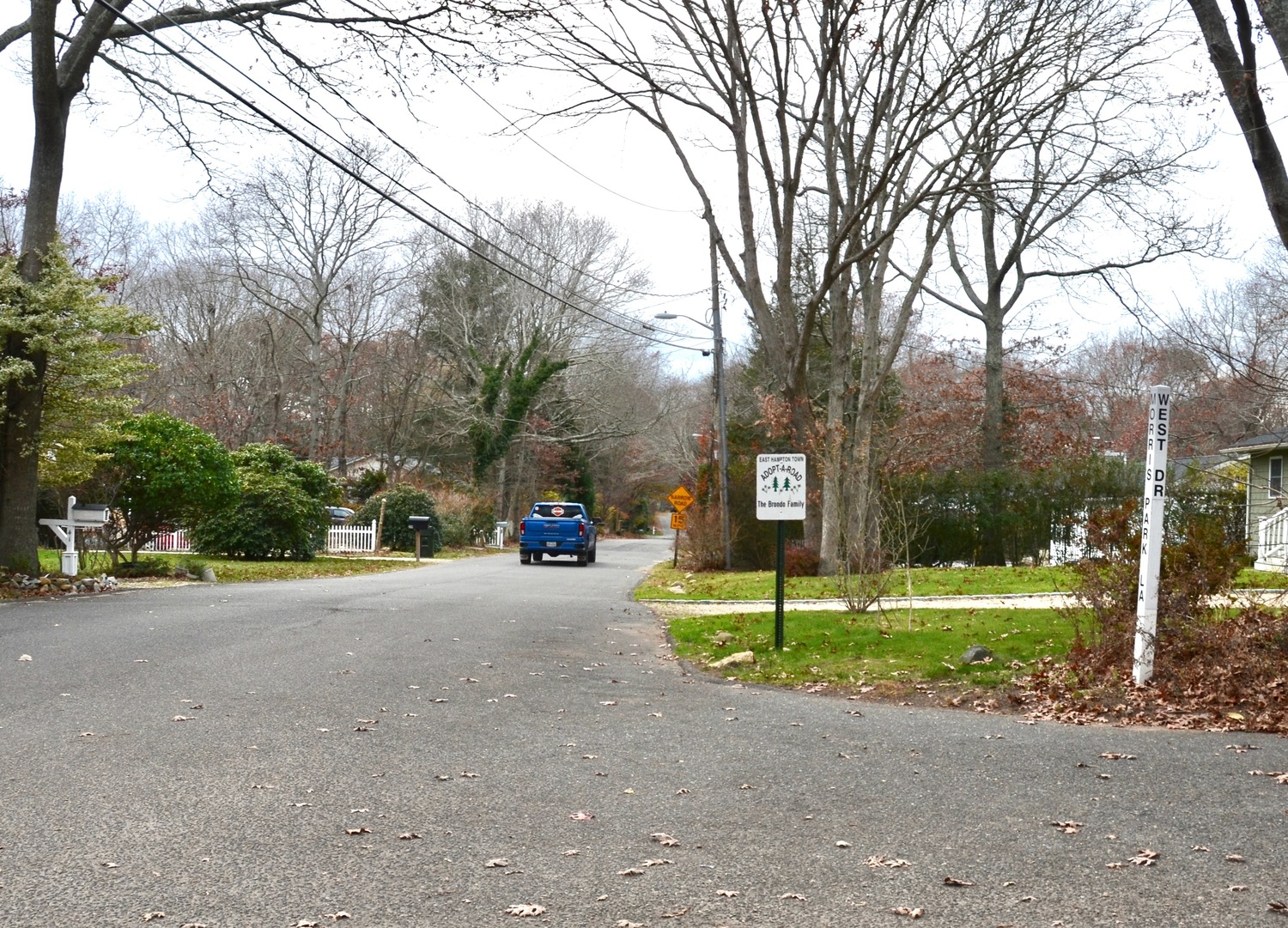
Morris Park Lane and West Drive in northern East Hampton are the latest backroads to be inundated by vehicles trying to dodge traffic backups, to the chagrin of residents. East Hampton Town has proposed imposing a weight limit to at least cut down on the number of heavy commercial vehicles using the narrow residential streets, and two new stop signs to slow some of the cut-through traffic. KYRIL BROMLEY
The rumble of traffic down back roads and side streets around the South Fork has become a daily scourge for residents of dozens of neighborhoods around the region in the last decade, as traffic has ground to a halt on main thoroughfares and the rise of navigation apps has led harried drivers through labyrinthine routes to their destinations with algorithms that see only speeds and time tallies.
Municipalities have struggled to find ways to check the new deluge of vehicles in places where they are unnecessary and unwanted, dangerous and a costly burden on infrastructure not intended for daily commuter traffic.
Sagaponack last year installed “speed humps” on several of its streets to slow traffic. Southampton Village used an army of police officers to block access to its main road from side streets during rush hour. East Hampton Village has launched a pilot project with temporary speed humps on one of its beach roads — one inhabited by perhaps the densest collection of billionaire residents anywhere — and is considering making another one-way traffic only to at least halve the number of cut-through speeders.
East Hampton Town is the latest to join the fray, introducing a proposal last week to add new stop signs and impose a new weight limit on any vehicles traveling down Morris Park Lane and West Drive — two narrow residential streets that have become an unlikely traffic bypass for heavy and fast moving vehicles.
“With the weight limit, it will stop vehicles coming from the Springs-Fireplace corridor, industrial trucks and what not, cutting through — school buses are cutting through there,” Councilwoman Kathee Burke-Gonzalez said during a discussion last week. “Also, if you’re coming from Springs-Fireplace along West Drive and you’re making a left hand turn, some folks are taking it too fast, so having the stop signs there will slow that traffic. There’s some ways we can improve the conditions down there so that folks will be more comfortable.”
She noted that there are only two other streets in the town that have weight limits on them: Accabonac Road and Indian Wells Highway — both of which have 8,000-pound limits intended to keep large trucks and buses from using them.
The board agreed to formally introduce the proposal to put a similar weight limit on West Drive and Morris Park Lane and for the stop signs and to schedule a public hearing on the matter for December or January.
The town has long been beset by complaints from residents of neighborhoods whose streets have become bypasses to traffic backups or short cuts. Residents of Indian Hill Road, Miller Lane East and Miller Lane West have complained for years about cars speeding through the zig-zag of their tiny, one-lane streets. But town officials have rebuffed calls for traffic calming measures like speed bumps, rumble strips or making some of the roads one-way, to slow or deflect the traffic. Intermittent speed enforcement by police has had little effect.
But as the spread of apps guiding drivers has led cars and large commercial vehicles into more and more neighborhoods, officials are increasingly pressed to take some kind of action in the name of safety, if not nuisance.
“There’s a lot of roads in our community where kids could go out and ride their bike and throw a ball around — but they can’t anymore because there’s just so many more people living here,” Burke-Gonzalez lamented.
She and Supervisor Peter Van Scoyoc both blamed the mobile apps for much of the problem, leading drivers to connections they might otherwise never have known could shave off a couple of minutes of travel time.
“We’ve really seen quite a change with the increased number of people traveling the roadways and even many of our secondary roads at capacity at various times and people seeking to avoid those backups by taking shortcuts through neighborhoods,” Van Scoyoc said. “To the extent we can make those roadways safer, we will, but we’re not going to be able to put up barricades.”
Southampton Village last year banned right turns onto Hill Street/Montauk Highway from roads coming in from the north during rush hour, and left turns from roads coming in from the south. During the summer of 2022, the village posted police officers at every intersection to stop cars from entering the highway — both to discourage cut-through traffic but also to alleviate the merging, which worsens the backups of vehicles using the main road — but the practice was too expensive to continue in the long term.
Now the village is also looking at weight limits as a possible way of at least alleviating some of the problem by removing the heavy commercial vehicles from the blur of traffic wending through neighborhoods that lie between main access roads.
“We have bumper-to-bumper traffic on residential streets — to the point where between 4 p.m. and 7 p.m. we have people who literally cannot get out of their own driveways,” Southampton Village Mayor Bill Manager said. “It’s really affecting the quality of life for a lot of residents.”
The village has purchased a portable vehicle scale and has hired traffic consultants to identify village roads where new weight limits could be used to tamp down bypass traffic by heavy trucks — which are a nuisance for residents and also put undue wear-and-tear on residential streets not built to the same specifications as primary roadways.
“We can enforce some weight limits and let the police do some enforcement that way,” the mayor said. “We think that will help.”
Manger is on County Executive-Elect Ed Romaine’s transition team, and said he’s been voicing the concerns of South Fork leaders to keep advancing the effort to find solutions to the traffic snarls.
East End officials are meeting this week with representatives of the MTA to discuss the future of rail service between Speonk and Montauk, Van Scoyoc said, and plan to press for expansions of service in the near future.
“They’re doing a needs assessment for the next 20 years — many of those needs are needed now, and have been for the last five years,” he said. “There is really no opportunity to increase our roadways and the railroad is underutilized and in order to better utilize it required infrastructure improvements.”


 Michael Wright on Dec 1, 2023