


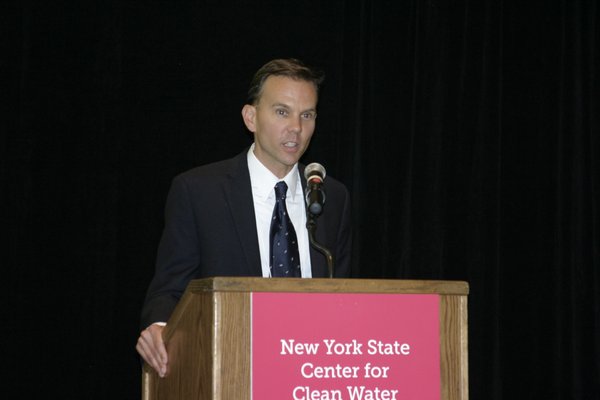
 3 Photos
Scientists from the New York State Center For Clean Water Technology presented strategies for new septics to reduce nitrogen from septic flows by up to 95 percent last week. Michael Wright
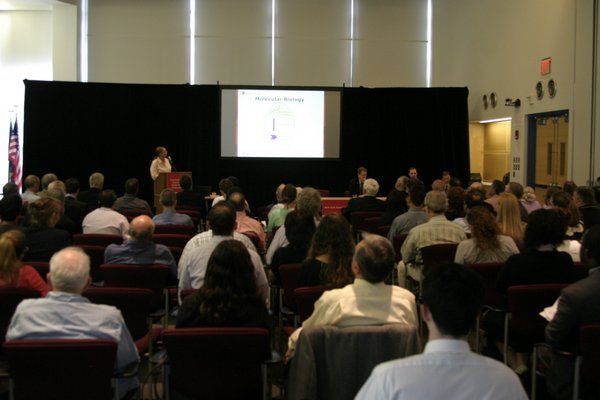
Scientists from the New York State Center For Clean Water Technology presented strategies for new septics to reduce nitrogen from septic flows by up to 95 percent last week. Michael Wright
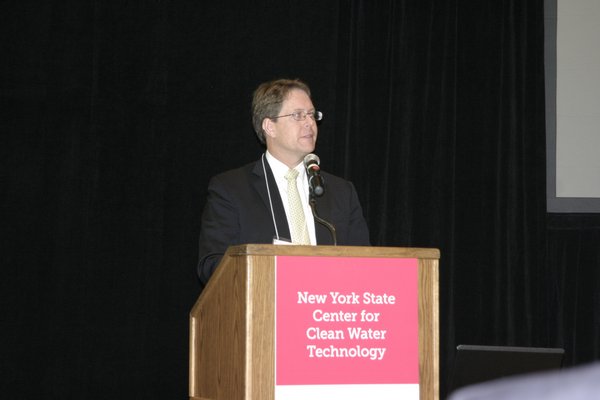
Scientists from the New York State Center For Clean Water Technology presented strategies for new septics to reduce nitrogen from septic flows by up to 95 percent last week. Michael Wright
Scientists at Stony Brook University say they are testing new septic treatment systems that could reduce the amount of nitrogen released into groundwater by as much as 95 percent—and could be installed on a residential property for as little as $10,000.
The systems that the team of researchers from the fledgling New York State Center for Clean Water Technology have been focusing their early testing on employ grids of piping laid just beneath the surface of a home’s lawn. The pipes release wastewater into the ground across a broad area, allowing it to trickle down through layers of a sand-and-wood pulp mixture designed to filter out the bulk of nitrogen in human waste.
Early inground tests of the first designs conceived by the center’s researchers achieved 85-to-95-percent nitrogen removal, Dr. Christopher Gobler, the center’s co-director, told the participants at a symposium in Stony Brook on Thursday, June 23. More designs will begin being tested this week in Massachusetts, he said, as researchers look to find ways to both streamline construction and maximize nitrogen removal.
The designs in the development pipeline thus far are what the scientists call “passive” systems, in that they primarily rely on gravity and natural chemical reactions to neutralize nitrogen, rather than mechanics and synthetic filters. By taking the simpler, less mechanical approach, the systems will be inexpensive to operate, require low maintenance, and be on par with the costs of current septic systems to install, experts say.
The new systems, the center’s leadership said at its first symposium on its findings last week, offer the best hope for affordable and effective improvements in home septic treatment, of the sort needed to cut nitrogen inputs into local waters and stanch decades of proliferating algae blooms that have wiped out marine vegetation and shellfish species and forced closures of beaches and pond waters to human use.
Last week, scientists and public officials called the battle for new technology to improve septic systems across Long Island and the nation, the defining battle of the current generation of leadership and said the Center for Clean Water Technology is the anchor of the effort.
“This is the problem of our time … and what we will be judged on by future generations,” Suffolk County Executive Steve Bellone said at the symposium’s opening on Thursday morning, at the Stony Brook campus. “We’re at the stage now where the time for analysis and study must be complemented by action.”
At the outset, the center’s stated goal has been to slash the amount of nitrogen released into the ground by residential septic systems from 40 to 50 parts per billion, to 10 ppb or less. The second goal is to make such systems comparable in costs to the standard systems employed today.
As more and more public funding is poured into water quality improvement programs—with the looming potential for a windfall of Community Preservation Fund tax revenues up for referendum in the fall—it is expected that septic system replacement subsidies will be employed to spur homeowners into removing decades old cesspools and standard septic rings.
To that end, the center’s research has focused in large part on systems that could be ready for testing and deployment into the marketplace in less than five years.
There is something of a stopwatch on the effort, since part of the center’s mission looks to the future of the products they are developing in commercial production, and competitors seeking to tap the same markets.
When it was conceived, the Clean Water Center was seen as the first cog in what could become a technology hub on Long Island, pairing scientific research with industrial production of the systems designed by researchers.
With nearly half a million outdated inground septic systems tied to homes, Suffolk County holds a potentially vast marketplace opportunity for the development and sale of new septic technology.
“Our problem is big enough that there must be an opportunity to be harnessed,” the center’s Associate Director Jennifer Garvey said in a presentation on market analysis. “The cost of replacement pales in comparison to the costs of doing nothing.”
Ms. Garvey noted that the market for septic technology is a difficult one to get into, since it requires substantial research funding and numerous hurdles to regulatory approvals. But the Stony Brook center, she said, is uniquely positioned to put itself at the head of the field, because it has substantial funding—$3 million in seed money and another $2 million in pledged recurring funding from New York State—already in place.
Ms. Garvey also said that no other water quality think tank like the New York State center is focusing its research and development specifically on septic wastewater nitrogen removal. And with as many as 3.5 million homes around the country employing individual septic systems that do not treat wastewater sufficiently to meet clean water standards, the long-game potential for affordable new technologies could be over $1 billion a year for decades to come.
The timing is right, thanks to the much publicized connection between residential wastewater and water quality degradation along the coastlines for nitrogen removal technology to carve out a lucrative niche in the marketplace, Ms. Garvey added.
“This could be the Silicon Valley of water technology,” State Assemblyman Fred W. Thiele Jr. said of the growth potential. “This center is going to be a critical link, because without the technology, we can’t move forward.”
The Center for Clean Water Technology was conceived by former Southampton Town Supervisor Anna Throne-Holst and Ms. Garvey, her former chief of staff at Southampton Town Hall, and created in partnership with New York State, Stony Brook University and Suffolk County. Its seed funding came in the form of $2 million from the state and $1 million from Bloomberg Philanthropies.
The center’s scientists are already looking past the near-term technology to conceptual ideas like separating urine—which accounts for 75 percent of nitrogen in household waste—and super-fine cellulose membranes to filter out nitrogen in on-site septic treatment systems, as well as at conceptual microbial fuel cells that scientists hope could someday take advantage of natural reactions to turn the treatment of wastewater into an energy source.
“The opportunities are amazing here,” said Dr. Harold Walker, the center’s other co-director. “The funding … hasn’t met the scope of the problem. With some targeted funding, there’s a lot of low hanging fruit.”
The center’s funding goal is reach to $7 million by its fifth year of operation, with partnerships in the private sector and federal grant support coming to bear as technological innovations start to bear fruit.
The hopes and expectations of those who spearheaded the creation of the center are high, both in terms of the economic possibilities that creating a technology development hub could mean for Eastern Long Island, as well as for the improvements to water quality across Long Island.
“This is a heavy burden on this center,” Mr. Thiele said. “We’re relying on you.”


 Michael Wright on Jun 28, 2016