


 2 Photos
Ørsted has announced that the South Fork Wind Farm will be comprised of no more than 12 turbines, rather than as many as 15, as originally planned, but the turbines will be much larger than the ones built off Block Island in 2016 and visible from Montauk's shores on clear days.
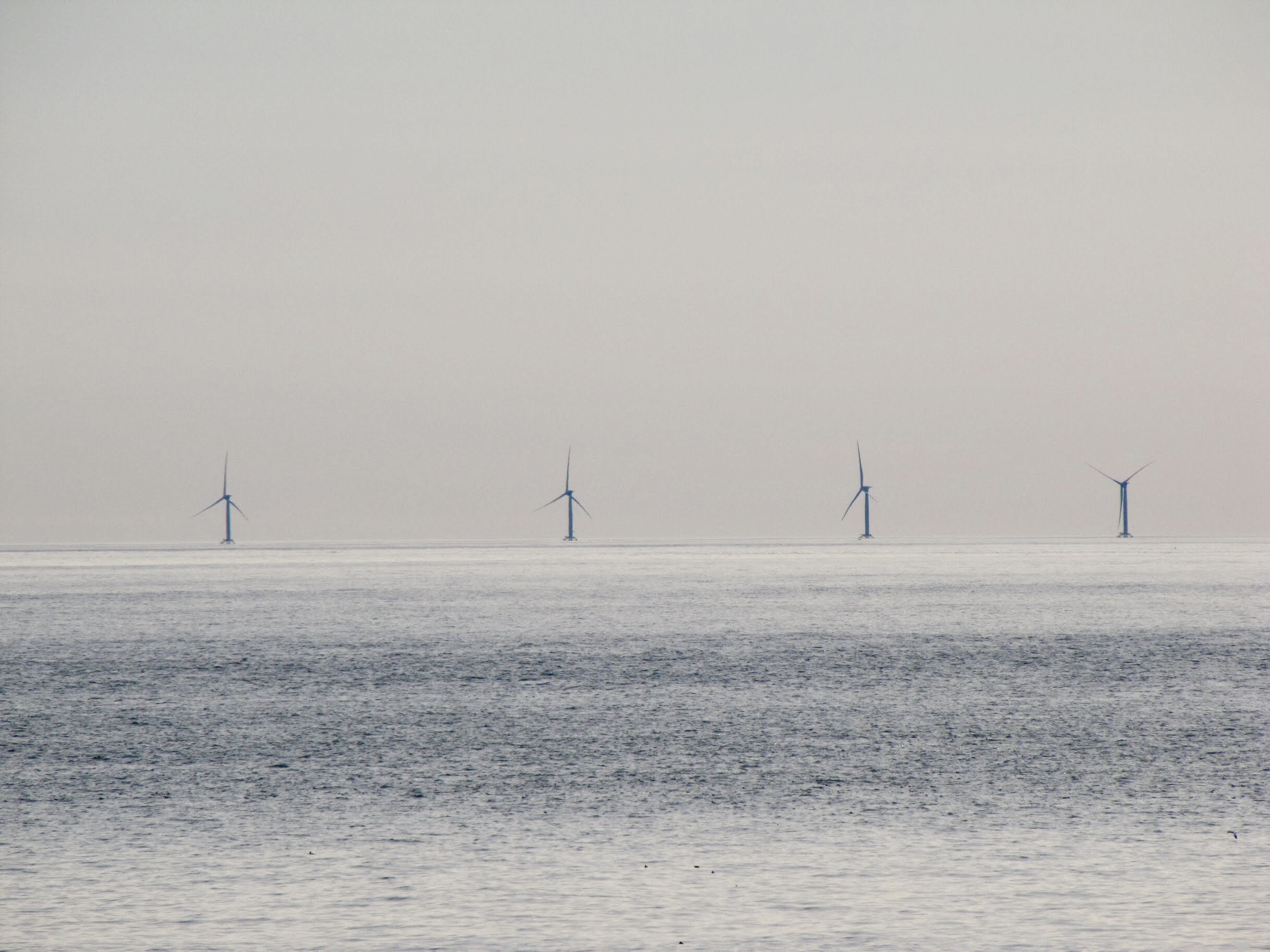
The Block Island Wind Farm turbines, as seen from the bluffs in Camp Hero State Park in Montauk. The turbines Ørsted says it will use for the South Fork Wind Farm, which will be another 20 miles further from shore, will be nearly 300 feet taller. Michael Wright
The developers of the South Fork Wind Farm said they have reduced the number of turbines they plan to connect to the South Fork from 15 to 12 — though the amount of power sent ashore in East Hampton will remain the same.
The shift is a product of the availability of much larger turbines than when the project was originally proposed. An Ørsted spokesperson said that the company has settled on using 11 megawatt turbines for the project, which allows the total number of turbines to be reduced from 15 to 12 while still meeting the 132-megawatt planned power supply that the company has agreed to with the Long Island Power Authority.
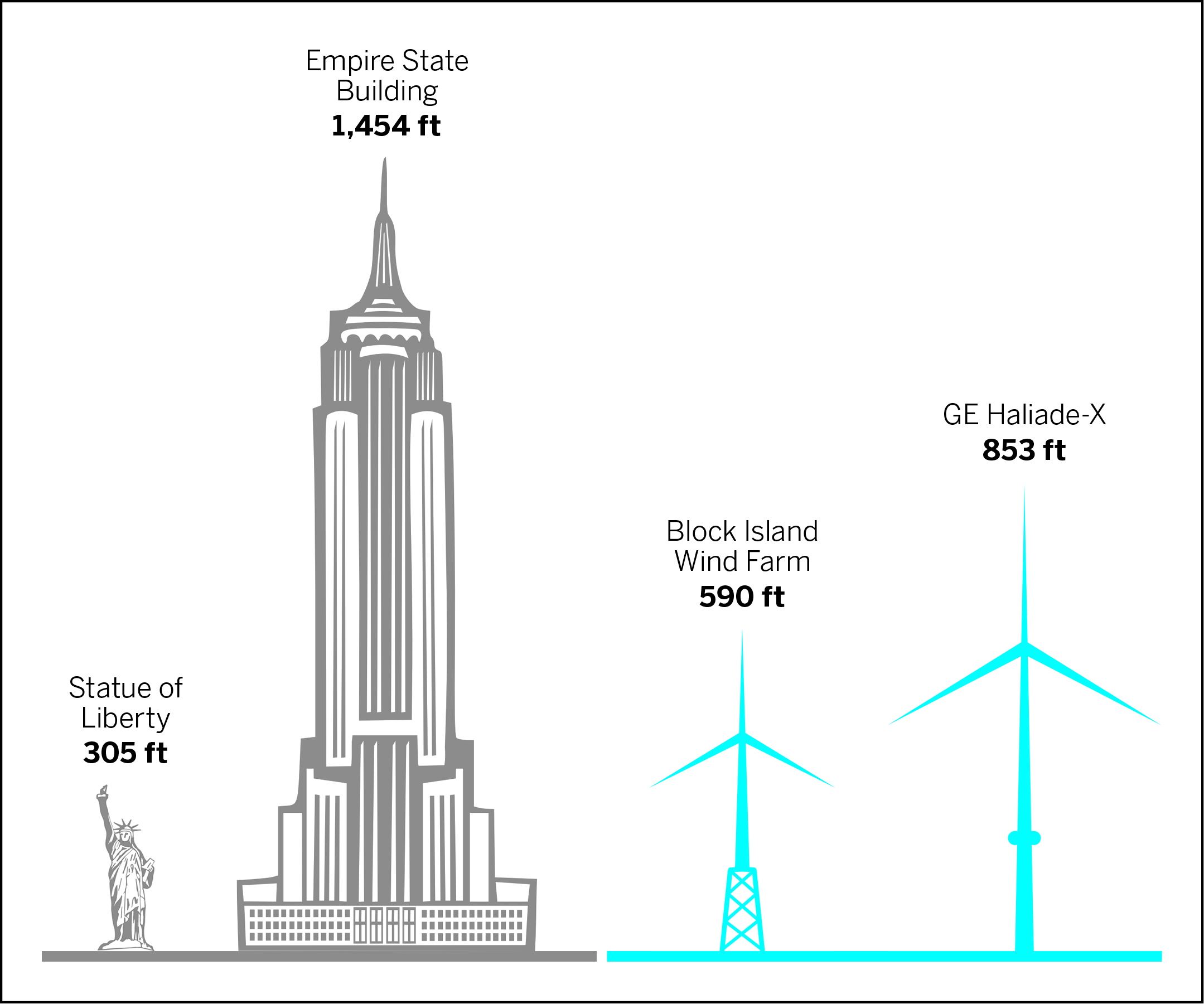
The turbines used in the Block Island Wind Farm, and visible from the shores of Montauk on clear days, are rated at 6 megawatts. They tower to about 590 feet above the surface of the sea, while the current 11-megawatt Siemens turbines reach nearly 800 feet and a turbine being produced by GE that will also top the 11 megawatt nameplate tower soars to more than 850 feet.
But it also comes amid the public review process of the project by the Rhode Island Coastal Resources Management Council. Analysts and fishing groups from around New England and New York have objected to the company placing the turbines in ecologically sensitive areas close to Cox Ledge — an undersea ridge of rocky bottom that is an important fishing area for Montauk and Rhode Island fishermen and a critical nursery for bottom dwelling fish species like the beleaguered Atlantic cod.
Watchdogs locally and in New England say the reduction in the size of the turbine array lessens the potential impacts but still leaves concerns about the impacts the project would have on the the critical habitat at Cox Ledge. Scientific advisory staff for the Rhode Island council called putting the wind farm on the fringes of Cox Ledge a terrible choice.
“The location of the SFW project on Cox Ledge, an area known for its biological diversity, is in our view one of the worst possible locations within Rhode Island Sound for this project,” the council’s analysts wrote in their 20-page report on the project.
That assessment rang true to local critics of the proposal as well. East Hampton Town Trustee Rick Drew said this week that he remains very bothered by the arrangement of the turbines. Mr. Drew and attorneys for the Trustees lobbied to have an alternative approach called “micro siting” included in the federal review process that would require the company to keep any turbine bases at least 500 feet away from complex habitat features on the ocean floor. There has been no acceptance of that alternative by Ørsted or demand for it from BOEM or other reviewing agencies.
“Each one of those sites is a 20-acre patch of destroyed bottom,” Mr. Drew said. “They have gone down to 12, but they still do not address micro-siting and one of those sites is still very impactful on Cox Ledge. I am still not sure there is an understanding locally of how poor a choice this really is — whether its 3 turbines or 11 or 15 or 20. I feel like there is a feeling that the turbines are a long ways away and out of sight out of mind, but it’s impossible to overstate how important that area is for our fishermen, for our constituents.”
Mr. Drew is quick to point out that the placement of the five turbines off Block Island by Ørsted’s predecessor, Deepwater Wind, actually may have had an ecological benefit for fish species, by providing new habitat in an area of otherwise featureless bottomlands. There are areas away from Cox Ledge where the turbines could be placed in similarly less impactful bottom, he says. But the siting problem was a self-created hardship by Ørsted, which he said has “boxed itself into a corner” with the siting of the turbines by delineating only a tiny portion of the vast section of seafloor it has leased from the federal government for the South Fork Wind Farm, so that other planned wind farm projects can use sections of sea floor where the South Fork Wind Farm could have shifted to.
Another Ørsted project, Sunrise Wind, will construct 100 turbines or more immediately adjacent to the South Fork Wind Farm, with construction likely taking place concurrently.
Along with the reduction in the number of turbines, Ørsted also said it has agreed to a $12 million compensation package for Rhode Island fishermen — money that would be made available over 30 years to fishermen to compensate them for income lost if they are displaced from traditional fishing grounds because of the placement of the wind turbines.
But a New England commercial fisherman’s group told the Providence Journal this week that the compensation proposal was a “backroom deal” that doesn’t come close to making up for the $15 million to $40 million the fishermen say they will lose because of the South Fork Wind Farm alone.
Ørsted has yet to propose any compensation package for New York’s commercial fishermen as part of the federal application. A spokesperson said on Monday that a compensation plan for New York fishermen is “subject to an ongoing process.”
“They’ve done nothing for mitigation here,” Bonnie Brady, the director of the Long Island Commercial Fishermen’s Association, said recently. “Nothing.”


 Michael Wright on Jun 2, 2021