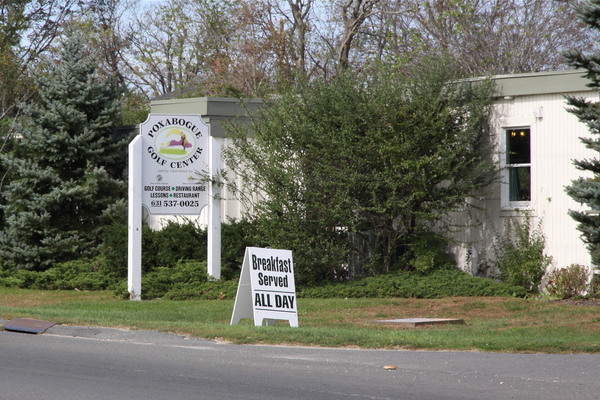
The Southampton Town Board on Tuesday unanimously approved the purchase of East Hampton Town’s half-share of the Poxabogue Golf Course in Sagaponack Village, with little fanfare.
Following a quick public hearing during which no one spoke, the board voted to go through with the $2.2 million purchase of the 39-acre property, utilizing Community Preservation Fund proceeds.
The sale serves two purposes, officials said. It allows East Hampton Town to work toward eliminating $2.4 million in debt it still owes for its half of the course, and it rules out the possibility that private developers could come in and purchase East Hampton’s half of the course and build on it.
The towns jointly purchased the nine-hole golf course, which also includes a restaurant and pro shop, in March 2004 for $6.5 million, with Southampton using CPF proceeds for its half. East Hampton was unable to tap its CPF because the course is located outside of the town, and had to borrow the cost of its share of the purchase.
Financially strapped East Hampton Town is seeking to sell its half of the course to cut expenses. The town currently pays about $250,000 per year in debt payments resulting from the Poxabogue purchase. The East Hampton Town Board authorized selling its share in the course in October 2011.
Southampton Town Supervisor Anna Throne-Holst on Friday said that while she had some reluctance regarding the purchase, she would vote in favor of the acquisition.
“I’ve been very lukewarm about it myself,” she said. “I don’t buy the argument that doom, gloom and development would result if we don’t buy it.”
At the same time, Ms. Throne-Holst said, the upside of the purchase would be that any revenue generated by the course would now be reaped solely by Southampton, rather than split with East Hampton. “It makes sense that it is a Southampton-only entity,” she said.
Officials from both towns were unable to say exactly how much revenue was generated by the golf course in the years it has been municipally owned, but did note that all proceeds were funneled into a special joint reserve fund earmarked for maintenance of the course. According to East Hampton Budget Officer Len Bernard, as of mid-2011, there was about $400,000 left in the account. East Hampton would be entitled to half of whatever was in the account at the time of sale, he said.
Southampton Town Councilman Chris Nuzzi said he also supported the purchase, and that he believed there was an urgency to the acquisition to prevent a private entity from buying East Hampton’s share. “It locks up, in perpetuity, the preservation of that course,” he said. “We were contacted by people who had interest in the East Hampton portion.”
Mr. Nuzzi added that there was some confusion over the management of the course by officials from both towns that the purchase would finally settle.
East Hampton Town is prohibited, under the terms of its borrowing, to pay off the bond that financed the town’s half of the purchase until 2016, so the proceeds of the sale, $2.2 million, would be placed into a reserve account and used to make annual payments of about $220,000 for the next three years, Mr. Bernard said. In 2016, the remaining principal would be paid, saving eight years of interest payments, or about $288,000. The bond was scheduled to be paid off in 2023.
“It’s a good deal all the way around,” Mr. Bernard said of the upcoming sale.