


 1 Photo
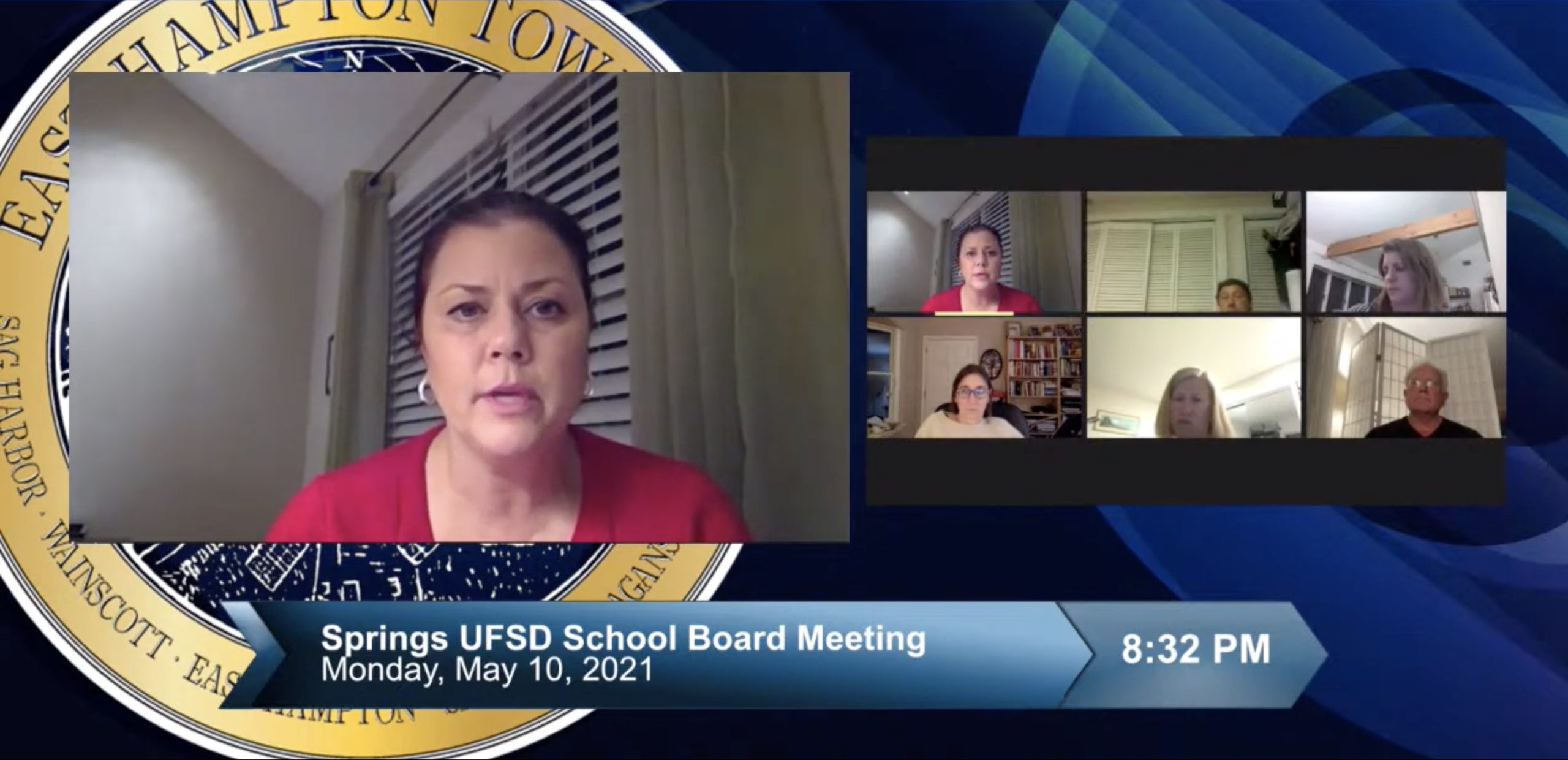
Springs School Principal Christine Cleary unveils two different school day scheduling options for the 2021-22 school year during the May 10 board of education meeting.
Springs School Principal Christine Cleary presented two preliminary schedule options for the 2021-22 school year, and teachers and parents said they saw the pros and cons of both.
Plan A, presented to the Board of Education Monday night, keeps the schedule near identical to what it’s been the past year-and-a-half during the COVID-19 pandemic.
Children would arrive to school at 8:20 a.m. and leave at 3:11 p.m., attending eight 49-minute periods during that time. There’d be two lunch and recess periods. Children in kindergarten through fifth grade would take specials like art and music once a week, and physical education twice a week. Science, technology, engineering and match classes, also known as STEAM, would be integrated into classes throughout the day, but could potentially be included as a stand-alone class. Students in sixth grade would move to an A/B schedule, and all kids in sixth through eighth grade would have specials one quarter or half a year as per New York mandates, attend physical education classes two-to-three times a week following the A/B schedule and have one English language arts and math class per day. Those in seventh and eighth grade would have Spanish classes every day, and sixth-graders would take Spanish every other day opposite an extra ELA class.
“The pro to Plan A is there are no major changes,” Ms. Cleary said. “Everybody’s had so much change in the last year-and-a-half that it might be nice to just decompress and keep things going as is and still provide a quality instruction program.”
The principal also considers longer periods to be beneficial, especially for kids at the junior high level, but said the downside is those in kindergarten through fifth grade are not meeting physical education state mandates.
“They’re not getting enough PE with eight periods, even though there’s a new gym, so there’s space to do so. A schedule needs to support it,” Ms. Cleary said. “Seventh and eighth-grade accelerated and AIS students will also miss specials like art and music to attend math lab, which is mandated for Regents programs, and/or for support services.”
Board President Barbara Dayton said no matter which plan the district goes with, there needs to be the correct amount of physical education built into the schedule.
“We were adamant with that when we went out for this bond project. We told community members we needed to do this and expand the gym to offer these classes,” she said. “But we’re also prepared to listen to out-of-the-box thinking. I don’t think we have to be married to something that we’ve done for a long time just because we’ve done it. We can certainly try different ways of doing things and figure out what works best for our students and staff.”
Third grade teacher Cristen Keyes said she fears STEAM classes being integrated into curriculum rather than continue as a standalone special class, especially after once-a-week Spanish classes were replaced with STEAM this year.
“Last meeting, we found out we are not filling [STEAM teacher William] Hallman’s position. And we used to have foreign language for younger grades,” she said. “I’m concerned about the variety of specials that the children will be receiving if we take Spanish and STEAM out of the equation, and I’m also concerned about losing positions, about class sizes.”
Ms. Cleary said she questions how beneficial that once-a-week Spanish class is at the elementary level.
“Can we have a higher-impact special that will benefit them in the long run?” she asked.
Parent Jen Russell, like second grade teacher Ashley DellaPolla, wants to see Spanish classes begin even sooner. She pointed to the theory of multiple intelligences, citing research behind exposure to a second language before the age of 10.
“Children can absorb language better prior to that,” Ms. Russell said, “so it’s good to get those classes in before middle school, even if it’s just one day a week.”
Second grade teacher and parent Monique Sullivan sees benefits to Plan A.
“Students have the ability to do more things with one subject,” Ms. Sullivan said. “You’re given more time to devote to one content area or a hands-on lesson. It’s more time for independent work as well. We do try to meet with individual students at the end of workshop models — we can work on skill areas with individual students — and that’s something we may not see as much of if we have less time for each period.”
The educator said this because Plan B was presented with the same arrival and dismissal time, but students would attend nine, 43-minute periods.
Due to the added class, Ms. Cleary said three lunch and recess periods would be created, which means less kids on playgrounds and fields at one time, creating what she said would be a better staff-to-student ratio when outside.
Each special would be one-to-two times a week and physical education classes would be attended three days a week. Again, STEAM classes could be integrated or a stand-alone special. Those in sixth, seventh and eighth grade would have Spanish class every day. This would mean that an eighth-grade Spanish Regents exam could be offered in the future.
“We’re trying to figure out how to get the most bang for our instructional buck,” Ms. Cleary said, “and we want to pick everyone’s brains on that.”
Those in sixth through eighth grade under Plan B would also have an extra ELA and math period every day.
Ms. Cleary said additional periods for social-emotional learning, civics, executive functions and/or STEAM would be beneficial, but said additional monitors for lunch and recess may be required if current staff couldn’t stay for a third period.
Many teachers did not like shorter class times, but also felt the plan would leave them with less opportunities to prepare lessons. Ms. Cleary countered with more specials comes more free periods for teachers.
“We want more curriculum planning time,” special education teacher Kristy LaMonda said. “But I like this idea of looking at the big picture and seeing how and what we can utilize to get our kids where we want to be — with college and career readiness and with all the things they deserve.”
Ms. Sullivan argued a nine-period day may also leave service providers with less time to work with students, saying children already lost a lot of time due to COVID-19 restrictions.
Director of Human Resources and Pupil & Personnel Services Keri DeLalio said while there are many unknowns, as administrators are unsure what mandates the state will put in place next year, like keeping kids in cohorts, the goal is to meet the needs of all students.
“We know planning time is important, and of course we want input from our staff,” she said. “We’re going to form a curriculum committee to look at what’s being done in library, science and art and look at STEAM across the board so it’s not redundant and we can enrich students.”
Board member Timothy Frazier said he understands there’s a different dynamic with Springs School compared to others — having students from kindergarten through eighth grade in one building — but said to him, it’s a “no-brainer” to go with Plan B, especially because of the mandates and the added space.
“I think, what you’ll find, at least from my perspective, is that you’ll be able to give more equitable time to both K-5 and 6-8, but you’ll be able to do things a little differently at each of those levels, which we need to do, and we’ll have the flexibility to do that,” he said. “It also allows the flexibility to put some additional things in that all kids like, are motivated by and engaged in.”
Superintendent Debra Winter also discussed the idea of early dismissal, at 11:30 a.m., one Friday a month to give teachers the opportunity to plan ahead and attend development courses, which are state mandated. Ms. Dayton said she’s unsure of the logistics of that, asking if it’s giving more time than needed. Ms. Winter said while the issue hasn’t been as prevalent during the coronavirus health crisis, she noticed many children being pulled out of class early when she was first hired to get to doctor and dentist appointments on time in western Long Island. Ms. Cleary said Project MOST may be able to step in and work with students who could not leave early on those days.
“Our goal is to provide a well-rounded, needs-based, high-impact learning experience for all of our kindergarten through eighth grade students,” Ms. Cleary said. “We wanted to evaluate where we’ve been and nail down where we want to be. We wanted to look at what works, and what hasn’t worked.”


