


 4 Photos
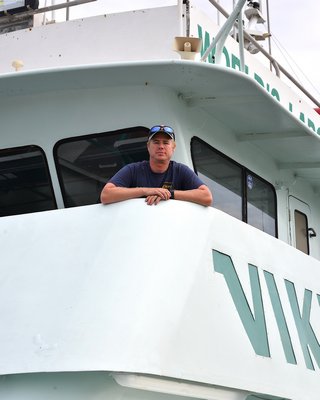
Carl Forsberg aboard the Viking Starship.
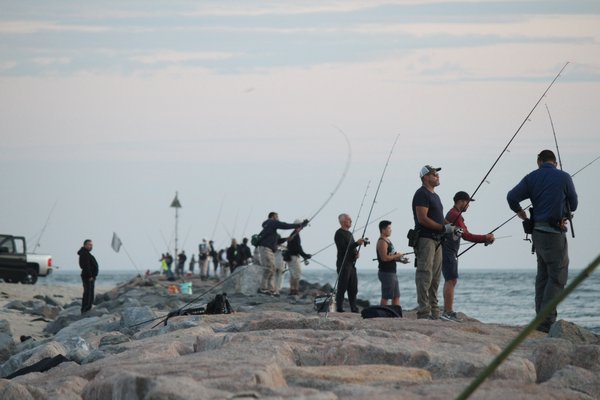
Striped bass fishermen are debating how best to reduce the number of fish they kill each year to help the species rebuild.
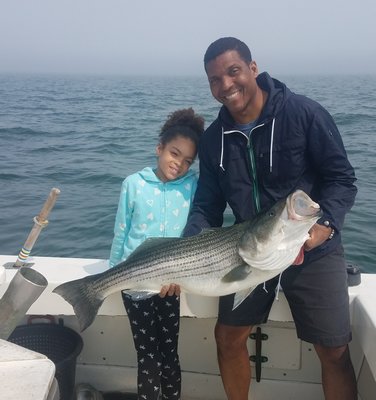
Striped bass fishermen are debating how best to reduce the number of fish they kill each year to help the species rebuild.
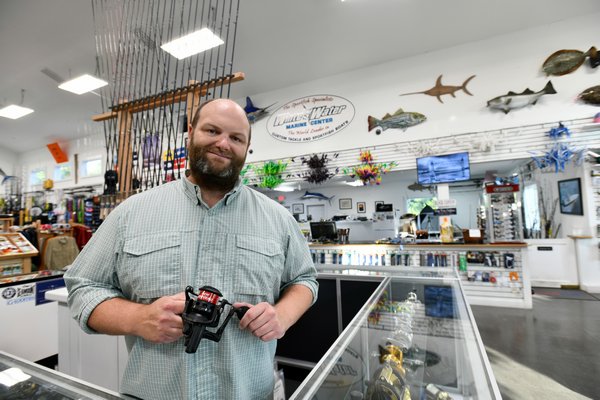
Bryce Poyer, co-owner of White Water Outfitters, in his shop in Hampton Bays. DANA SHAW
A roiling debate over how to reduce the annual harvest of striped bass along the Atlantic seaboard to allow the species to recover from years of overfishing has pitted the interests of various fishermen against each other and sparked heated exchanges in online venues and, last week, in a public hearing with federal fisheries managers.
Hundreds packed into a meeting room at Bethpage State Park last week to offer their views on a battery of options that marine biologists have laid out that they say would each reduce the number of dead striped bass — one of the nation's most economically important fish stocks — by up to 18 percent per year, and hopefully help the stock recover to what scientists say are necessary levels by 2023.
The battle over how to proceed has focused primarily on what restrictions should be placed on recreational fishermen, who account for about 90 percent of the striped bass harvest, though the extent to which commercial fishermen should share in the cuts is also on the table.
There are a number of considerations to be weighed, including size restrictions that would push the minimum length of a "keeper" striped bass up from the current 28 inches to as much as 35 or 36 inches; or creating a size range, or "slot," that would be harvestable, with anything under and over a certain size having to be released.
Secondary options for further reductions are also being proposed: shorter seasons and new restrictions on tackle, like requiring the use of hooks that are less likely to mortally wound fish destined to be thrown back.
As it often has in the past, the weighing of the benefits and costs of each option has carved a divide between certain groups of fishermen.
Among those who fish primarily for fun, to put an occasional meal on the table, or who are focused on the hunt for a trophy-sized fish, the preference has trended toward the most restrictive option — namely, a minimum size of 35 or 36 inches for all harvesting of striped bass.
"There is a precedent there, the only precedent we have with striped bass stock recovery — we had the one fish at 36 inches in the early 1990s when the biomass was very low and they came back," said Craig Cantelmo, the chairman of the marine resources committee for the Montauk Surfcasters Association. "An abundant fishery is mandatory for someone to feel like they have a reasonable expectation of going to catch a fish. We don't have that now and we're seeing it in participation rates going down and tackle shops suffering."
Bryce Poyer, co-owner of White Water Outfitters, a tackle shop in Hampton Bays, said he would rather see a slot limit that allowed a smaller fish to be kept while still reducing the overall number of fish harvested.
"To me, a 28 to 35 [inch] slot is sufficient to give my local customers a chance at a keeper that's worth pursuing and still get to cull out a fish when there's only bigger fish around in Montauk," he said. "Other small measures I think just make sense too, requiring circle hooks, doing away with the crew allocation on charters, making sure people know that striped bass can't be gaffed. Things like that will make a small difference here and there but add up in the end."
Others see a both a need and a biological benefit to the option of keeping the minimum size lower. The captains of for-hire boats, like Montauk's large fleet of charter and party boats, have mostly advocated for the lower size limit, saying that a higher minimum would threaten their business by making it more difficult for their customers to catch their limit of take-home fish.
"We understand a reduction is needed, but we're not a fan of any of the options," said Captain Carl Forsberg of Montauk's renowned Viking Fleet. "I would rather see one fish at 30 inches and maybe a shorter season to reduce the number of dead discards which is just fish being counted against us anyway that don't get to go home to feed a family.
"A 35-inch minimum would do a lot of damage to this industry," he added. "It would probably hurt us in Montauk the least, actually, because we catch bigger fish, but the rest of the island would really struggle. And if you have that 35, you are going to have a lot more dead discards."
The issue of "dead discards" — fish that are caught and then released but do not survive the hook wounds or exhaustion of the struggle — has proven to likely be the most vexing problem of the many that were spotlighted by a benchmark assessment of the striped bass stock in 2018. These wasted fish make up about 10 percent of fish caught and released by recreational anglers, according to scientific estimates, but nearly half the total number of bass that die each year — some 3.4 million fish in 2018.
Professional captains note that their fishing approach focuses on putting fish on ice and that once a limit is reached they will typically move on to target other species. The higher the size limit, the more fish they will have to catch and release, with some destined to die anyway, before they stop targeting them, captains said. A larger minimum size will mean more fish caught before a limit is filled, and more wasted dead discards.
"I will kill thousands of more striped bass with a larger size limit," said Captain James Schneider, who runs a party boat out of Huntington Harbor. "The 28-inch limit allows me to keep the fish that are gut hooked or in trouble, and when I'm done, I stop fishing and go for something else. I don't sit there and abuse the resource."
Capt. Forsberg suggests that the relatively small charter and party boat fleet could be put into its own category, with the smaller size limit that would speed the filling of limits and reduce dead discards, while other fishermen could be limited to only keeping larger fish and throwing more back.
Captain Michael Potts, a Montauk charter boat captain, said he thinks the slot limit approach should be reversed: allowing fishermen to keep a small fish, or a very large fish, but making them release fish in the mid range of sizes because those strong fish are the force of the breeding stock. Whether younger fish or very large older fish are more fecund is a long-running debate in fisheries circles, but Capt. Potts anthropomorphizes the matter:
"Take a human, a 25-year-old woman or a 55-year-old woman, which one is going to be able to have more healthy babies?" he said. "I don't think it's the biggest fish, it's the teenagers, and we should be protecting the maximum breeders. Let the scientists figure out which ones are the most effective breeding sizes and protect them."
Across the board, fishermen seem to be in favor of mandating the use of "circle hooks" — a type of dramatically curved hook that tends to catch fish in the lip, rather than deeper in the mouth or gullet — for fishermen using bait to catch striped bass. Even a shortened season was something few fishermen seemed opposed to — although striped bass are often not yet in residence on the East End when the season currently opens on April 15, like they are in New Jersey.
Mr. Poyer said he hopes that whatever the choices made in the regulatory push-and-pull are, the debate and the sting of the coming reductions will change the all-too-human habits of binge and purge when it comes to utilizing a natural resource.
"From a tackle shop owner's standpoint, what drives me most crazy is this roller-coaster of attitudes that we go through," he said. "It's 'kill 'em all' and then we kill too many and it's 'save them all' and then they come back and it's 'kill 'em all' again. We need to change the culture of the fishing community and smooth out this rocky road and we'll all be a lot happier in the long run."


 Michael Wright on Sep 9, 2019