


 2 Photos
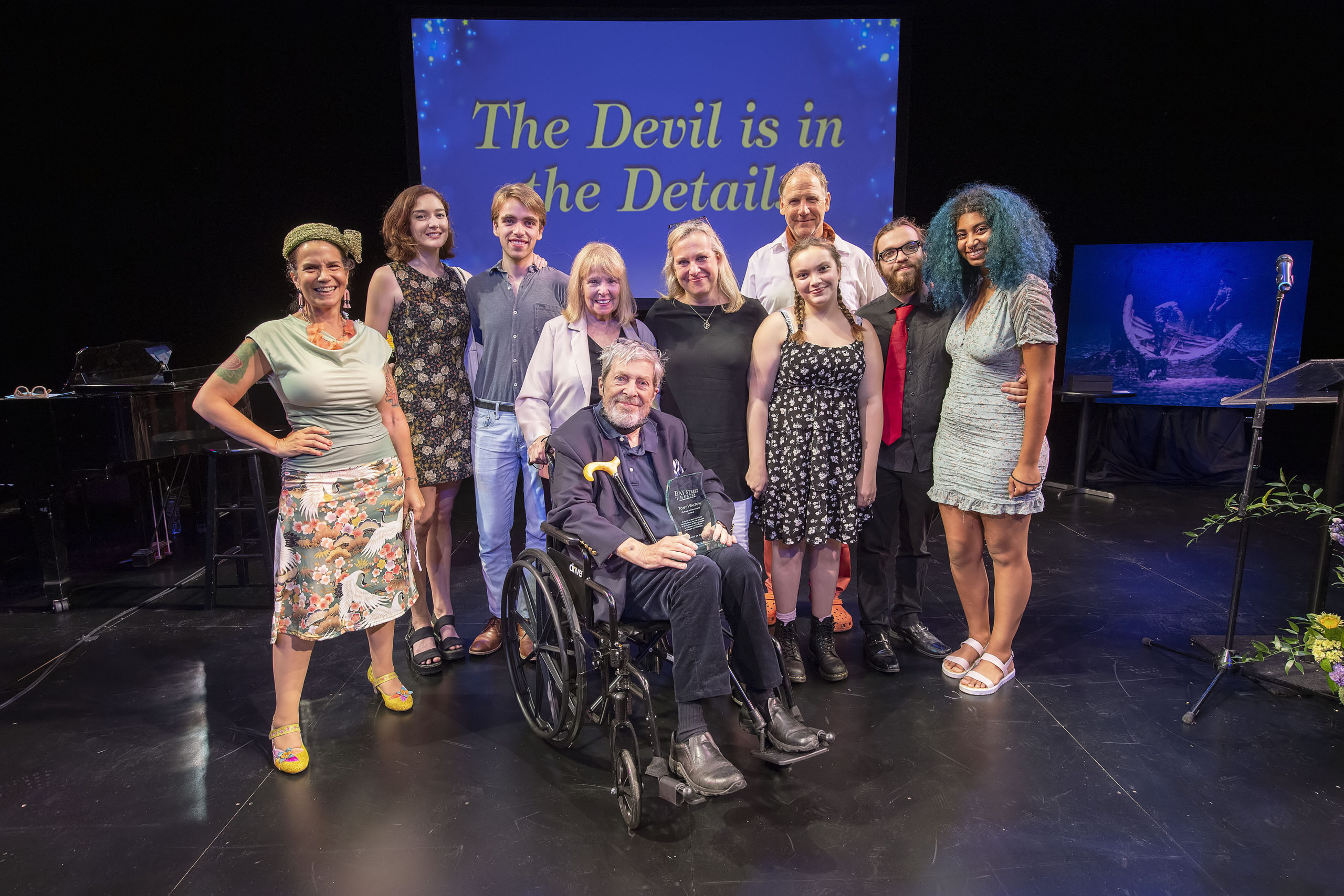
Tony Walton and his family on August 26, 2021, during the Bay Street Theater event to celebrate his life and work. MICHAEL HELLER

Tony Walton. COURTESY EMMA WALTON-HAMILTON
Tony Walton, the legendary British-born production designer, theater director and longtime East End resident, has died. He was 87.
According to his stepdaughter, Bridget LeRoy, Walton died on the evening of Wednesday, March 2, at the New York City apartment that he shared with his wife, Genevieve LeRoy-Walton. Also with him at the couple’s Upper West Side home at the time of his death were daughter Emma Walton Hamilton and LeRoy.
According to Walton Hamilton, Walton’s daughter with his first wife, Julie Andrews, the cause of death was complications of a stroke.
Born in Walton-on-Thames in Surrey, England, on October 24, 1934, Walton studied art and design at the Slade School of Fine Art in London. He went on to build a legendary career as an Oscar, Tony, and Emmy award-winning production and costume designer for stage and screen.
On Broadway, he garnered 16 Tony Award nominations for his sets and costumes, with wins coming for his scenic designs for “Pippin” (1973), “The House of Blue Leaves” (1986) and “Guys and Dolls” (1992). For 10 years, he was also the production designer for Madison Square Garden’s annual version of Charles Dickens’s “A Christmas Carol.”
Walton also worked on 20 films during his career, with directors including Mike Nichols, Paul Newman, Bob Fosse, Sidney Lumet, Ken Russell, François Truffaut and others.
Among his many film and television accolades was an Academy Award win for his art direction and set work on the 1979 film “All That Jazz,” directed by Fosse. Walton also received Oscar nods in costume design for his work on the 1964 film “Mary Poppins,” starring Julie Andrews, followed by a 1974 nomination for “Murder on the Orient Express,” and, in 1978, a nomination for his work on “The Wiz.”
Walton also won an Emmy Award for his production design of the 1986 television version of Arthur Miller’s play “Death of a Salesman.”
Though he was a world-renowned theater and film designer with numerous accolades under his belt, for many years Walton and LeRoy-Walton had a home in Sag Harbor — and local theaters were the frequent beneficiaries of his many talents.
“They had a home on Madison Street for over 30 years, from the mid-’70s to roughly 2007,” Walton Hamilton said of her father and stepmother. “They adored Sag Harbor, and he designed a number of his shows and films in his studio at the house in Sag. Among his favorite activities were dining at The American Hotel, shopping at Sagalund, Kramoris Gallery, Sylvester’s, Sage Street Antiques and the Sag Harbor Variety Store; directing and attending productions at Bay Street and Guild Hall; and entertaining at their beautiful home, which was one of the oldest in Sag Harbor.”
Among the shows Walton designed for Sag Harbor’s Bay Street Theater, which was co-founded by his daughter, son-in-law Stephen Hamilton and the late Sybil Christopher, was “Men’s Lives.” With a script by the late Joe Pintauro, the play told the story of the East End’s baymen and was based on Peter Matthiessen’s book of the same name.
It was the first play produced on the Bay Street Theater stage when it opened in 1992, and Walton’s set featured the hull of a dory which he had found on a local beach.
Other Bay Street Theater productions featuring Walton’s costumes or sets included “The Boy Friend” (directed by Julie Andrews), “Blithe Spirit,” “House,” “Nobody Don’t Like Yogi,” “Noel and Gertie,” “Make Someone Happy” and “Inspecting Carol.” Just last August, Bay Street Theater presented a tribute to Walton hosted by Tony Award-nominee Melissa Errico with appearances by several of Walton’s collaborators, including Tovah Feldshuh, Alec Baldwin and others.
“While I was not yet at Bay Street when Tony worked here, he was and will always be an essential part of the soul of our theater,” said Scott Schwartz, Bay Street Theater’s artistic director and the son of Stephen Schwartz, who wrote the music and lyrics for “Pippin.” “From its founding, Tony made major contributions — from being a part of the actual creation and construction of our theater space itself to designing and directing many shows for us, including doing the brilliant set design for Bay Street’s inaugural production of ‘Men’s Lives.’ He will be deeply missed, and all of us at Bay Street are so grateful he was a part of our lives.”
“This last summer, we were lucky enough to be able to honor Tony for his lifetime of achievements in the theater,” added Bay Street’s executive director, Tracy Mitchell. “It was such a pleasure and an honor to have him again at Bay Street and to celebrate him with his friends, family and fans.”
For the stage of Guild Hall’s John Drew Theater, Walton directed two plays by Peter Shaffer — “Equus” and “The Gift of the Gorgon,” both starring Alec Baldwin. In 2005, he directed Orson Welles’s “Moby Dick Rehearsed,” starring Peter Boyle, and, in 2013, Noel Coward’s “Tonight at 8:30,” with Blythe Danner.
“Knowing and working with Tony was like disappearing down a rabbit hole into a bliss-filled world of Faberge egg magic,” said Kate Mueth, who worked closely with Walton on several Guild Hall productions. “Knowing the history of his work and all the glorious projects that had been touched by his stunning artistry was truly breathtaking and an era of irretrievable connection.
“To work with him and his incredible way of seeing things — to call he and Gen family friends, was such an honor,” she added. “We have lost a giant of an artistic era quickly slipping from our collective memory.”
Locally, this past December, a collection of Walton’s artwork went on view in a retrospective exhibition at the Mark Borghi gallery in Sag Harbor. The show, which ran through February 3, featured imagery of more than 100 of Walton’s stage and costume designs.
It was a fitting tribute to the designer, given his close association with Sag Harbor. Over the years, Walton frequented many village businesses and locations in search of inspiration for his theatrical designs or as research for the “Dumpy the Dump Truck” series of children’s books, which were written by Andrews and Walton Hamilton and featured his colorfully whimsical illustrations.
Walton was also a fan of the Sag Harbor Cinema, and in an interview a few months after the 2016 fire that destroyed a portion of the theater, he admitted that the art deco letters spelling out “Sag Harbor” on the building’s façade served as inspiration for one of his set designs.
“I was inspired by the Sag Harbor movie theater neon sign when I designed the title logo for the original stage version of Bob Fosse’s ‘Chicago’ — which has been duplicated erratically for many productions of the show since then and even somewhat ‘referenced’ for the Rob Marshall movie version, which I did not design … though I would love to have done so,” wrote Walton in a 2017 email. “The letters ‘G,’ ‘H,’ ‘A’ and ‘O’ somewhat inter-relate between the Sag Harbor Cinema sign and my ‘Chicago’ logo. We had a neon sign that we made to hang overhead during some parts of the show.”
The cinema wasn’t the only source of inspiration for Walton. One of the shops he frequented in search of source material was Romany Kramoris Gallery on Sag Harbor’s Main Street. Over the years, he and LeRoy-Walton became close to the eclectic store’s proprietor, Romany Kramoris.
“Of the many times Tony walked into the gallery with Gen, on this particular day he was alone. This means it’s serious searching,” Kramoris recalled in an email. “He began his usual sifting through the art and design books in stacks and began pulling them out one by one, taking his time to study each. Then, looking at me, he said, ‘I’m working on a project. I don’t suppose you have something on the architecture of the wooden houses of old Russia?’ I walked over to the book table, shuffled through a few books, Russophile that I am, pulled out a tome, ‘Old Russian Wood Villages.’ We looked at each other both astonished and beaming.
“Months later, my friends and I planned an evening on Broadway where we saw a production of ‘Dyadya Vanya’ — ‘Uncle Vanya,’ with Tony’s beautiful sets accurately depicting the old Russian wooden architecture,” she noted. “What joy and satisfaction!
“Da svidan’ya, ya lyublyu tebya, Tony,” added Kramoris, writing the Russian words for “Goodbye, I love you, Tony.”
In addition to his wife and daughters, Walton is survived by five grandchildren.
A private service was held in Sag Harbor followed by interment at Oakland Cemetery. A public celebration will be held at a later date.
In lieu of flowers, donations in Tony Walton’s name can be made to Bay Street Theater, Guild Hall or the Actors Fund.


 Annette Hinkle on Mar 6, 2022