


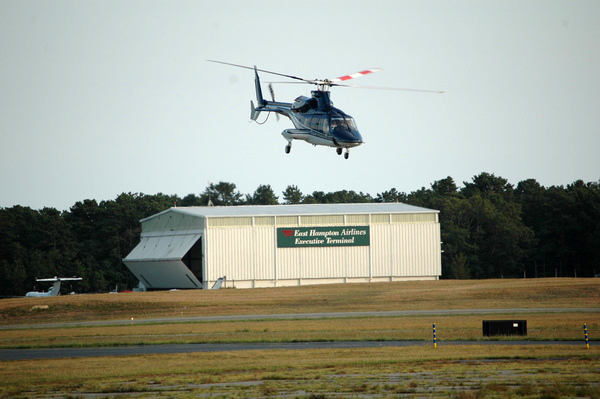
 1 Photo
It’s one of those uniquely “East End” quandaries: helicopters ferrying some of the world’s richest people from Manhattan to their weekend homes are driving some residents loopy with their frequent summer flights.
But, after years of impasse, a breakthrough of sorts could be on the horizon. East Hampton Town Councilman Dominick Stanzione reported this week that talks with the Federal Aviation Administration have yielded a credible—but far from certain—solution.
FAA officials told representatives of the five East End towns this summer that altering the rules for the airspace over Manhattan could force a larger number of helicopters from the predominant route over the north shore of Long Island, according to Mr. Stanzione, and herd the aircraft onto an alternate path along the south shore, which would take them over fewer homes.
The FAA did not return a call on Monday seeking to confirm the proposal.
Mr. Stanzione said he and FAA officials have been looking for an “administrative” fix to the helicopter problem since legislation that would have given the FAA explicit authority to regulate helicopter traffic failed recently. FAA officials came back to East End representatives in June with their proposal, Mr. Stanzione said.
“There is currently, now, an envelope, an altitude envelope within the New York City airspace that helicopters can fly under,” he said. “Helicopter operators are using that envelope to pass through Wall Street and Midtown to fly to the northern route, over Whitestone Bridge, over the northern part of Long Island. The FAA is reviewing options to severely restrict this envelope, which, if implemented, would force aircraft to a southern route.”
The northerly route takes helicopters along the north shore of Long Island until they reach the North Fork, at which point they cut south toward either Gabreski Airport in Westhampon, the Southampton Village helipad or East Hampton Airport. Helicopters headed toward East Hampton roughly follow Northwest Creek, often passing over Sag Harbor and Noyac. A southerly route, which is longer, would take the aircraft along the south shore until they reached the South Fork. Those headed to East Hampton would fly over Georgica Pond.
The plan could result in the southerly route absorbing more than half of the helicopter traffic, according to Mr. Stanzione. The northerly route, he said, currently takes almost all of it.
Rather than relying on a legislative solution from Congress, he said, “We wanted to use existing authority of the FAA, which includes controlling airspace in New York City.”
The proposal came out of meetings between FAA officials and a Multi-Town Helicopter Noise Advisory Committee, which convened in February with representatives from the East End towns.
But rerouting the helicopters might not be enough to quell a growing insurgency of residents living under the busiest flight paths, some of whom have begged the Town Board to take action while others want East Hampton Airport shut down entirely. This week, some said they are forming a civic group called Citizens Alliance To Cancel Helicopters.
Barry Raebeck, a Wainscott resident who is a founding member of the group, described helicopter noise as a blight to both property values and mental well-being.
“While only dozens benefit, thousands of innocent and unwilling people are having their peaceful summer and weekend days ruined by this ongoing aerial assault,” he wrote in an email. In a letter to the Town Board, Mr. Raebeck said he counted 52 helicopter passes over his property during a three-hour period last weekend.
Mr. Stanzione said almost all pilots comply with voluntary agreements with local officials on when they can land helicopters at East Hampton Airport and how low they can fly over town. But, he said he is considering hiking penalties for those few “bad apples” who do not. He explained that the town has little authority to regulate air traffic, limiting its power to handshake agreements with pilots and the collection of fees for use of the airport.
At the moment, pilots who land between 11 p.m. and 7 a.m. have an additional 25 percent tacked onto their approximately $100-landing fees, but he said it could become much steeper. He also said he is considering having their names published in local newspapers.
Faced with burgeoning anger from their constituents, members of the Town Board pressured Mr. Stanzione during a work session on Tuesday to come up with new enforcement measures by the next meeting. Councilwoman Theresa Quigley floated the prospect of surcharges as high as $25,000 for helicopter owners who defy curfews and altitude restrictions.
Pilots have agreed to fly at altitudes higher than 2,500 feet, Mr. Stanzione said, but he added that they have no choice but to fly closer to the ground when there is cloud cover—which, not incidentally, is when noise complaints tend to spike.


