


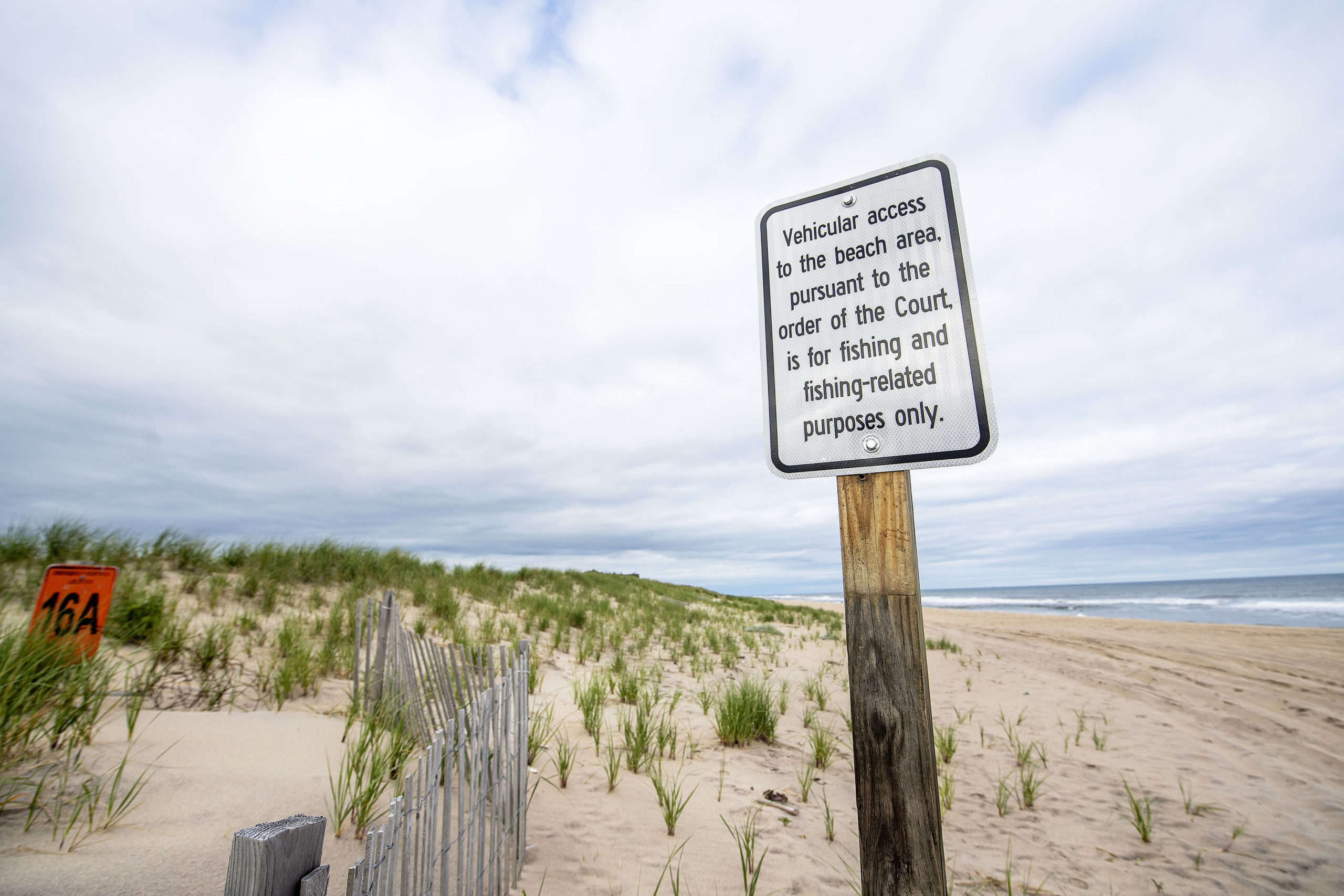
 1 Photo
East Hampton Town has posted signs at "Truck Beach" in Amagansett saying that the beach is only accessible by four-wheel-drive vehicles for fishing. But the homeowners who won a lawsuit against the town claiming the beach is private say that all vehicles should be banned for all purposes.
East Hampton Town posted advisory signs over the holiday weekend at the stretch of Amagansett beach commonly known as “Truck Beach” saying that, due to a February court ruling declaring the beach privately owned, vehicles may only access it for “fishing and fishing related purposes.”
But the homeowners who live just beyond the dunes and mounted a 12-year legal fight challenging the use of the beach by vehicles may not find the town’s admonishment — there is no reference to any statute or enforcement authority on the signs — a sufficient deterrent to comply with what the court ordered in February.
The town is appealing the ruling and has asked for a stay of the court order until the appeal process is completed, but the state courts have thus far not obliged and town officials say the signs are a fair interpretation of the limitations imposed by the court.
“We’re asking people to abide by what the court said for the time being,” East Hampton Town Supervisor Peter Van Scoyoc said. “The exclusion by the court was for fishing related activities, so that’s what we posted.”
The February ruling by a five-judge panel of the New York State Supreme Court’s Appellate Division, found that an approximately 4,000 foot stretch of beach between Napeague Lane and the western boundary of Napeague State Park, was included in the 1882 sale of the upland areas by the East Hampton Town Trustees to real estate developer Arthur Benson and is privately owned, collectively, by the homeowners who now live in the neighborhoods across the dunes.
The ruling said that members of the public should retain the right to access the beach for “fishing and fishing-related purposes” only, as described in a clause of the original 1882 deed that reserves for town residents the right to “land fish boats and netts [sic] to spread the netts on the adjacent sands and care for the fish and material as has been customary heretofore on the South Shore.”
There were, of course, no motor vehicles in 1882.
“I don’t really understand what they are doing — they are under a mandatory injunction to not allow anyone to park or operate a vehicle on the beach,” Ken Silverman, one of the homeowners in the Beachampton neighborhood that brought the lawsuit, said of the town’s obligation to enforce the restriction of vehicles this week. “The court has ruled it is private property. The people who, as of now, are entitled to it do not allow people to use vehicles on the beach, so I don’t know how the town thinks it can allow vehicles in any circumstance. [The court ruling] says some fishing related activities are allowed, but it doesn’t have anything to do with vehicles.”
The stretch of beach has long been one of only a smattering of areas where the town has allowed 4x4 vehicles to access the beach during the day in summertime since a broad prohibition of it was imposed in the 1980s. Most other town beaches are closed to vehicles between 9 a.m. and 6 p.m. from mid-May until mid-September. East Hampton Town and the East Hampton Town Trustees, who own most of the ocean beaches, issue 4x4 permits to residents that allow the driving of vehicles on the sand when allowed.
The inclement weather over the Memorial Day weekend meant the power of the court order, and how violations might be addressed, was not tested. When the sun shines and the temperatures rise, those who have flocked to the beach in their 4x4s in increasingly large numbers over the last 20 years as the prevalence of SUVs exploded, may have to disperse to the other, smaller stretches of town beach that allow 4x4 access in summer or to the adjacent New York State park beaches, which require the purchase of a special permit but allow vehicle access at all times.
Mr. Van Scoyoc said he was unclear as to who would have the standing as the property owner to make a legal complaint against any vehicles using Truck Beach despite the town’s admonishment.
The homeowners have mounted video cameras in the dunes along the beachfront — concealed in fake birdhouses — to record activity on the beachfront. Footage of the beach during busy summer weekends in 2015 — including images that showed hundreds of vehicles, people urinating in the sand and children playing near the tire ruts in the beach that serve as vehicle travel lanes —was a key component of the case the homeowners mounted against the beachgoers.
When the homeowners’ lawsuit was wending its way through the state civil court system, the town began preparing the legal framework for seizing ownership of the beach through eminent domain should it lose the case in court.
The effort was shelved after the initial ruling in the town’s favor, but Mr. Van Scoyoc has said he is willing to revive it should the appeals process not prove fruitful. But he said it would be a step of last resort only.
Mr. Silverman said that he was encouraged by the fact the court declined recently to issue a stay of the order while the appeal is considered, saying that typically such an injunction request is granted if the appeal is seen as having a reasonable chance at success.
The enforcement of the ban on vehicles, he said, will be watched closely by the homeowners as summer progresses.
“I think it’s logical that as a country of laws that the ruling is going to be followed,” he said. “It says if you bring your fishing pole down and you fish, that’s fine, but not with a vehicle.”


 Michael Wright on Jun 1, 2021