



 2 Photos
East Hampton Town Trustee Bill Taylor speaking at Sunday's gathering of members of the Town Trustees and commercial fishermen who are spearheading a class action lawsuit claiming that an easement over a privately-owned Amagansett beach cannot exclude them from using 4x4 vehicles to access the property.
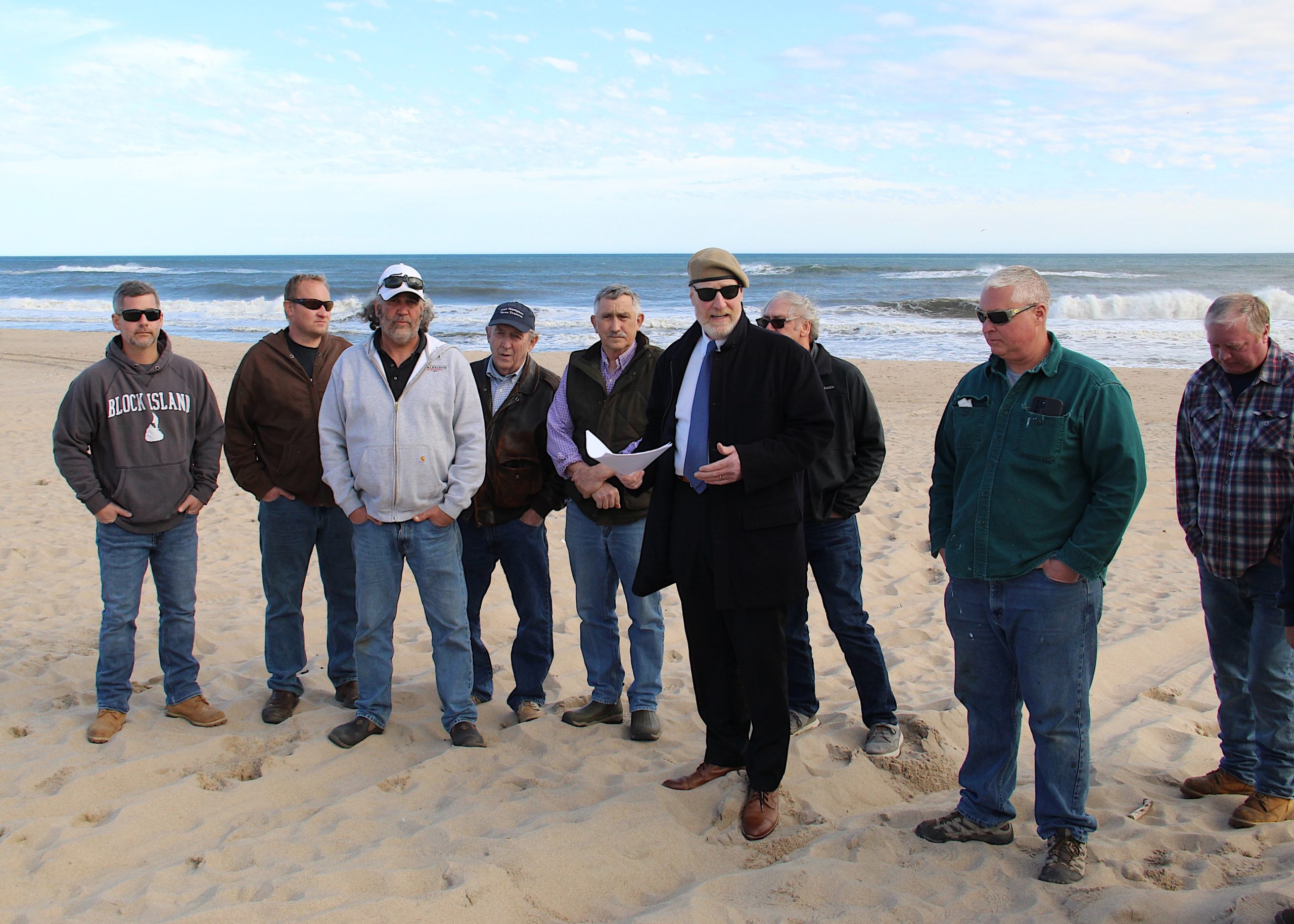
Southampton attorney Dan Rodgers, in beret, is representing commercial fishermen who are party to a lawsuit filed this week by the East Hampton Town Trustees claiming that an easement over a privately-owned Amagansett beach cannot exclude fishermen using 4x4 vehicles to access the property.
The East Hampton Town Trustees and a group of commercial and recreational fishermen last week filed a class action lawsuit against a group of Amagansett homeowners, seeking to compel a court to order that fishermen in 4x4 vehicles must still be allowed on a privately owned stretch of ocean beach.
The new claim focuses on the wording of a “reservation” in the 1882 deed for the property east of Napeague Lane, now a cluster of over 100 homes, and the 4,000 feet of ocean beaches that front it.
The reservation — what would typically be called an easement now — allowed that when the property, including the beach, was sold by the East Hampton Town Trustees to real estate speculator Arthur Benson, fishermen would continue to be allowed to use the beaches to harvest fish.
What that allowance means in the modern world, however, is seen a variety of ways, each with differing implications for the future use, or access to, that stretch of beach.
Since the late 1980s, until last summer, the beach was presumed to be as if it were owned by the Town Trustees, and, as it what was then a remote stretch of beach with scant residential development near it, it was one of the few spots where 4x4 vehicles were allowed to drive onto the ocean beach and park during the day in summertime.
But with the rise of the family SUV, the beach had become a destination for hundreds of vehicles on sunny summer weekends and earned the colloquial moniker “Truck Beach.”
As the neighborhoods on the other side of the dunes grew, the homeowners found themselves put off, or pushed out, by the lineup of trucks and picnic tables that set up along the oceanfront on summer weekends. They sued in 2009, claiming, among other things, that the beach was part of the original 1882 deed and was privately owned.
In February 2021, after a roller-coaster decade of legal jousting, a state appeals court ruled that the deeds for the 1882 sale to Benson included ownership of the beaches themselves.
But the court left the 139-year-old reservation intact. It said the town no longer had the authority to issue permits for the 4x4 vehicles to use the beach — but said little else.
When the homeowners accused the town of ignoring the court order by only posting signs and not pro-actively blocking vehicles from entering the beach, the court ordered that no vehicles were to be allowed onto the beach. The town has filed a counter-suit that, along with the contempt claims by the homeowners, is still pending.
The two sides read the reservation, perhaps unsurprisingly, in vastly different ways.
“The appellate division decision … said that what is left is the public’s rights under the reservation as set forth in the clear wording of the reservation: landing fish boats and spreading nets,” says Steve Angel, one of the attorneys who has handled the case on behalf of the homeowners. “But that’s all. You can land fish boats and you can spread nets. That is the public right that remains. I don’t think they have any room to argue the case beyond that.”
The veteran attorney notes that judges of the same Brooklyn-based panel of judges have ruled in the past that the wording of centuries-old contracts and colonial patents that still dictate much on the East End apply only in the strictest plain language reading, regardless of age and how the world around them has changed since.
But town officials and advocates for fishermen read the decision by the panel of four appellate judges from the State Supreme Court Appellate Division, 2nd Department, in much broader terms. They have argued that the words in the reservation refer to an activity in general: the use of the ocean beaches as the launching point for fishermen. Fishermen used to use horse-drawn wagons to pull their boats and now use 4x4 trucks, and there should be little difference in a legal sense, they say.
The relevant passage of the actual 1882 reservation says that it grants: “… to the inhabitants of the Town of East Hampton, the right to land fishboats and netts [sic] to spread the netts [sic] to the adjacent sands and care for the fish and material as has been customary heretofore on the South Shore of the Town lying westerly of these conveyed premises.”
The Trustees argue that the activity that is referenced in that 1882 reservation must have the reasonable legal flexibility to evolve, as the activity did to mean that today’s fishermen, in 4x4 vehicles, should be afforded the same allowances as their horse-drawn predecessors.
“For hundreds of years, members of the fishing community … have used their trucks—and their predecessors, on wheeled conveyances or vehicles— to transport their boats and fishing equipment to the water’s edge,” the lawsuit filed on Thursday reads.
The fact that the appellate court judges left the reservation in place — expressly rejecting a request by the homeowners to have it expunged — and referred to its allowances in their own words as “fishing and fishing-related activities, as contemplated in the plain wording of the reservation” would seem to dictate that there is still plenty of legal room for access to the beach, as the Trustees read it.
“The reservation is intact — they tried to get it taken out but the court refused to do that — so it is intact and it can’t mean you can only land boats, like they claim, because how did the boats get there?” Trustee Bill Taylor said in support of the class action lawsuit the board filed last Thursday in conjunction with a collection of commercial and recreational fishermen who use the beach regularly in their pursuit of striped bass and bluefish. “They used wagons, they brought tons of fish ashore, you could not operate without a conveyance. An F-150 is just a mechanical improvement the same as the Supreme Court said that modern firearms are the same as muskets under the Second Amendment.”
In the class action suit, the attorneys for the Trustees and the fishermen claim that recreational fishermen and commercial fishermen alike are being denied their right to access the beach with vehicles.
The principal common question of law for the class plaintiffs is whether their right to use the beach for fishing and fishing-related purposes includes the right to access the Atlantic Ocean by vehicle.
The homeowners, for their part, have said that beyond the crowds of recreational vehicles lined up door to door on summer weekend days, their concern over the use of the beach by vehicles is faint.
Commercial fishermen who fish in the old style, in particular, are of almost no concern since there is only one crew who still fishes with a surf dory and nets and does so only in October and November.
But from a legal standpoint, they have been vary wary of the concept of “fishing” being co-opted by those who would like to bring their vehicle to the shore for sunbathing and picnicking under the guise of going fishing because they had a fishing pole with them.
In addition to the arguments about the reservation, the latest lawsuit asserts that since the public had been using the beach since 1882, including in a variety of ways employing 4x4 vehicles, the homeowners should not be able to suddenly bar them under the legal doctrine of adverse possession — something the attorneys for the town had not argued in their defense of the original suit.
Angel said that regardless of the justifications of the activities at hand, he believes the court will reject the Trustees’ and fishermen’s case, along with the town’s countersuit, as being little more than an attempt to re-argue a case that has already been decided and lost.
“This is an attempt at, now, a third bite at the apple,” he said. “When I was doing the motion to dismiss the town’s case, their attorney said the appellate division never made a determination of the extent of the reservation, implying it wasn’t part of the case up to now. But … it was a central part of their case. It was argued from day one.”


 Michael Wright on Mar 23, 2022