



 2 Photos

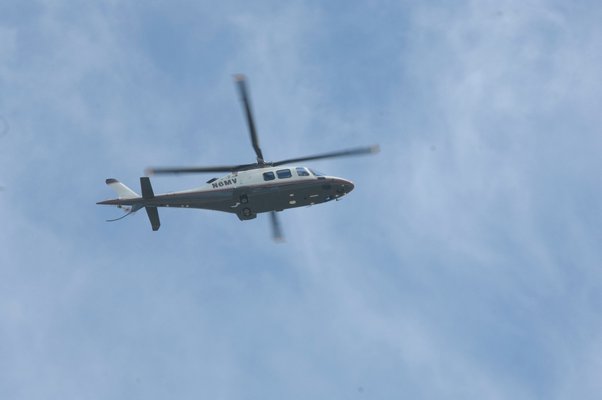
The confusion over the Federal Aviation Administration's (FAA) new rule, which creates a category of Stage 3 helicopters, can hopefully be put to rest, thanks to David Schaffer, the legal council for the East Hampton Aviation Association.
According to Mr. Schaffer, the new rule only creates the category of Stage 3 helicopters--it does not explicitly require regulations on the helicopters to be approved by the FAA.
All the rule does is create this category," Mr. Schaffer said in a phone interview on Tuesday morning. "But when it's read in conjunction with the existing law, you need FAA approval."
Furthermore, the necessity of FAA approval for Stage 3 regulations is applicable to grant-obligated as well as non-grant-obligated airports, said Mr. Schaffer.
"All of this concern about being grant-obligated or not is largely besides the point," he said
To regulate Stage 1 and Stage 2 aircrafts, grant-obligated airports must prove that the restrictions are not "unreasonable, arbitrary, or discriminatory," he said, but ultimately it is up to the FAA to determine if the restrictions fit that bill.
"There isn’t an application process per se," he said, "but as a practical matter if an airport has promised not to discriminate, it can’t discriminate."
Whether an airport is grant-obligated or not is essentially irrelevant to whether or not the restrictions will be successfully implemented, he added.
"If the town imposes restrictions on helicopters and the FAA rules in their favor, the helicopter companies will most likely take them to court. If the FAA doesn't agree with the town, the town will take the FAA to court," said Mr. Schaffer. "Either way, you end up in front of the same court, which generally ultimately makes the decision."
The Federal Aviation Administration enacted a rule earlier this week that creates a new class of helicopter that only can be regulated in grant-obligated airports, such as East Hampton Airport, with FAA approval, according to a release issued by East Hampton Town Councilwoman Kathee Burke-Gonzalez, liaison to the East Hampton Airport Planning Committee—an “additional hurdle” for the airport, she said.
Stage 3 aircraft, according to the new designation, are those that have the “latest available noise reduction technology” in their design, according to the Federal Register’s website. Stage 1 aircraft are the oldest and loudest, while Stage 2 aircraft are about 10 decibels louder than comparably sized Stage 3 aircraft, according to Houston Airport System’s website.
As it stands, according to the town’s press release, East Hampton Airport can place restrictions on Stage 1 and 2 aircraft without the FAA’s approval.
But Quiet Skies Coalition Chairwoman Kathy Cunningham challenged the interpretation of the new rule. Ms. Cunningham said that under Part 161 of the FAA’s regulations, grant-obligated airports can only regulate Stage 1 and Stage 2 aircrafts with FAA approval—and she maintains that Stage 3 aircrafts cannot be regulated at all under this part of the FAA’s code. “You can’t regulate them, through any protocols, through the town while they are grant-obligated,” she said.
Ms. Burke-Gonzalez said she was unable to speak about the regulations as they stand or the new rule’s implication on East Hampton Airport. Likewise, FAA officials were unable to give any specifics on what can and cannot be regulated—although an official noted that by creating a designation for Stage 3 aircraft, some regulation was implied.
However, the FAA’s criteria for grant-obligated airports to regulate Stage 2 and Stage 3 aircrafts seems to be in line with the town’s press release, according to the administration’s website. It outlines “Notice Requirements for Stage 2 Regulations,” which includes guidelines for the notice of proposed restriction, required analysis of proposed restrictions and alternatives, comment by interested parties, among other instructions—but no approval process is noted, nor any suggestion that the FAA must sign off on the town’s regulation of those aircraft.
But for regulating Stage 3 aircrafts, the FAA’s website explicitly outlines “Notice, Review and Approval Requirements”—suggesting that FAA approval is necessary for the town to enact regulations.
The rule takes effect May 5, 2014, and the town’s status as a grant-obligated airport ends on December 31, 2014.
“The elevation of some helicopters to Stage 3 category reinforces the option for the town to allow grant assurances to expire and re-exert its rights as the owner and operator of the airport,” said Ms. Cunningham.
Because the airport is grant-obligated, they cannot deny the landing of any aircraft and must stay open 24 hours a day, 365 days a year, which creates constant noise, Ms. Cunningham said.
The Airport Planning Committee has formed two subcommittees to represent those concerned with noise and those involved in the aviation community, to examine the proposed technical noise analysis to consider all factors and make a fair decision as to how to address the problems.
In terms of renewing their status as grant-obligated, the airport is looking into ways to be self-sufficient and generate revenue, thus alleviating the need to “encumber another 20 years of literally anarchy,” said Frank Dalene, co-founder of the Quiet Skies Coalition.
The town is still unsure as to whether or not it will remain grant-obligated in 2015, according to the release.
"


 Erica Thompson on Mar 10, 2014