


 1 Photo
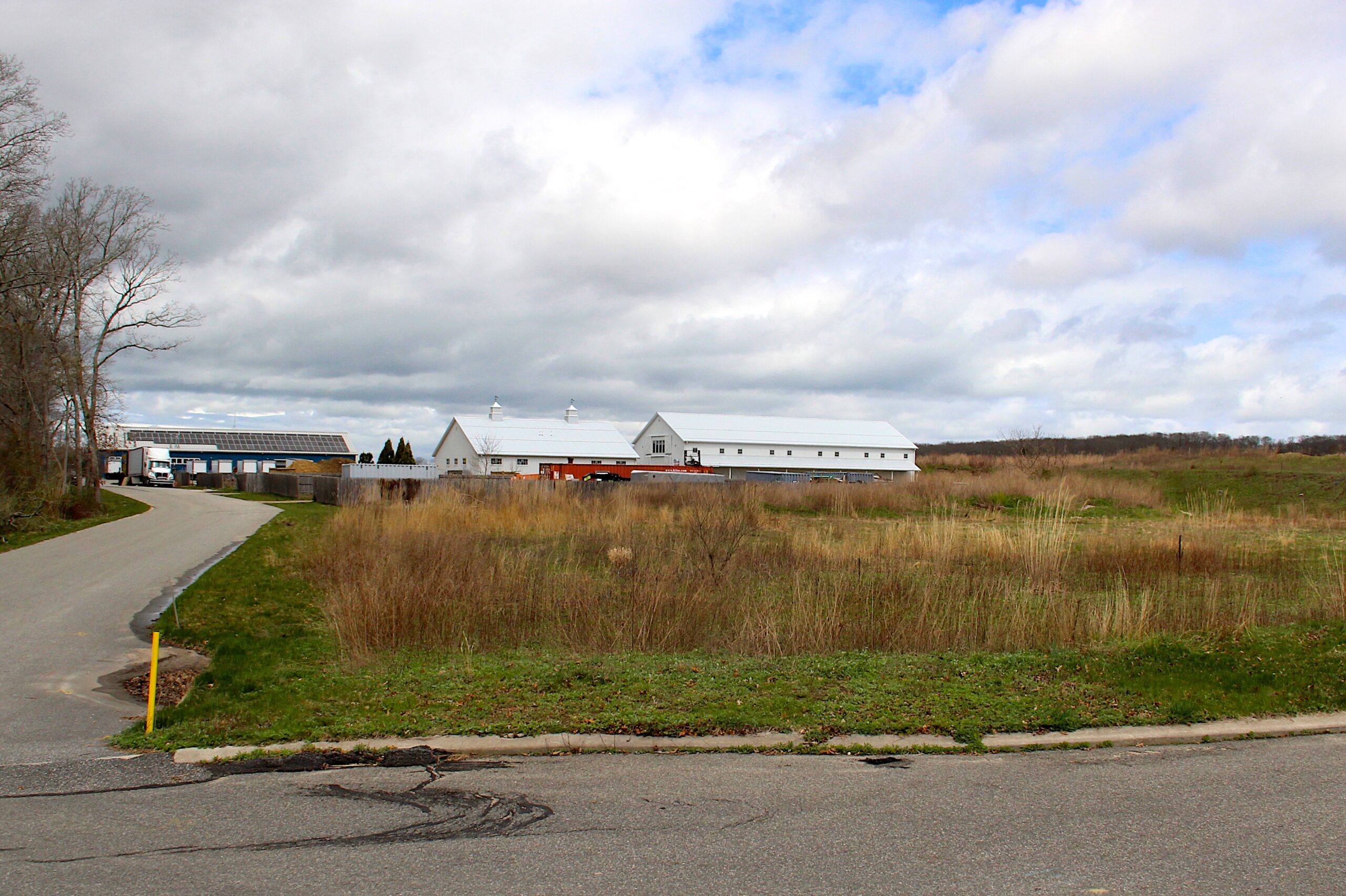
The developers of the South Fork Wind project have applied for permission to store soil and water removed from the trenches being dug beneath Wainscott roads at a vacant property on Tan Bark Trail behind the Bistrian sand pit.
South Fork Wind has applied to use a vacant industrial property between Three Mile Harbor Road and Springs-Fireplace Road as a temporary storage site for soil and water removed from the ground during the digging of trenches in Wainscott for the wind farm cable.
In its application to the New York State Public Service Commission, South Fork Wind’s developers say that they would use the property on Tan Bark Trail for stockpiling of soil and water removed from the ground during the trenching, which must be tested for contaminants and hauled away under the construction plans approved by East Hampton Town and the state PSC, as well as staging equipment and parking for employee vehicles.
A spokesperson said that the soil and water stockpiling is expected to be about 150 to 200 cubic yards of soil — about eight truckloads worth — at a time, and no more than two water storage tanks, each capable of holding 20,000 gallons of water. The water tanks will contain granulated carbon, commonly used to remove chemical contaminants from water.
In 2017, groundwater in Wainscott was found to be contaminated with chemicals known as PFAS, emanating from East Hampton Airport, but the company says it has not found any sign of contaminants in any of the soil or water removed during the trenching for the project thus far.
According to Suffolk County records, the 1.6-acre property at 40 Tan Bark Trail is owned by Snyder Commercial Holdings and is one of four commercial-industrial lots developed by the Snyder family, owners of Round Swamp Farm, who have their commercial bakery and food preparation facilities nearby. The properties are zoned for commercial-industrial uses.
Tan Bark Trail is a narrow roadway created specifically to access the interior lots wedged between the residences and farm fields owned by the Snyder and Lester family and the Bistrian Gravel Corporation sand mine.
A spokesperson for the project developers, Ørsted and Eversource, said that adding new storage or staging sites is a common necessity in large construction projects as conditions change. The company is currently using the LIPA substation in East Hampton as its staging and storage site, but will be displaced when construction of the new substation that will eventually take in the power from the wind farm begins there this summer.
“South Fork Wind is requesting approval from the New York Public Service Commission to utilize an additional temporary ‘laydown’ area for construction-site materials at 40 Tan Bark Trail, a privately-owned parcel in an area zoned for Commercial Industrial use. The crew will swap this Tan Bark Trail site with the current staging site, at the East Hampton substation, once construction moves to that facility,” the project spokeswoman, Meaghan Wims, said in a statement from the developers.
“Just as at the substation site, the Tan Bark Trail site will be utilized for PSC-approved laydown purposes, including storing soil and conducting the required treatment of all groundwater from the construction site. The treated water, in accordance with the project permits, will be taken to an out-of-Town disposal facility. South Fork Wind will not discharge any water into the estuary.”
The company statement came in response to an email circulated by Wainscott resident Simon Kinsella on Monday spotlighting the newly filed application on the project’s online permitting portal. Kinsella, who has been a vociferous opponent of the project and has filed two lawsuits seeking to halt it, called the plans for the property a “hazardous waste treatment site” and commented on the relative proximity of the property to the creeks that are the headwaters of Three Mile Harbor.
“The blandly worded plans read as though the 1.6-acre site will be ‘a laydown area’ for ‘worker meetings, parking, office trailers, receiving deliveries,’ but there are incongruous phrases such as ‘water treatment operations’ and water that ‘will be stored in treatment tanks utilizing granular activated carbon,’” Kinsella wrote. “Up to 1,000 residential homes are within 1 mile of the proposed hazardous waste treatment site (at 40 Tan Bark Trail) near Round Swamp Farm on Three Mile Harbor Road. South Fork Wind has not notified affected residents in proximity to the site, and the town has remained silent.”
Wims said that none of the claims by Kinsella was accurate. “To date, approximately 5,000 cubic yards [of soil] have been handled, and we encountered zero hazardous materials,” she wrote in an email on Tuesday, noting that the project trenching is already about halfway complete.
“During the temporary holding of water, a sample of the water from each tank will be tested according to the most recent version of NYSDEC’s Guidelines for Sampling and Analysis of 1,4-Dioxane and PFAS. All water [will] be treated with granular activated carbon … before the water is disposed of. Treated water will be transported by vacuum trucks to out-of-town disposal facilities, contingent upon preapproval from the disposal facility.”
Most of the materials, both soil and water, removed during the construction will be trucked directly to an approved storage site outside of East Hampton Town, but at times the sites may be unable to accept either soil or water and the project would use the Tan Bark Trail property as a temporary storage site.
The application says that up to 30 truckloads of material in a given day may be possible, or one about every 20 minutes throughout a workday.
The application to the PSC says that the soil stockpiles will be placed atop an impervious liner and will be covered and “stabilized” in accordance with the stormwater pollution prevention plan in the original environmental management and construction plan for the project. The water tanks will be placed atop impermeable mats to prevent any escape of water in the event of a leak, according to the application.
Because the Public Service Commission, which typically approves utility installation projects, was the so-called lead agency for the on-shore component of the wind farm project, town boards do not have any say in the approval of the request to use the property as proposed. Typically, a new use on a commercial property would have to be reviewed and approved by the Planning Board.
The project spokesperson declined to comment on the length or terms of the agreement with the property’s owners.
Councilwoman Cate Rogers, the Town Board’s liaison to the project, said that the town has been keeping close watch on the testing of soil and water samples from the construction site and has posted all the results submitted on the town’s website.
Since the project was begun, none of the tests conducted on soil removed from the trenches has shown any traces of PFAS chemicals, though two of the test wells dug by the crews along the route did produce groundwater that had trace amounts of PFAS chemicals in it — as more than 200 private wells in the hamlet have since the chemicals were first identified in groundwater there in 2017, prompting the town and Suffolk County Water Authority to extend water mains throughout the hamlet.
“If the town feels there is the potential for an unsafe situation, we will oppose it,” Rogers said. “The state is the lead agency, but we can enforce all of our environmental requirements thought our easement agreement. Dewatering is nothing new. We’ve dealt with it before and the town will make sure that it is safe, just as we have every other aspect of the project.”


 Michael Wright on Apr 20, 2022