


 1 Photo
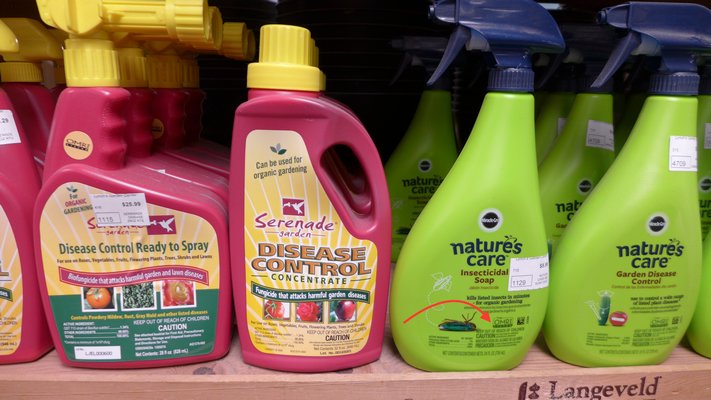
Four different products for disease and insect control. And while Serenade is a great name only the two Nature's Care products have the ORMI label on the bottom right, indicated by a red arrow. ANDREW MESSINGER ANDREW MESSINGER

To put this into perspective: The Long Island Expressway went no farther than Huntington. There was a commercial greenhouse on the east side of Southampton Village that covered nearly an acre. Plastic pots hadn’t yet been invented. And when you went to the nursery or garden center to buy pansies or perennials, they had been freshly dug from the fields.It was the early 1950s, and when my father would come home from work, or on weekends, I would be his shadow as he cared for his roses, fruit trees and vegetable garden. He may have known what organic gardening was, but I surely didn’t.
But there were some interesting juxtapositions. A couple of miles from our Kings Point house was a farm that still had cows on it. We would drive over in the family Desoto, and his farmer friend would scoop some stuff up from a pile near the barn and dump a load or two into the car’s trunk. I loved the smell of the stuff, but my mother would complain for weeks about the “scent” the manure left in the family car. And as the aroma would dissipate, he knew it was safe to return to the farm for another trunkful.
The manure went into the flower beds, especially the rose beds, and he’d add some to the vegetable patch as well. He obviously knew about the organic magic of manure, but it would be years before I did.
So, was he an organic gardener in the early 1950s?
In the garage, there was a wooden cupboard that he had resurrected from some friend’s home renovation, and it hung on the wall next to where he parked his car. In the cupboard, he stored bags of Sevin, Malathion, Chlordane and, yes, DDT. That should answer any questions about his dedication to organic gardening—but I doubt if he was at all unusual, because these chemicals, dangerous as they are, and were, were commonplace in the home garden and garage. But even years after I was old enough to read and understand Rachel Carson’s “Silent Spring,” that bag of DDT still managed to remain in the garage cupboard.
Many years later, I remember driving down Halsey Neck Lane in Southampton and seeing a truck spraying the trees that line that beautiful street. I have no clue what was being sprayed, and what the target of the spraying was. In those days, spraying was indiscriminate and done more on a schedule than as an insect or disease problem dictated. “Monitoring” as a word describing the practice of observing insect and disease issues and then coming up with a control strategy had not even been considered yet.
The next day, I drove down Halsey Neck Lane again. There were dead birds everywhere.
These days, our poisons are in other areas. We rarely have instances of birds falling dead from trees after a spraying incident, but we have ponds and lakes that are lifeless, or mysterious fish kills and outbreaks of deadly algae that lead right back to our gardens, lawns, septic tanks and cesspools.
But I was still not an organic gardener. Rodale’s Organic Gardening magazine was seen as a lunatic fringe publication, and the few organic gardens that I knew about on the East End were weed-infested plots producing mediocre crops more likely to be found in the third world than what we could buy at local farms that used traditional chemical farming.
A group of local “community” gardeners invited me to visit their Bridgehampton garden, where everything was organic. It was disgusting. A large wooden barrel sat in the middle of the field, filled with what they said was compost tea. It was teaming with mosquito larvae, and a dead bird floated on top.
My, how times have changed! Few of you probably remember those dark years when you could go from Hampton Bays to Montauk and never see a single osprey. You could drive from Southampton to Mastic and never see a single red-tailed hawk. Now, you see osprey regularly—they even nest atop the houses on Meadow Lane—and it’s hard to drive more than a couple of miles on Sunrise Highway without seeing a red-tail.
Garden centers can’t get enough organic fertilizers and pesticides on their shelves. Golf courses, which were once the domain of chemical horticulture, now complain about the population of worms on their fairways. Now that they are using more organic fertilizers, the golf course soils have come back to life instead of being sterile strata of soil and sand with little if any biological activity. Now, the worms have returned, and the moles that love to eat them. Now, it’s the worms and moles that are the threat. Beats the poisons any day, in my book.
And last week I read that Whole Foods is in trouble and closing stores. How can that be? Simple: The chain was established on the premise that organic was theirs alone. But, surprise! Now every single supermarket is selling nearly as much organic produce as traditionally grown chemical produce, and Walmart and Costco are probably the two largest sellers of organic produce and food in the country. Who woulda thunk?
Now, as the organic movement has become part of mainstream living and mainstream gardening, some pretty ridiculous things are taking place. Now, when you go to buy potting soils or seed-starting media, you can’t help but notice that most of the bags now tout that they are organic. Kind of begs the question: What in the world were they putting in these mixes before they were “organic”? For the most part, the main portions of “soil” that’s inorganic is sand, silt and clay, none of which should be in store-bought potting mixes and seed-starting mixes.
Then there are the organic fertilizers. From houseplant fertilizers to lawn and tree fertilizers, there now seems to be an organic fertilizer for virtually every plant you might want to grow. Tomatoes, roses, fruit trees, palms, vegetables in general, African violets, orchids … there’s an organic fertilizer for it.
But there’s also a lot of hype and what I’ll call “price boosting.” If you take a careful look at some of these fertilizers, you’ll find that their components and analyses are remarkably similar, with maybe a 1- or 2-percent change in nutrients. Organic lawn fertilizers can be especially confusing, because you can find one brand with a product for spring, summer and fall feeding, but when you delve into the ingredients you’ll discover that the big difference between the products is not necessarily in nutrient content but in the marketing and pricing.
Gone are the days of the innocence of “organic.” The bottom line is that organic is certainly the way to go. But when it comes to your garden and landscape, you still need to be an informed consumer, and you still need to keep in mind that while organic certainly means safer, it does not mean it’s benign and that it can’t pollute and have a detrimental effect on our environment. Even when it comes to organic fertilizers and pesticides, know what you need, don’t use more than you need and know how to use it.
Keep growing!
More Posts from Andrew Messinger


