


 1 Photo
The residents and consultants who have proposed spending more than $20 million to rebuild six miles of beach, from Water Mill to the East Hampton Town border, with sand pumped ashore by giant dredges heard from some of their neighbors this week who do not want to be burdened with the cost of work they say they do not need.
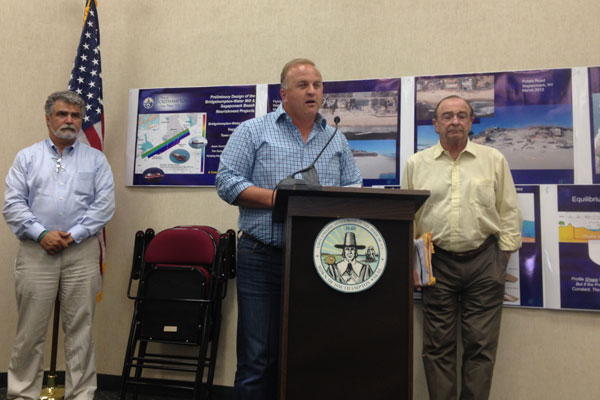
Residents of the districts that would be assessed a special tax to pay for the work—nearly 90 percent of the cost would come from oceanfront homeowners, with the remainder paid for by all Southampton Town residents—and some of the neighbors who would not be so deeply affected, crowded into the Town Hall meeting room on Friday afternoon for the first of two meetings on the project. After the second, slated for Friday, the Town Board will be left to decide whether it will lend the borrowing power necessary for the project to move forward.
Some offered tales of severe erosion that left their houses exposed to ocean storms, and said the houses were likely still standing only because there has not been a hurricane in more than 20 years. But others said they have experienced no threat, have healthy dunes in front of their homes, and don’t want to be assessed the tens or even hundreds of thousands of dollars the project would cost them over the 10 years of the bond that would pay for it.
“I’m not in a position to be philanthropic to the world,” said Rosalind Cole, who said she has owned her oceanfront cottage in Bridgehampton for 40 years. “Forty years ... and I’ve never had a problem. It worries me that there is going to be an unnatural thing being done when the natural thing is working very well. I don’t think people who have never had a problem should have to pay.”
Ms. Cole worried that she would have to pay between $70,000 and $100,000 over the life of the bond, which would be repaid by a special tax on the oceanfront homeowners. Some of her neighbors would have to pay much more—more than $2 million in the case of Sagaponack property owner Ira Rennert.
Ms. Cole was not alone in her argument that the project’s cost was neither worthwhile nor within her budget. Others said they think the town should pay for the entire project if it thinks it is so important.
“I don’t think the Town of Southampton is my favorite charity,” said Alexandra Gladstone, who criticized it, and her own neighbors, for continuing to build large houses too close to the ocean. “If the town is going to make it easy for people to build on the ocean, I think they should be paying for most of it.”
Other residents on Friday told tales of having had the same attitude about the dunes in front of their house as Ms. Cole, only to have their tune change dramatically a few years later.
“For the first 25 years I said: ‘Wow, Potato Road has it bad,’” Surfside Drive resident David Lederman told the large audience. “I met Aram Terchunian, and he told me about sand waves, and he said it will be your house someday. I said, ‘Twenty-five years? I don’t think so.’ Well, now here it is. Our house used to not even be visible from the beach. Now, we’re right on the beach. It’s coming to you next. It will be Dune Road, it will be Jobs Lane.”
One of the residents who has spearheaded the beach rebuilding effort, Jeff Lignelli, said that Ms. Cole lives near Mecox Beach, where the town spent $100,000 this past spring to pile sand where dunes had been, to protect the beach parking lot from encroaching erosion.
Mr. Terchunian, a Westhampton consultant hired by the project organizers, said that the shrinking dunes seen in some stretches of the project area are only the symptoms of a broader beach system that is in the late stages of sand starvation, or bankruptcy, to use his frequent financial analogy.
“The dune is the canary in the coal mine—when the dune is eroding, you’re in the late stages of the problem,” he said. “Take your household budget. If you have $100,000 in the bank, you don’t worry about a $1,000 bill. But if you have a balance of $1,000, you worry a lot about the bills. That’s what’s happening here. Our reserves have been so depleted that the natural fluctuations of the beach have a dramatic impact now.”
Mr. Terchunian blamed the erosion of the broad beaches in the area on four rock groins built in East Hampton near Georgica Beach and Main Beach in the 1960s. The groins have slowly robbed the beaches to the west of sand that should have naturally flowed down from the east, he said. The broad dune systems that once stood between homes and the ocean there are only possible if there is a broad beach seaward, from which dry sand will blow landward and be caught by dune grass or sand fencing and rebuild natural dunes—as happened in West Hampton Dunes after a large beach rebuilding project, he said.
Other residents, including some who don’t live on the beach and wouldn’t have to shoulder most of the financial burden, raised doubts about whether the project would even do what it purported to do and provide a broad, protective beachfront that could last a decade or more and would offer greater protection from severe storms like hurricanes.
Bridgehampton resident Jeff Vogel cited claims made by a coastal science professor, Dr. Orrin Pilky, that predictions of the durability of beach nourishment projects are almost always wrong, and that the projects never provide the protection they claim they will. Dr. Tim Kana, an engineer with Coast Science & Engineering, the North Carolina firm that designed the project proposal for the Water Mill-Sagaponack stretch, said that Dr. Pilky is an “entertainer” and that his own pessimistic predictions about beach restoration projects have been proven wrong.
“With our Nags Head project, he said the first storm that comes along will wash it all away,” Dr. Kana said. “Hurricane Irene came through, and we didn’t lose a single yard of sand in that project.”
Nonetheless, Dr. Kana and Mr. Terchunian both acknowledged that nothing is guaranteed when dealing with Mother Nature, only that the science shows the high probability that the project would be a major benefit to the beachfront in the area.
“It’s not a cure,” Mr. Terchunian said.
“Any project on the open coast has a risk,” Dr. Kana added. “If we stood up here and said, 100 percent, this is what is going to happen, we might as well be weather forecasters. There is going to be some inaccuracy in our predictions, but it’s not going to be so inaccurate as to ruin your investment—or I’d be off selling shoes somewhere.”


