


 1 Photo
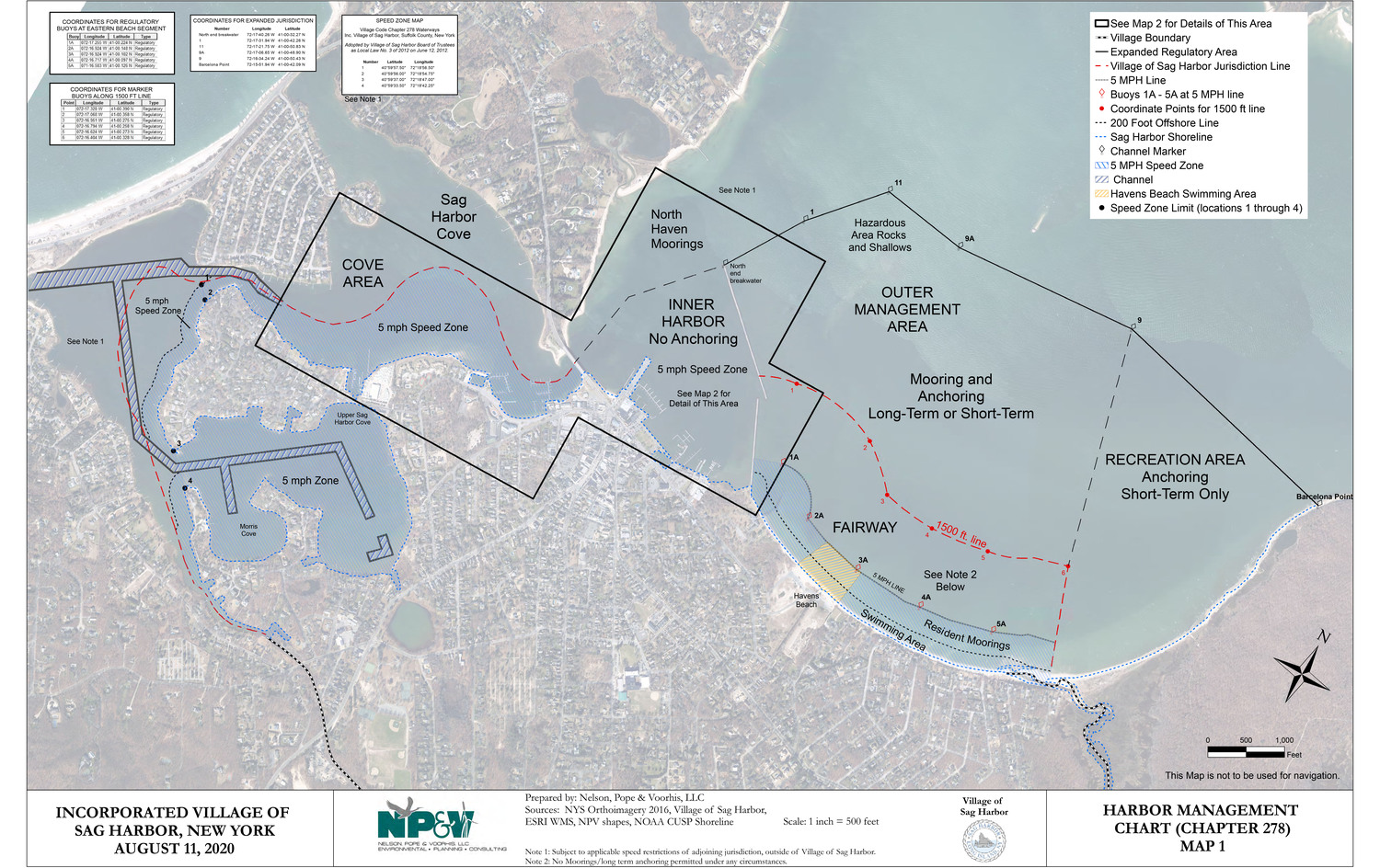
The Sag Harbor Village Board wants to better control boat moorings in the outer management area of the harbor. COURTESY SAG HARBOR VILLAGE
What at first appeared to be a relatively simple effort by the Sag Harbor Village Board to better organize and control the outer management area mooring field, which lies beyond the breakwater, ran into questions about overcrowding and potential pollution that led the board to table the proposal for additional work.
Assistant Harbormaster Chris Duryea outlined a plan on Tuesday, March 12, that would allow as many as 85 moorings and make adjustments to the current layout to use space more efficiently, avoid recently planted eelgrass beds, and stay clear of the fairway, a navigational area that runs between 500 and 1,500 feet from shore.
There is currently no limit to the number of moorings that can be placed in the outer mooring field. There were 67 last year.
As part of the new rules overseeing the outer management area, the village would collect a $350 annual administrative fee for each mooring to help cover the cost of harbormaster patrols and inspections of boats’ sanitary systems.
In addition, for the first time since it assumed authority over the outer mooring area when it passed a waterways law in 2021, the board would approve or deny mooring applications, belatedly taking over that responsibility from the harbormaster’s office.
Duryea said the idea for reorganizing the mooring field, assigning numbers to each mooring and requiring that they be placed at precise locations using GPS, came from private contractors who place moorings for private boat owners or to rent out themselves.
“This was never a path forward to extend the mooring field. We didn’t come in here and say, ‘We want to put more boats out there,’” he said. “This was a path to organizing the mooring field, making it more efficient, making it safer and protecting the environment at the same time.”
Duryea said that, on average, there are only about 28 boats tied up to moorings in the outer field and another nine boats anchored. The busiest day of last season occurred on Labor Day weekend, when a total of 56 boats were either moored or at anchor. Overall, he said, occupancy in the mooring field was about 41 percent of capacity.
This year, there were a total of 103 requests for moorings, including 80 from commercial operators, an increase of 34 from commercial interests over last year. Duryea said that the number proposed for this year was whittled back down to the compromise of 85.
Imposing a limit was important, he said, because “we don’t want to see people making a land grab.” He added, “Somebody could come in and drop 50 to 75 moorings, and all of a sudden they are in the mooring business.”
Trustee Jeanne Kane, who oversees docks and the harbor for the board, agreed that the goal was “to limit unchecked expansion and use of the mooring field.”
“At the same time, we wanted to balance the needs of the residents, boaters and commercial operators and create a perfect balance,” she said, adding, “if that is possible.”
But Shannon Richards, a resident of Azurest, questioned why the village seemed to be bending over backward for the financial benefit of contractors who make their living installing moorings. “The bay is a public resource,” he said. “I’m not sure why the tail is wagging the dog here.”
He called for stricter limits on the number of boats that are allowed to moor or anchor, adding that eelgrass and marine life were suffering due to the pressure from an increasing number of boats in the harbor.
“We have essentially taken the bay and turned it into a parking garage,” he said. “These kind of percentage increases are shocking, because we don’t need this expansion — the operators want this expansion.”
Steve Williams, another Azurest resident, also pointed to environmental degradation, saying that as eelgrass disappeared, so, too, did scallops and other shellfish. Plus, he said, the current mooring plan places most of the bigger boats off the Azurest shore. “Having the larger boats near us is going to be claustrophobic,” he said.
Lisa Desamours of Sag Harbor Hills thanked the board for undertaking a review of the outer mooring area but said it should not be considering an increase in the number of boats that are allowed there until it does an environmental assessment of the impact.
Village resident Russell Kratoville suggested that since private businesses are using a village asset, that they should be required to bid for the right. He also suggested that village-owned businesses be given priority.
Attorney Tiffany Scarlato, who often represents clients appearing before village regulatory boards, questioned why parking spaces were not required for the owners of boat moorings as they would be for village business owners.
Mayor Tom Gardella said he was also concerned about increasing the number of boats that can be moored in the area, suggesting that the board freeze the number of moorings to last year’s level and, if possible, reduce the number.
John Parker, a member of the Harbor Committee, agreed wholeheartedly. Although he was not allowed to speak during the work session before Gardella ended the meeting, he returned to the podium during the board’s regular meeting, which followed immediately, to call for the board to adopt a resolution freezing the number of moorings.
“There is a serious risk we are going to have an expansion of moorings before this board can take action,” he said.
But the board held off on his suggestion, pending a review of the situation by Village Attorney Elizabeth Vail.


 Stephen J. Kotz on Mar 13, 2024