


 1 Photo
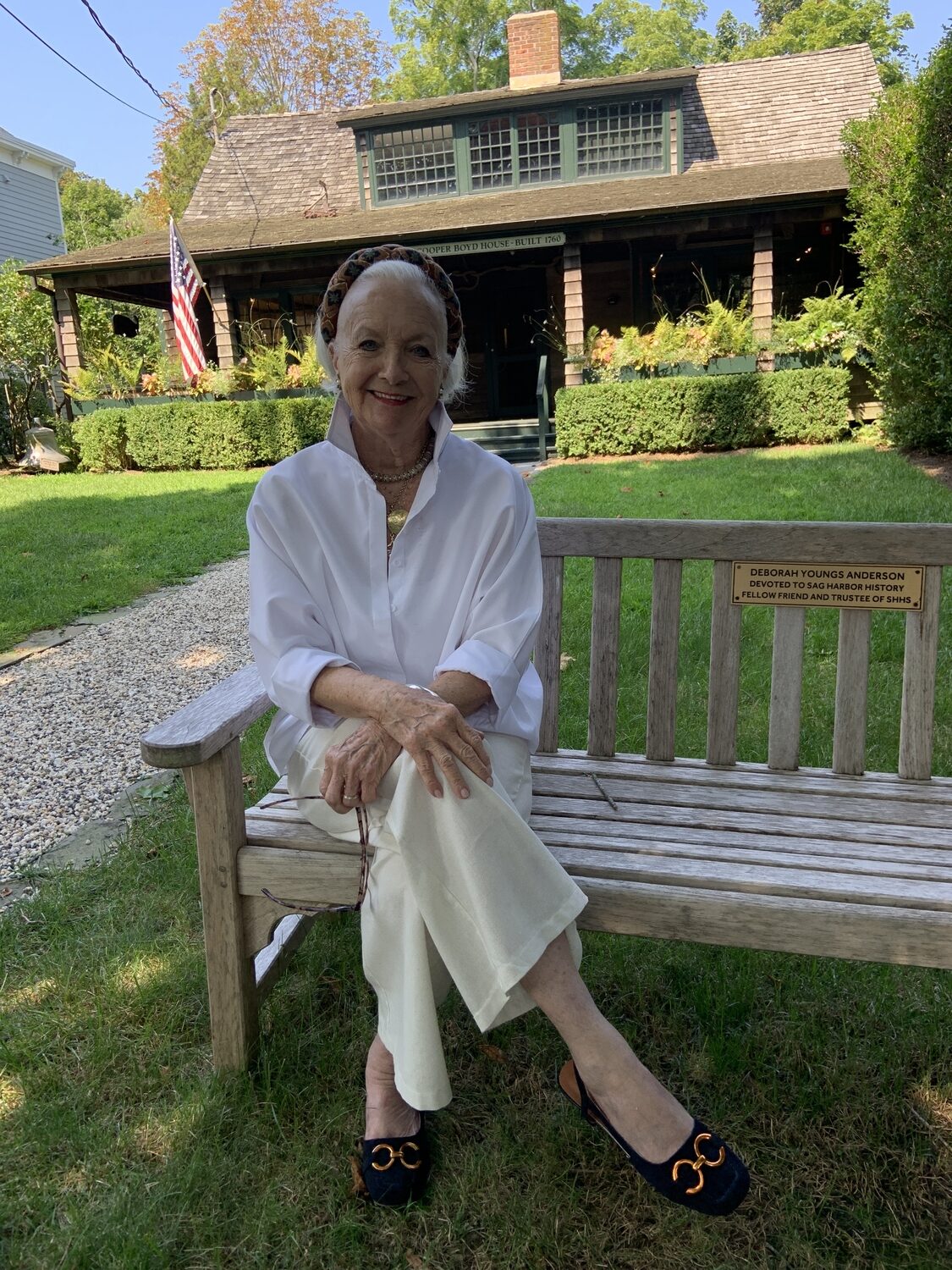
Nancy Achenbach, who served two terms as president of the Sag Harbor Historical Museum, was recently appointed executive director. STEPHEN J. KOTZ
Nancy French Achenbach, who recently served two three-year terms as president of the Sag Harbor Historical Museum, has been appointed the organization’s first executive director.
The museum’s board of directors made the announcement shortly after it held its annual summer gala in June on the grounds of the Sag Harbor Custom House, which, speaking of history, is right next-door to the Hannibal French house, whose owner just happened to be Achenbach’s great-grandfather, but more on that later.
“One of my ambitions is to make this place bigger,” Achenbach said during an interview in the museum’s Annie Cooper Boyd House headquarters on Main Street this week. “It’s quite well known, but I would like to see it bigger.”
She was speaking figuratively, of course. The Annie Cooper Boyd house sits on a typical postage stamp-sized, Sag Harbor lot, and the museum, which already has a small whaleboat shop on the rear of its property, is planning to erect a second, small building to house its archives.
Besides creating a larger presence in the community for the museum, Achenbach said she also wants to encourage an interest in local history among high school students, five of whom were among the museum’s volunteer docents this summer.
The museum, which has hosted a series of preservation forums in recent years, also would like to work with the village government to update its guidelines for overseeing development in the village’s historic district.
Plus, Achenbach said she would like to reach out to the other historical institutions in the village, the Sag Harbor Whaling and Historical Museum, the Eastville Community Historical Society, and Preservation Long Island, which owns the Custom House, about doing more joint programming.
An example of that was the recent joint presentation of “Enslaved at the Custom House: Luxury and Labor in 18th Century Sag Harbor,” a talk by the directors of the In Plain Sight Project, which was co-hosted by Preservation Long Island and the museum.
Another pressing matter, Achenbach said, is for her to sit down with the various historical organizations to discuss the 250th birthday of the United States on July 4, 2026.
“We need to do some organizing, to get things on the calendar,” she said. “Not only in the village, but in East Hampton, Bridgehampton and Southampton, too.”
Achenbach’s is a part-time position for which she is paid $40,000 per year. She and Claudia Ward, the museum’s office manager, are its only paid employees. Historical museums in surrounding villages and hamlets typically have at the minimum a paid director.
Zach Studenroth, who has replaced Achenbach as the museum board’s president, said the board did not let Achenbach know it was thinking of appointing her to the director’s position, but that she had been doing both the job of the director and of the board president for some time. “Part-time directors are really full-time directors taking a part-time salary,” he said.
The museum was able to afford a part-time director after former board member Bethany Deyermond led an effort to obtain approval from the State Education Department for it to qualify for local tax support. As part of that effort, the museum officially changed its name from the Sag Harbor Historical Society. In May 2023, voters in the Sag Harbor School District approved a special $75,000 annual allocation for the museum.
This past year, the museum has also created its first strategic five-year plan, which was led by board member Renee Simons.
Achenbach was born and her family lived in New York City until she was in third grade, but her family has deep local roots.
Her great-grandfather Hannibal French was business partners with his brother Stephen, and they financed the voyage of the Myra, which, in 1871, was the last whaling ship to leave the Port of Sag Harbor. It never made it home, and was condemned as unseaworthy and broken up at the dock in Barbados in 1874.
Although the French brothers were late getting into whaling, they invested in the steamship business when ferries connected Sag Harbor and New York. Achenbach’s grandfather Frank French was purser on the Shinnecock, one of those steamships.
After her family moved back to North Haven from the city, Achenbach attended local schools, graduating from the Academy of the Sacred Heart of Mary. She attended Pierce Junior College in Philadelphia and worked as a secretary for a time, before getting married to Benjamin Roland Achenbach, a lawyer she had met in Philadelphia. They moved to Washington, D.C., where she worked with the Hospitality and Information Service, a division in the State Department that provided a helping hand to the families of diplomats living in the United States.
The couple moved to the Old Town neighborhood in Alexandria, Virginia, and Achenbach worked with the Campagna Center, which provided recreational services for disadvantaged youth. Later, she served for eight years as the director of the Athenaeum, a gallery and performance space there.
She also served as youth director at St. Paul’s Episcopal Church in Alexandria and helped chaperone a youth group trip to work in squatters’ camps near Johannesburg, South Africa, in the late 1990s.
In 2003, Achenbach and her husband, Benjamin, retired to Sag Harbor, where he died in 2014.


 Stephen J. Kotz on Aug 27, 2024