


 2 Photos
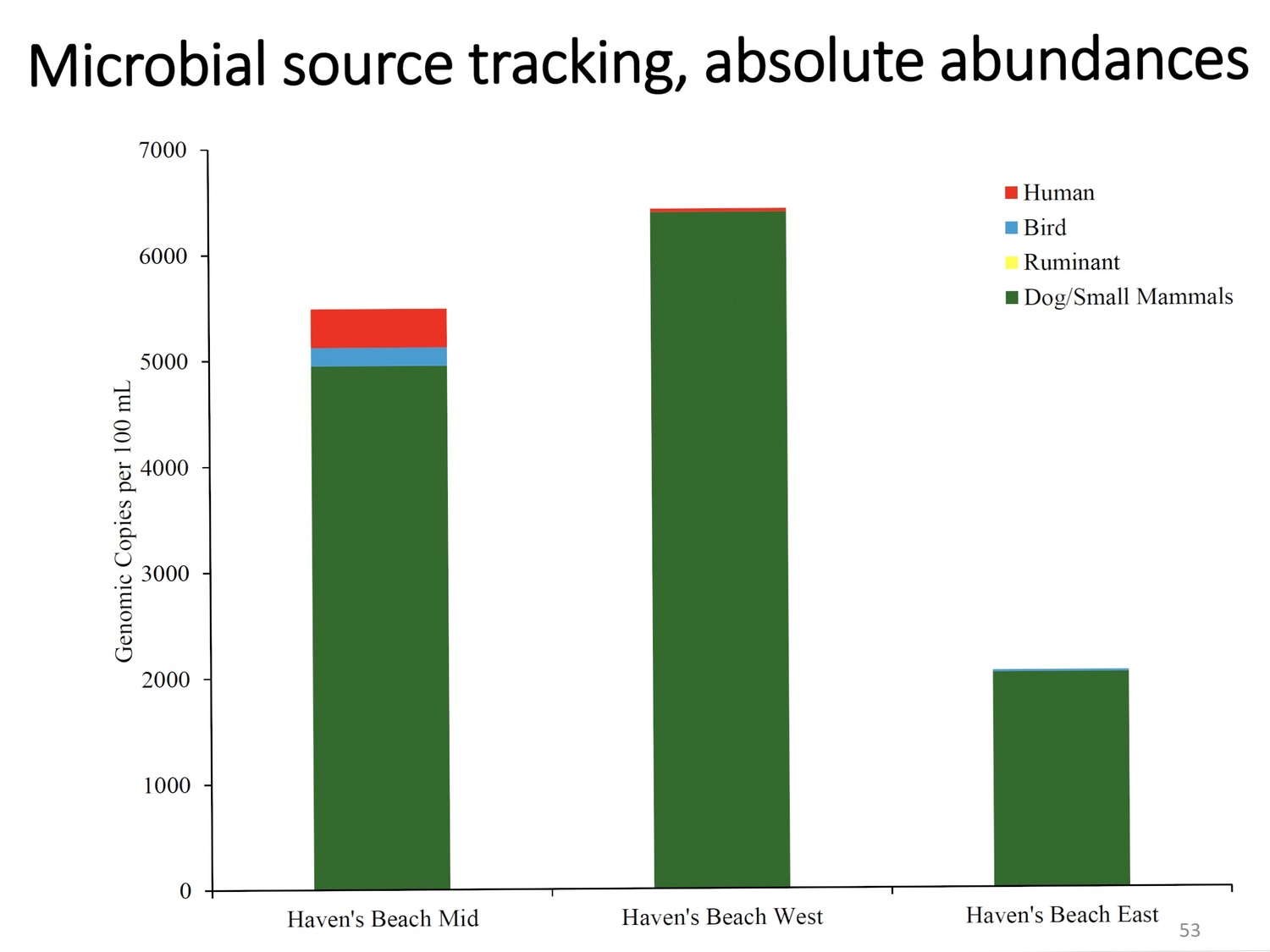
Fecal bacteria are found at all three testing sites along Havens Beach, Sag Harbor’s public bathing beach. Almost all of it is from dogs (shown in green), according to Dr. Christopher Gobler.
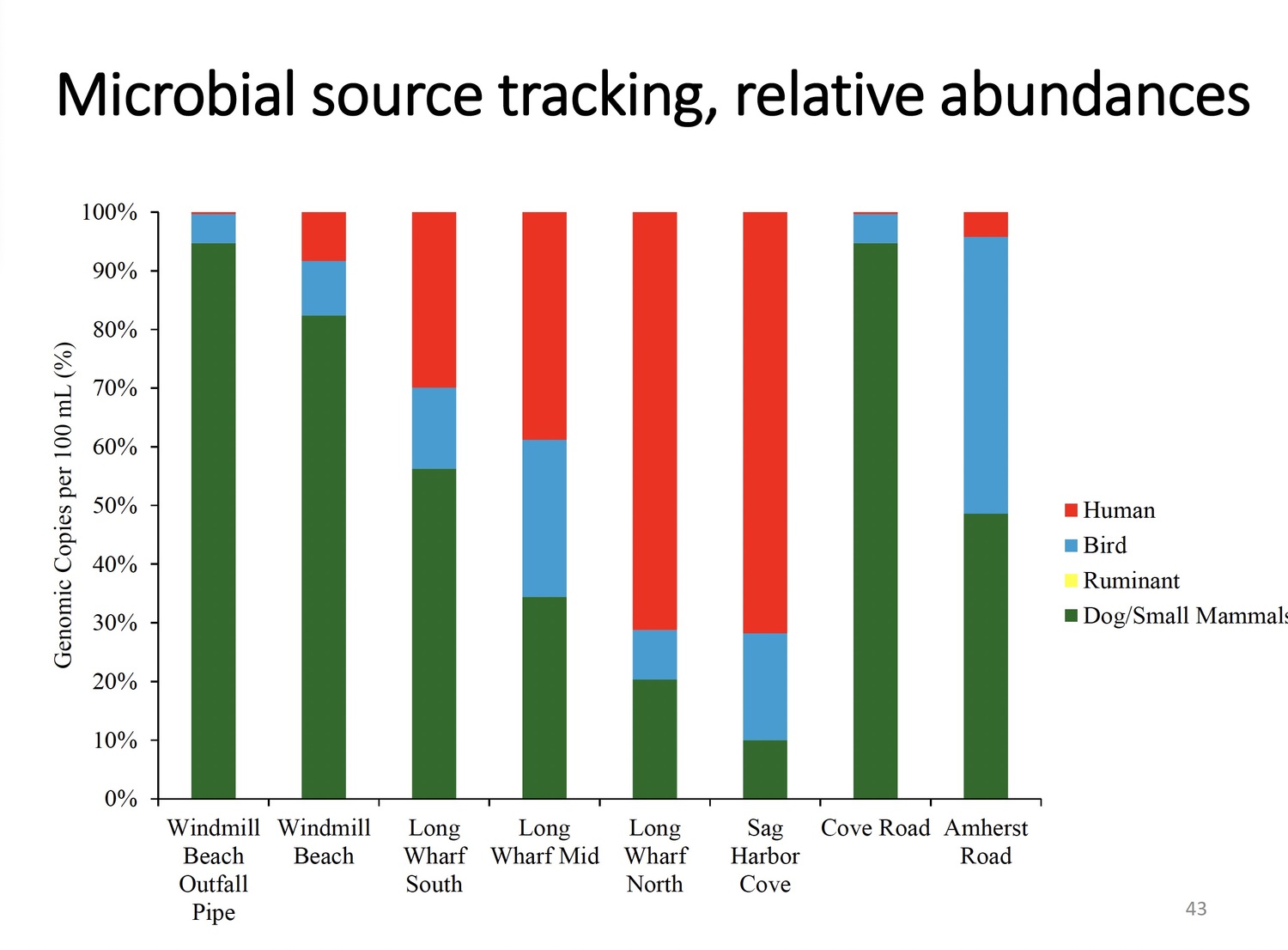
A slide from Dr. Christopher Gobler’s presentation on Sag Harbor water quality to the Harbor Committee on March 7 showed genomic evidence of high levels of human fecal waste (shown in red) in water samples taken last summer and early fall on the north end of Long Wharf and in Sag Harbor Cove. Fairly large amounts were also found at two other Long Wharf locations and at Windmill Beach.
Describing what he called “the clearest picture we’ve had yet” of bacterial pollution in the waters around Sag Harbor, Stony Brook University marine scientist Dr. Christopher Gobler told the village’s Harbor Committee on March 7 that human waste from “vessel discharge” was a source of fecal bacteria at several test sites at and near Long Wharf last summer.
Presenting what has become an annual report since 2018 on Sag Harbor’s seasonal water quality, Gobler presented slides this year showing that human waste was the top source of fecal bacteria at two testing sites.
One site was at the north end of Long Wharf and the other was in Sag Harbor Cove near 30 Redwood Road. In each case, human waste was the source or more than 70 percent of fecal bacteria detected. The source was determined by DNA testing.
Gobler has hinted in past presentations that illegal septic discharges from boats and yachts might be the source of fecal bacteria in the inner harbor area. But this year he said there is a clear pattern showing that “as you move into the harbor,” water quality testing reveals “there is vessel discharge.”
Human waste was a lesser but still quantifiable source of fecal bacteria at two other Long Wharf testing sites closer to shore, one at the south end and another at the midpoint of Long Wharf; and also at nearby Windmill Beach, just to the west of the wharf, where children and visitors can be seen swimming in the summer. The ratio of human waste at those three test sites were about 40, 30 and 10 percent, respectively, of the total fecal bacteria present. Dogs, small mammals and birds were the source of the balance.
Evidence of human waste nearly disappears just a little farther west, where a pipe delivers wastewater runoff into the harbor from the central downtown area. Only a trace of human waste was found there. About 95 percent of the total found came from dogs and, to a much lesser degree, birds and small mammal waste.
Releasing septic waste from boats into the water is illegal anywhere in Sag Harbor’s waters and across all of the Peconic Bay estuary. All village-managed waters are a no-discharge zone under the Village Code; the federal government made the entire Peconic Bay Estuary a no-discharge zone in 2002.
Gobler and his students have been conducting increasingly expansive water quality studies in the waters from eastern Havens Beach to Amherst Road in Redwood on the west under a program spearheaded in 2016 and 2017 by Harbor Committee member Mary Ann Eddy and funded by public and private sources, including the Sag Harbor Partnership, the Sag Harbor Yacht Club and the Breakwater Yacht Club. The village of North Haven began partnering with Gobler to study water quality at sites there separately in late 2022.
Despite trouble spots, Gobler reported in his conclusion slide last week that “water quality conditions in Sag Harbor were, on average, good.”
The high points of Gobler’s annual presentations are not always easy to glean. His reports are factual summaries accompanied by graphs and charts with a bit of meticulously straightforward commentary by Gobler.
Among other highlights last week, Gobler spoke about:
• The longstanding problem of high nitrogen loading from in-ground residential septic systems and fecal bacteria in the waters at Havens Beach. The fecal counts come almost entirely from dog waste, and to a lesser extent, birds. The nitrogen from septic systems is carried in street runoff that flows into a drainage swale east of Havens Beach and into the bay. Gobler said detours and diversions in the drainage swale would give the runoff more time to be absorbed into the sandy area south of the beach.
• The Sag Harbor sewage treatment plant, data showed, is far more effective at removing nitrogen in wastewater than even advanced residential “innovative/alternative” septic systems and even other municipal treatment plants. He said expanding the treatment plant’s service area — as now planned by the village — will be a benefit for the harbor’s water quality.
• The bacterium Vibrio vulnificus, once referred to as “flesh-eating” and seen in tropical waters, is becoming a threat faster than expected in the Northeast as global warming raises water temperatures. A paper published a year ago predicted it would be a concern in New York by 2080, Gobler noted. “That paper was good for about four months,” he added, “because in August last year there were outbreaks of Vibrio vulnificus [and] people died” in the Long Island region. The federal Centers for Disease Control (CDC) has formally alerted doctors to be on the lookout for it, he reported.
Gobler’s March 7 presentation to the Harbor Committee can be seen in its entirety on Sag Harbor’s YouTube channel at youtube.com/@villageofsagharbor8681.


