Sag Harbor Express

Long Awaited Beach Nourishment For Tiana, Montauk Slated For 2022

authorMichael Wright on Jan 6, 2021

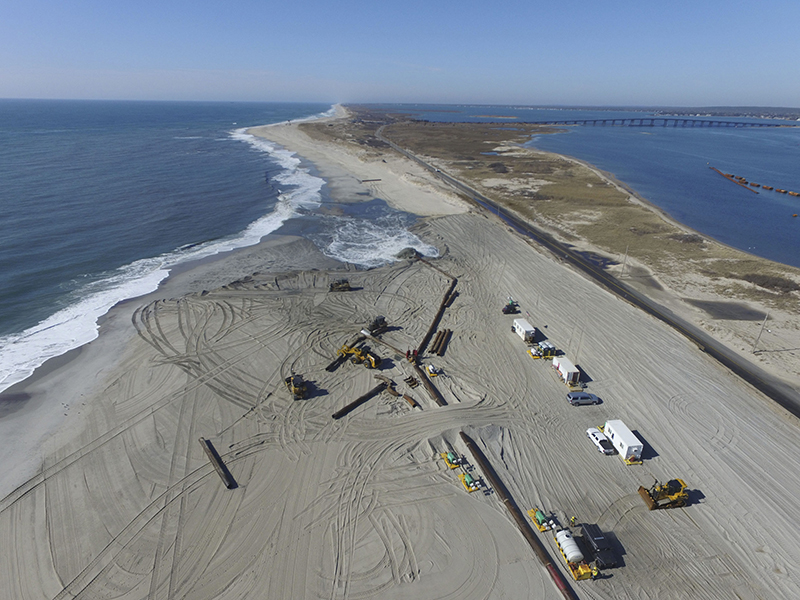
Federal contractors could potentially begin pumping millions of tons of sand onto South Fork beaches by year’s end, or early 2022, after funding for the long-awaited Fire Island to Montauk Point Reformultation Study, known for decades as FIMP, was approved by Congress and President Donald Trump as part of the appropriations bill that also secured $900 billion in additional pandemic relief aid.

Two South Fork projects, in the Tiana region of Hampton Bays and in Montauk, are expected to be seen as priority projects and likely among the first to be mobilized, local officials said this week.

The FIMP work plan has been presented to the New York State Department of Environmental Conservation, which will coordinate with Suffolk County and the local towns where work will be done to secure the necessary easements along the stretches of shorefront where new sand will be pumped into the beachhead from offshore stockpiles.

The state and towns, and any private land owners whose property fronts proposed work areas, must sign off on the work by the end of May with an October mobilization date, according to consultant Aram Terchunian, who has represented both town in the planning of the FIMP projects.

A spokesman for the Army Corps of Engineers on December 23 said that the official forecast for the commencing of construction is 2022.

The Hampton Bays-East Quogue nourishment and the rebuilding of the beaches off downtown Montauk are considered one project in the FIMP plan, and will be mobilized concurrently and conducted by the same dredging crews, Mr. Terchunian said last week after the project was officially given the financial green light. Where precisely the dredging will start first —Montauk or Hampton Bays — will be up to the construction company that wins the bids for the work.

Montauk is due to have about 600,000 cubic yards of sand — about 750,000 tons worth, or 75,000 dumptruck loads — pumped onto its beaches to restore the natural profile of the beach and reduce erosion during major storms, Mr. Terchunian said.

The initial project, which is likely to cost in the range of $15 million, will be paid for entirely by the federal government. But once the beach has been rebuilt, the Army Corps of Engineers plans to return as often as every four years to add sand, which would have to be paid for in part by the local municipalities, namely New York State and East Hampton Town.

The town has formed a committee of public and private interests that are drafting plans for an “erosion control district” that would levy taxes on some Montauk properties to pay for the long term maintenance of the beach once it has been rebuilt. The committee has also considered raising funds to pay for the pumping of additional sand as part of the initial work, to make the beach even wider.

“We’ve had a number of meetings, and we did a survey of beach users and everyone likes the idea and would be willing to pay to ensure the beach is there and wide,” Supervisor Peter Van Scoyoc said. “But the question still is how do we break down the distribution of costs.”

The Tiana area of East Quogue and Hampton Bays, where chronic erosion has threatened public beaches and Dune Road itself for years, is slated to get approximately 1.5 million tons of sand.

Residents of East Quogue who live along the project area have already created an erosion control district to pay for their share of the future maintenance costs, along with the town and Suffolk County, which own the bulk of the shoreline landward of the beach in the Tiana area.

Each of the two projects could take three to four months to complete, Mr. Terchunian said.

The FIMP plan also includes major bolstering of beaches near Shinnecock Inlet, in West Hampton Dunes and on Fire Island, as well as in the Water Mill-Bridgehampton area, though those areas are likely seen as lower priority because they have seen major nourishment work in recent years.

The beaches between Shinnecock Inlet and Ponquogue were rebuilt with some 750,000 tons of sand last winter through an emergency appropriation. The FIMP plan calls for a 30-year maintenance of the beach profile there. West Hampton Dunes has been regularly nourished as part of the legally mandated maintenance of the beach there and is a lower priority.

The work is to be funded entirely by the federal government from the $1.7 billion allocated to the FIMP work plan as part of the Superstorm Sandy recovery aid allocated by Congress in 2012.

The FIMP project, which was begun as a sweeping assessment study of coastal dynamics in the 1960s, was infamous for decades for being stuck in governmental limbo, hamstrung by its scope and inconsistent funding. But following Superstorm Sandy’s impacts, the study’s focus finally received the funds needed to turn measured needs into shovel-ready projects.

You May Also Like:

A New 27east and More Big Changes for The Express News Group

The Express News Group is launching a brand-new 27east.com this month, a major step forward ... 13 Dec 2025 by 27Speaks

Sag Harbor Village Police Reports for the Week of December 11

SAG HARBOR VILLAGE — An officer responded to a call from a Rysam Street address a little after midnight on Saturday. The caller told the officer that a man wearing a black ski mask had walked onto her porch and banged on the front door then ran off. The woman provided the officer with surveillance video from her Ring camera, which visually confirmed what the woman said had happened. Police described the man as white, “approximately 6 feet tall, wearing a black ski mask, black hoodie with a red logo on the back, and wording on the left chest, a ... 12 Dec 2025 by Staff Writer

Harmony for the Holidays

Let’s be real: As jolly as the holidays can be, they can also be overwhelming. ... by Jessie Kenny

A Little Time, a Big Impact: Pierson's Interact Club Brings Joy to Seniors and Revives Blood Drive

Isabella Carmona DeSousa didn’t know much about Pierson’s Interact Club when she joined two years ... 11 Dec 2025 by Cailin Riley

Dear Neighbor

Congratulations on your new windows. They certainly are big. They certainly are see-through. You must be thrilled with the way they removed even more of that wall and replaced it with glass. It must make it easier to see what is going on in your house even when the internet is down. And security is everything. Which explains the windows. Nothing will make you feel more secure than imagining yourself looking over the rear-yard setback from these massive sheets of structural glass. Staring at the wall has well-known deleterious impact, and windows the size of movie screens are the bold ... by Marilee Foster

I Can Dish It Out

Our basement looks like the final scene in “Raiders of the Lost Ark,” where the (found) ark is crated and wheeled into the middle of a government warehouse with stacked crates going on for miles. In other words, we have a lot of stuff. This tracks. Mr. Hockey and I have been married for 36 (according to my calculator) years. We’ve had four (no calculator needed) pucks. We’ve lived in seven (according to my fingers) different homes in three (no calculator or fingers needed) countries. In 2010, we moved back to East Hampton full time. We brought everything we had ... by Tracy Grathwohl

The Urgency of Real

The Hamptons International Film Festival typically takes up a lot of oxygen in the fall on the South Fork, but it’s worth celebrating a slightly smaller but just as vital event in late autumn: the Hamptons Doc Fest. Running this week for its 18th year, the festival of documentaries was founded by Jacqui Lofaro and has become an essential part of the region’s arts scene every year. It’s a 12-month undertaking for Lofaro and her staff, and the result is always a tantalizing buffet of outstanding filmmaking, not to mention unforgettable stories. The arrival of the era of streaming services ... 10 Dec 2025 by Editorial Board

Hitting Pause

East Hampton’s housing shortage is real; the town can’t afford to ignore any potential long-term solutions. But the recent — and now scrapped — plan for a large employer-run complex on Three Mile Harbor Road raises too many questions that haven’t been fully answered. The proposal, put forward by Kirby Marcantonio and an unnamed partner, would have created 79 units of employer-controlled housing, comparable to a project he has pitched on Pantigo Road. To make it happen, the East Hampton Town Board would have had to allow the project to sidestep the town’s 60-unit limit on affordable developments, and rezone ... by Editorial Board

Proceed With Caution

Overlay districts are a common zoning tool used by many municipalities. Southampton Town has used them to varying degrees of success — the aquifer protection overlay district has been a winner; a downtown overlay district in Hampton Bays less so — in various parts of the town. They essentially look at the existing zoning, then allow those rules governing what can be done on properties to be reconsidered if there’s a newer concern to be addressed. In a bid to clean up the process for creating more affordable housing, the Town Board is looking at a new overlay district that ... by Editorial Board

The Whole Picture

When it comes to evaluating a complex development proposal, splitting up the application into separate parts may seem tempting, especially when environmental uncertainties loom. But in the case of Adam Potter’s plan for 7 and 11 Bridge Street, the Sag Harbor Village Planning Board should resist any temptation to segment the project for review. Potter’s attorney has asked the board to consider the gas ball property at 5 Bridge Street — a site that could provide the 93 parking spaces required for Potter’s 48 residential units and commercial spaces nearby — separate from the main development. The reason is understandable: ... by Editorial Board