


 2 Photos
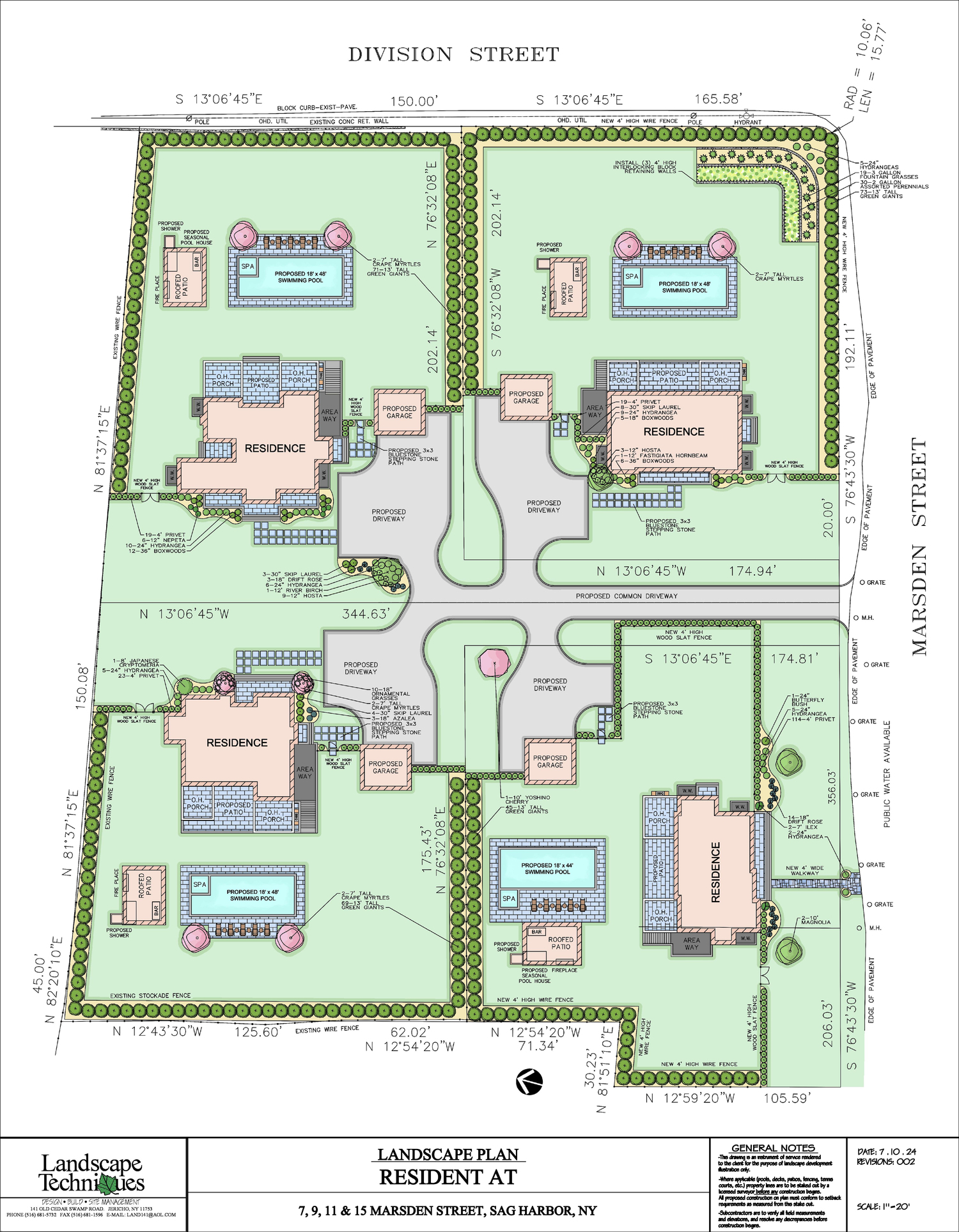
The proposed layout of the four houses builder Matthew Pantofel is proposing for the Marsden Street property he recently purchased. COURTESY MCDONOUGH AND CONROY ARCHITECTS
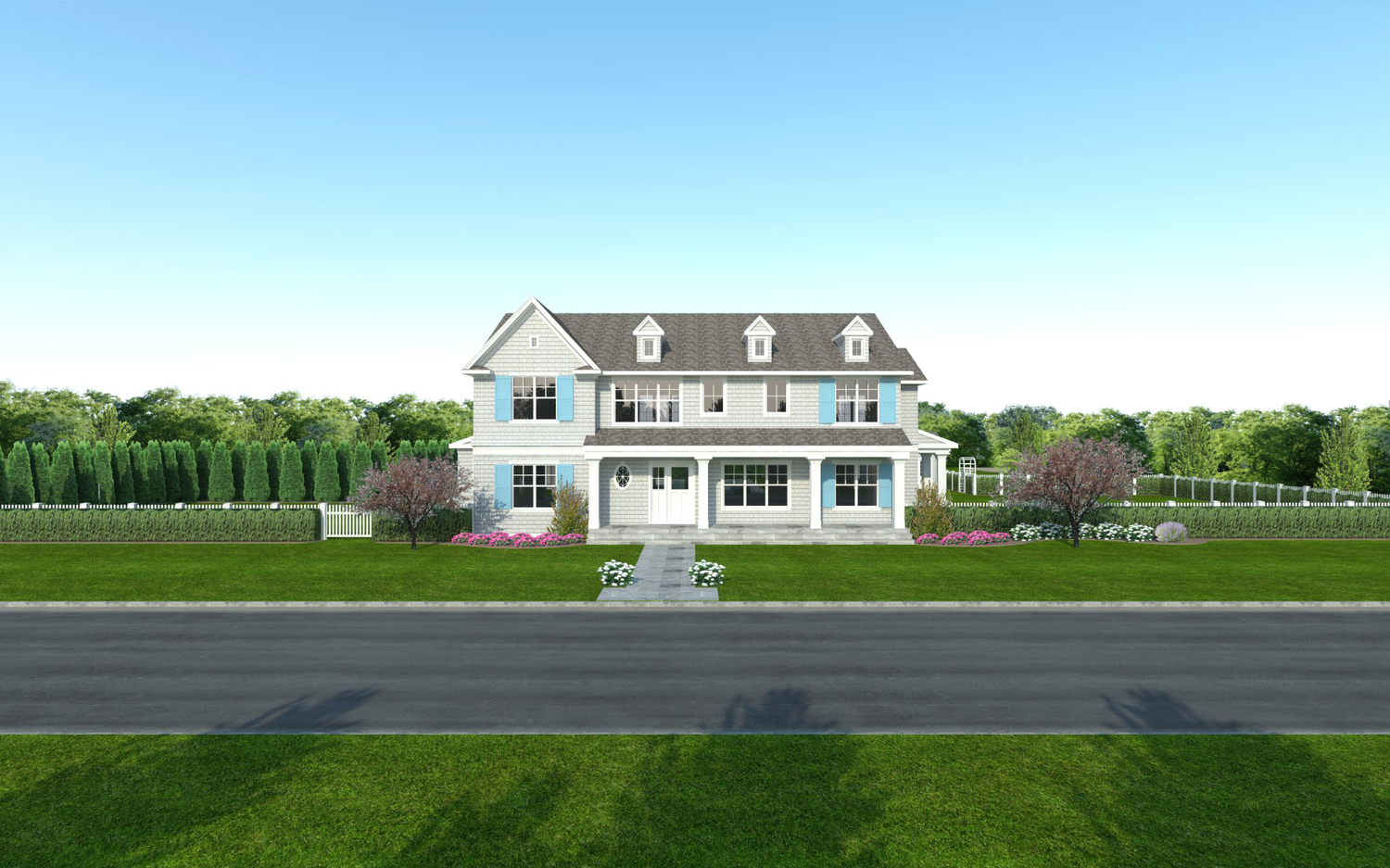
A rendering of one of the houses Matthew Pantofel plans to build on Marsden Street in Sag Harbor. COURTESY MCDONOUGH AND CONROY ARCHITECTS
The Sag Harbor Village Board of Historic Preservation and Architectural Review continued its review of the proposed development of four lots on Marsden Street at a special meeting on Tuesday, August 6.
Although several speakers praised the various house designs offered by Matthew Pantofel, who owns the property, still more opposed them, describing them as too big and more suitable for a suburban subdivision than in the village’s historic district.
After a nearly three-hour-long hearing, the ARB was nowhere close to reaching a decision on whether to approve any of the designs, and Chairman Steve Williams adjourned the hearing until September 12.
Pantofel, the owner of BJC Custom Builders in Southampton, is seeking permission to build four houses ranging in size from 4,703 square feet to 5,114 square feet on four lots bounded by Marsden and Division streets that he purchased from Pat Trunzo after an effort by the Sag Harbor School District to acquire the 3.37-acre property fell short in a failed referendum last year.
The ARB opened separate hearings on Pantofel’s four proposed houses last month, and on Tuesday listened to a summary of each application by his attorney, Denise Schoen, before taking public comments.
Schoen told the board that none of the houses would require a variance and each fell well under the maximum size allowed for each lot. Each house includes different design details that Pantofel added to the mix in response to the ARB’s requests.
The board began by going over the design for a house at 7 Marsden Street that Pantofel plans to build for himself.
“My immediate reaction is one of a significant amount of mass,” offered alternate board member Sewit Bocresion, who was sitting in for member Megan Toy, who recused herself from the hearing after seeing the front elevation. “Could we achieve the same thing by shifting it sideways?”
Pantofel said the house would be about 60 feet wide on a lot with 200 feet of street frontage, and would not overwhelm the streetscape. In addition, the house proposed for the adjoining lot, 15 Marsden Street, was pivoted to appear less obtrusive.
Guy Davis, a Sag Harbor resident, referring to the vacant Marsden lots, said the development would help improve “an eyesore for the town.” James Peyton, also a village resident, said he thought the size and scope of the houses on large lots “beautifies the area, and I think it will fill in nicely.”
Val Florio, an architect and member of the Village Zoning Board of Appeals, who said he was speaking as a neighbor — he lives on Madison Street just around the corner from the development — offered mostly favorable critiques of each house design, offering suggestions for how their massing and impact on neighbors could be reduced.
Trunzo also appeared in support the applications. He said that Sag Harbor was full of individual neighborhoods with their own scale. “These are large lots for Sag Harbor, and they will fit very comfortably,” he said of the houses being proposed.
“Just because you have a large lot doesn’t mean that it all has to be cleared. It doesn’t mean your house needs to be prominent,” responded Williams, who told Trunzo the ARB functioned as something of a homeowners association, serving as a guide for development for the entire village.
At one point, Williams said the ARB was powerless to stop development of the property. But Lauren Friedman, a neighbor who is an attorney, said case law supported similar boards that had required developers to reduce the scale of their projects.
Other speakers also took issue with the designs. Dawn Smith said each house taken individually appeared to fit the neighborhood, “but when you have them all, the density explodes.” The proposed houses, she added, were about twice as large as other large houses in the neighborhood.
Karen Arrigoni, an architect who lives nearby, said “This is a proposal for four giant spec houses in the middle of a historic district. The whole thing needs to be rethought. These houses are completely out of scale.”
Janis Donnaud agreed, saying the board seemed to be “dancing around” the main issue. “What is important is the houses are simply too big,” she said. “I think they are going to dramatically change the character of the neighborhood.”
Kathryn Levy said the design looked like something that would be proposed “in the flat fields of Sagaponack” and added that the renderings did not accurately portray the topography of the property.
Several speakers asked why the ARB was not undertaking a review under the State Environmental Quality Review Act. But Village Attorney Elizabeth Vail reminded them that the houses were being constructed on separate parcels that were part of a subdivision application, and the single-family homes being considered are exempt from the SEQRA review. Trunzo said the subdivision was approved in 1985.
Elizabeth Gilbert, who was one of those who inquired about SEQRA, said there were a number of environmental concerns that still need to be addressed, including the potential for flooding. “I’m going to be one of the recipients of the runoff once it is leveled,” she said of the site.
Dr. John Oppenheimer, who lives across the street from the proposed development, said the property is something of a village sump that collects runoff and that doing a SEQRA study during the subdivision process and not now had it backward. “We don’t know if it’s buildable,” he said.
Douglas Newby agreed, pointing out that the subdivision was approved nearly 40 years ago and environmental concerns had changed in the face of climate change. “It’s very important that the village consider the environmental impact of this development,” he said.
Besides causing drainage issues, others said the development would clear too much of the property. While some opposed Pantofel’s proposal to plant Green Giant arborvitae and privet as screenings because of their suburban feel, others said more shade trees needed to be saved.
Chance Pryor took issue with the proposal to only preserve seven major trees across the four lots.
“Some of these trees are grand trees, some of them aren’t so grand,” he said. “But to suggest that knocking all these trees down only to leave seven standing just seems like an entirely backward action in today’s world.”
Pryor said the development would contribute to the heating of the immediate area, and said trees served a valuable purpose in the fight against climate change. He said if the board approved the development plan, it would set a precedent for future developments.
“Just because you can clear an entire lot of trees and build yourself a mansion doesn’t mean you should,” he said.


 Stephen J. Kotz on Aug 7, 2024