


 3 Photos
Joe Lauro, with a copy of the Reverend W.M. Mosley and his congregation singing "Oh Death, Spare Me Over Till Another Year." The record completes his collection of the entire series of Columbia "race records," 78s that were marketed to Black audiences during the 1920s and '30s. STEPHEN J. KOTZ
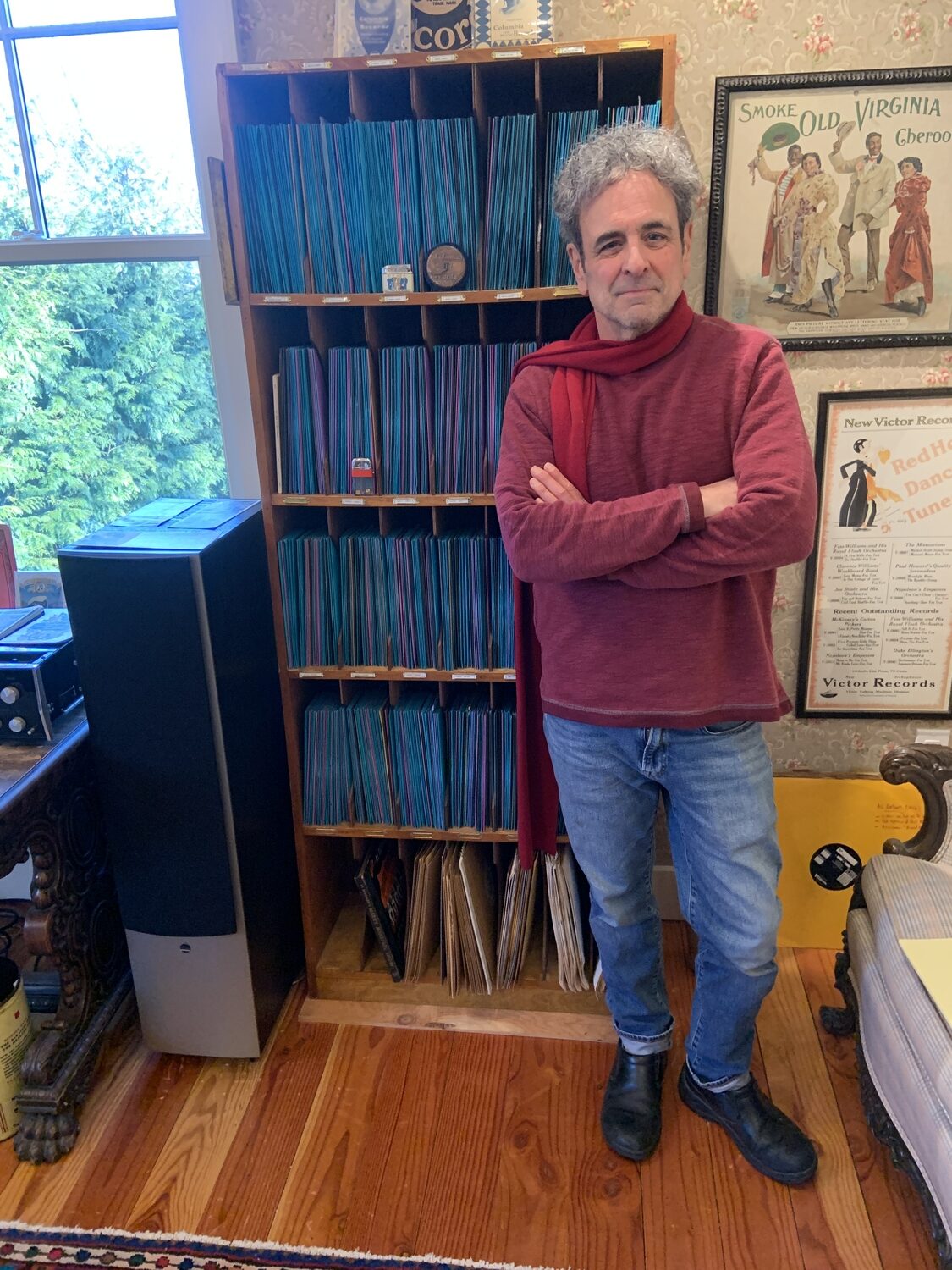
Joe Lauro, with his complete collection of Columbia "race records." STEPHEN J. KOTZ
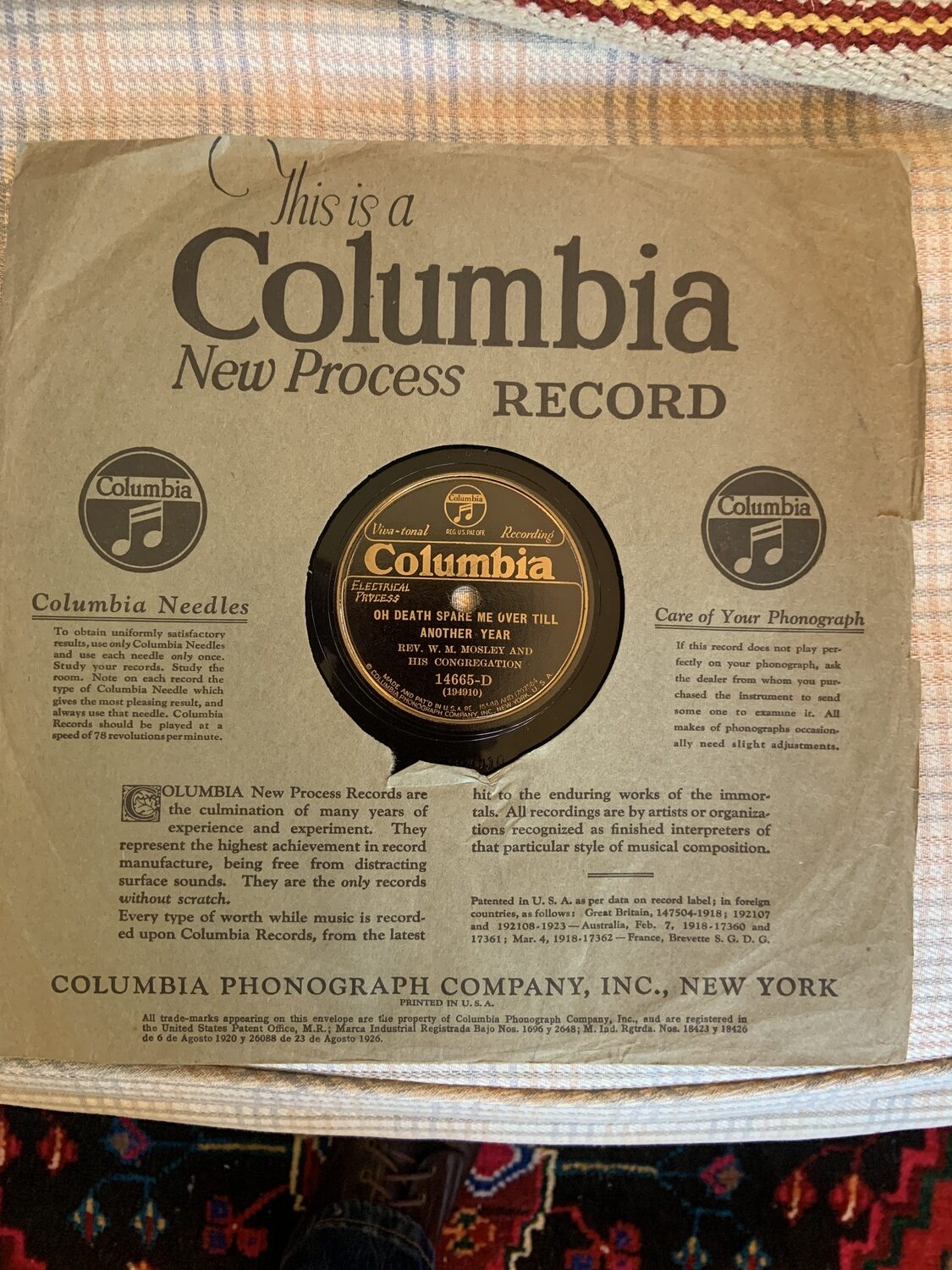
An extremely rare copy of the Reverend W.M. Mosley and his Congregation performing "Oh Death Spare Me Over Till Another Year" has been acquired by Joe Lauro. STEPHEN J. KOTZ
When Joe Lauro was a kid growing up in Massapequa Park, he’d ride his bike along Merrick Road, stopping at antiques shops and bookstores, where he’d comb through bins of second-hand records, searching for old 78s.
It’s a hobby that has stuck with him for the better part of 50 years.
Lauro, whose interests tend toward jazz, blues, jug and country, is a keen collector of music that was marketed by record companies from the 1920s to early 1940s to an emerging Black audience as “race records.”
Recently, he acquired an important piece for a collection that occupies pride of place on the second floor of the converted barn behind his Sag Harbor home: a copy of The Reverend W.M. Mosley singing “Oh Death Spare Me Over Till Another Year,” with his congregation joining in behind him.
The shellac record was one of more than 800 race records issued by Columbia Records from 1923 to 1932. And for years it was the only one of the Columbia releases that Lauro — or just about anyone else for that matter — did not own.
“Not even the Library of Congress,” Lauro said with a grin.
The Emergence of Race Records
If the artist’s name doesn’t ring a bell, that shouldn’t come as a big surprise, because along with the music of stars such as Louis Armstrong and Bessie Smith, record companies “recorded just about anything,” Lauro said, including sermons, comedy routines and hymns like “Oh Death.” Some may recognize the song, which appeared on the soundtrack of the movie “O Brother, Where Art Thou,” a version recorded by bluegrass artist Ralph Stanley.
The Rev. Mosley’s record was released in 1932, when the Great Depression was at its nadir, and sales of even top hits had plummeted. Lauro estimates that as few as 200 to 300 copies of the record may have been pressed.
A decade earlier, as the roaring ’20s began, Black people, while still relegated to the underclass of American society, began to share a little in the nation’s prosperity. “It was the Great Migration, when Blacks began to move from the South for jobs in the North,” Lauro said.
Record players had become reasonably priced, but until executives at Okeh Records were convinced otherwise, nobody had ever bothered to market music to the Black public.
Okeh’s 1920 release of “Crazy Blues” by Mamie Smith in 1920 sold an amazing 75,000 copies in its first month and set off a rush among major labels to cash in.
An Obsession That Began in Childhood
Lauro entered the world of old-time music through the front door. When he was a child of about 10, Lauro said he was enthralled when he saw “The Jolson Story,” a 1946 biography of Al Jolson, who made movie history by starring in the first talkie, “The Jazz Singer,” which was released in 1927.
He also remembers staying home from school when he was sick and watching a show called “Memory Lane,” hosted by Joe Franklin, that featured singers and old movie clips.
“I knew Al Jolson made records in the ’20s,” he said, “so my goal was to find one of those early records — and I finally did.”
At the same time, though, Lauro was hanging out with friends and listening to rock ’n’ roll. “I was also listening to the Beatles,” he said. “I had two worlds. I had the world with all my friends, learning how to play the bass guitar, loving Paul McCartney, and listening to all those groups that came later: Cream, The Band, the Grateful Dead. But at the same time, I had discovered Al Jolson as a kid.”
He still remembers the first album he ever bought. And it wasn’t “Sergeant Pepper’s Lonely Hearts Club Band,” or “Music From Big Pink.” It was “Jolson Sings Again,” a collection of songs he had performed on the Kraft Music Hall TV series.
“I bought it at Mays, which was a department store sort of like Target,” Lauro said. “I got it for something like $3.29. I was so excited. My hands were sweating when I got home and opened it.”
Lauro, who is well-known locally as an owner of Historic Films, a stock film archive that leases out clips, as well as the bassist in the band the HooDoo Loungers, also collects movie posters and other memorabilia.
He also sponsors a radio show and podcast, “The American Grooves Radio Hour,” that airs on WLIW-FM at 4 and 10 p.m. on Sundays. Lauro said the music that is heard on his show comes exclusively from the records in his own collection.
Tracking Down an Elusive Recording
“Every single one of these recordings is available on Spotify” or other streaming services, he said. But owning digital copies would not satisfy his itch, Lauro continued, looking around at his vast collection of records, all stored neatly in color-coded sleeves and shelved by label.
“I’m just really more of a collector,” he said. “I get pleasure out of dealing in the world of other collectors. We’re all a little obsessed.”
Yet, it was a digital version of the song that helped Lauro track down the rare record in the end.
Several years ago, after Lauro had shared his interest in obtaining the Mosley record with fellow collectors, one of them discovered a reissue on the Biograph label of all of the recordings Mosley ever made.
From there, Lauro tracked down the eight collectors who had contributed the material released by Biograph. Six were dead; one lived in Germany and could not be reached. The eighth, who lived in the United States, could not be found, either.
Lauro said he had given up hope of completing the collection — until one of his collector friends discovered the song on yet another collection issue, this one put out by Dust-to-Digital Records.
Lauro tracked down the owner of the source record through the record company and wrote to the owner, who called him back and said he was not planning to sell the record, but would entertain offers.
“I made him a fair offer,” Lauro said, “in fact, a-better-than-fair offer. And, three days later, I had the record.”
Even though he has found the holy grail, Lauro said he would continue to search for rare recordings that pique his interest.
“I still enjoy it and get excited about it, because I find new things every month, because there were thousands of records made,” he said. “And while 95 percent of them are not worth the shellac they are printed on, the other 5 percent is brilliant.”


 Stephen J. Kotz on Feb 4, 2025