


 1 Photo
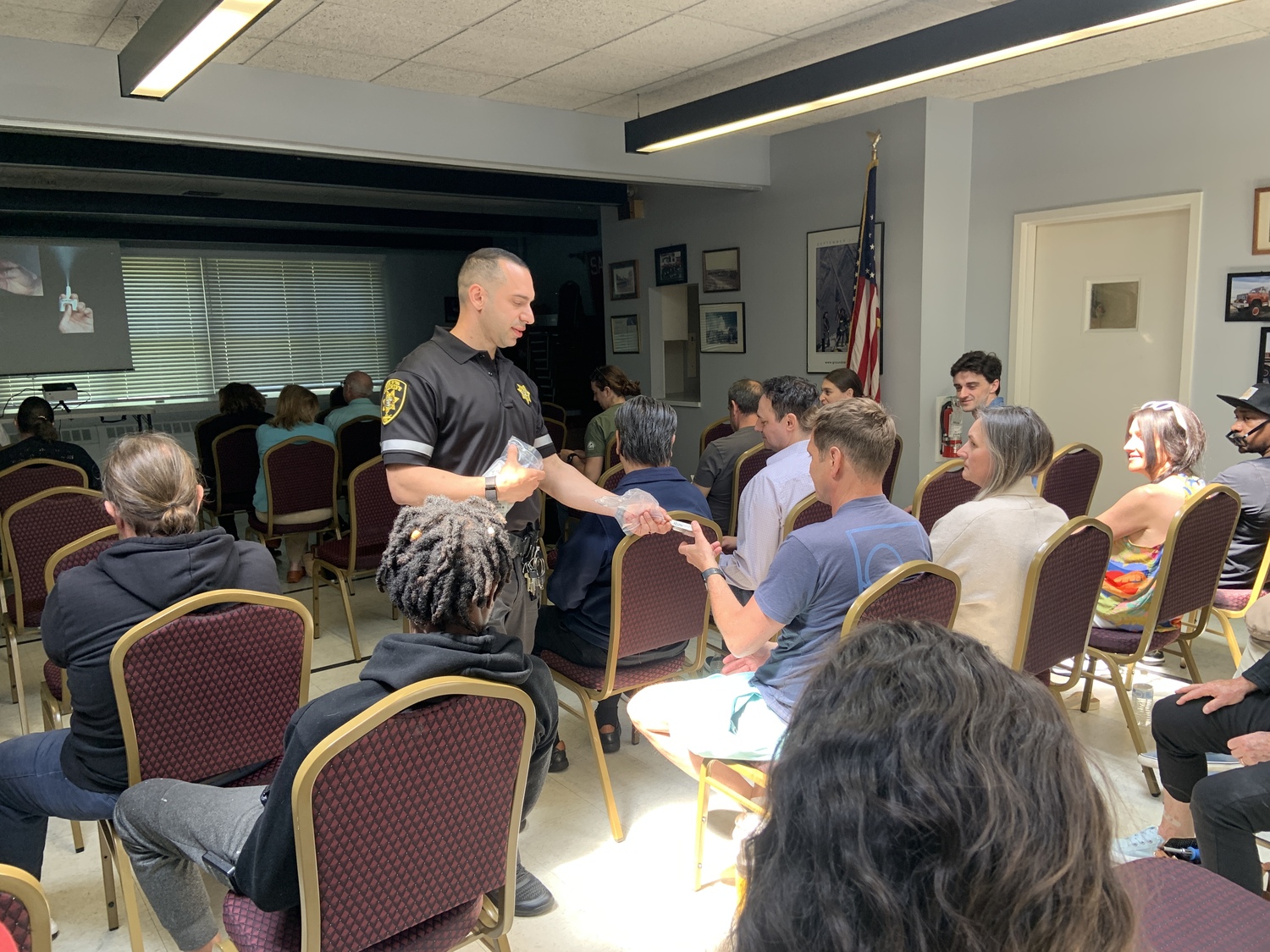
Suffolk County Sheriff's Deputy Mohamed Fakhro led a training in the use of Narcan to counteract overdoses at the Sag Harbor Firehouse on Monday. STEPHEN J. KOTZ
A crowd of about 50 people gathered at the Sag Harbor Firehouse on Monday morning to be trained in the use of Narcan, or naloxone, an effective antidote for opioid overdoses.
Suffolk County Sheriff’s Deputy Mohamed Fakhro led the hourlong presentation, which provided attendees with an overview of the ongoing opioid crisis that claimed 387 lives in Suffolk County in 2020.
Fakhro said the problem is exacerbated by parents who are in denial and refuse to believe their children can suffer from substance abuse disorder, and addicts themselves, who have no understanding of how far they have fallen. Often, he said, when a person suffers an overdose, friends are afraid to call for help because they believe they will be arrested.
He said if more people were trained in the use of Narcan, many lives could be saved. The drug is easy to administer. It comes in a small spray vial that can be inserted in the victim’s nose. It typically only takes a couple of minutes to work.
Narcan works by preventing opioids in the body from attaching to neurological receptors. The drug will continue to work against opioids in the blood stream for 30 to 90 minutes, he said, making it important to get an overdose victim to the hospital as soon as possible.
Fakhro said the modern opioid crisis can be traced to the marketing of the painkiller Oxycontin in the 1990s. The drug was widely prescribed, with few limits.
“That’s why we ended up here today,” he said, “Oxycontin being distributed freely.”
In addition, street heroin, which was once about 20 percent pure, has become much stronger, while remaining inexpensive. Often it is laced with additives such as fentanyl, which is so strong that an amount equal to four grains of salt can kill a person.
Fakhro said most overdoses do not kill the victim immediately; instead after the victim passes out, the drug depresses breathing. He said if called upon to aid an overdose victim, one should call 911, make sure the victim’s breathing passages are clear, initiate CPR, and administer a dose of Narcan. If possible, he said it is best to turn the victim onto his or her left side. If the victim does not respond to the first dose of Narcan, Fakhro said, a second dose can be administered.
Each participant was given a two-dose kit of the drug to take home with them.
David Falkowski of Open Minded Organics, who organized Monday’s event, said he had been committed to helping prevent opioid overdoses since the death in 2017 of Hallie Rae Ulrich, whose sister worked at his farm stand.
He cited her death as well as other deaths on the East End as a reminder that the problem is very much present here. He said he was proud that nearly 20 local businesses and organizations sent representatives to the training.
“Interpersonal relationships are lost in the modern world,” he said, adding that the training was a community-building exercise. “The success of this event was due solely to personal appeal — talking to people on the street. I had direct conversations with half the people sitting in that room.”
He added that if anyone found themselves in a position where they have to administer Narcan, they should remember: “You are giving someone else a second a chance to make a better decision,” he said. “It’s still up to them to make that choice, but you are giving them the chance.”


 Stephen J. Kotz on May 13, 2025