


 2 Photos
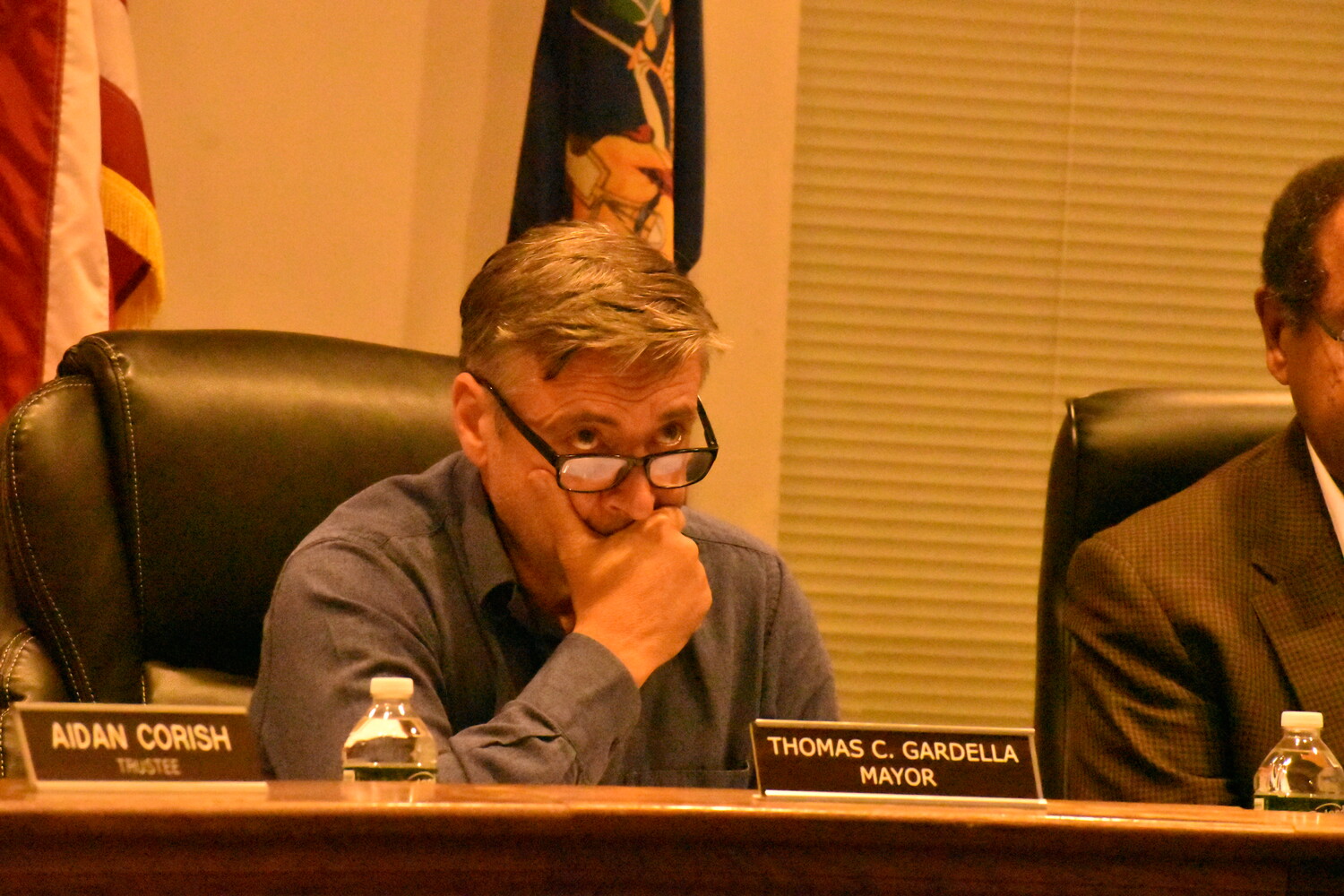
Mayor Tom Gardella listens to comments on the proposed Sag Harbor Village tree preservation law. STEPHEN J. KOTZ
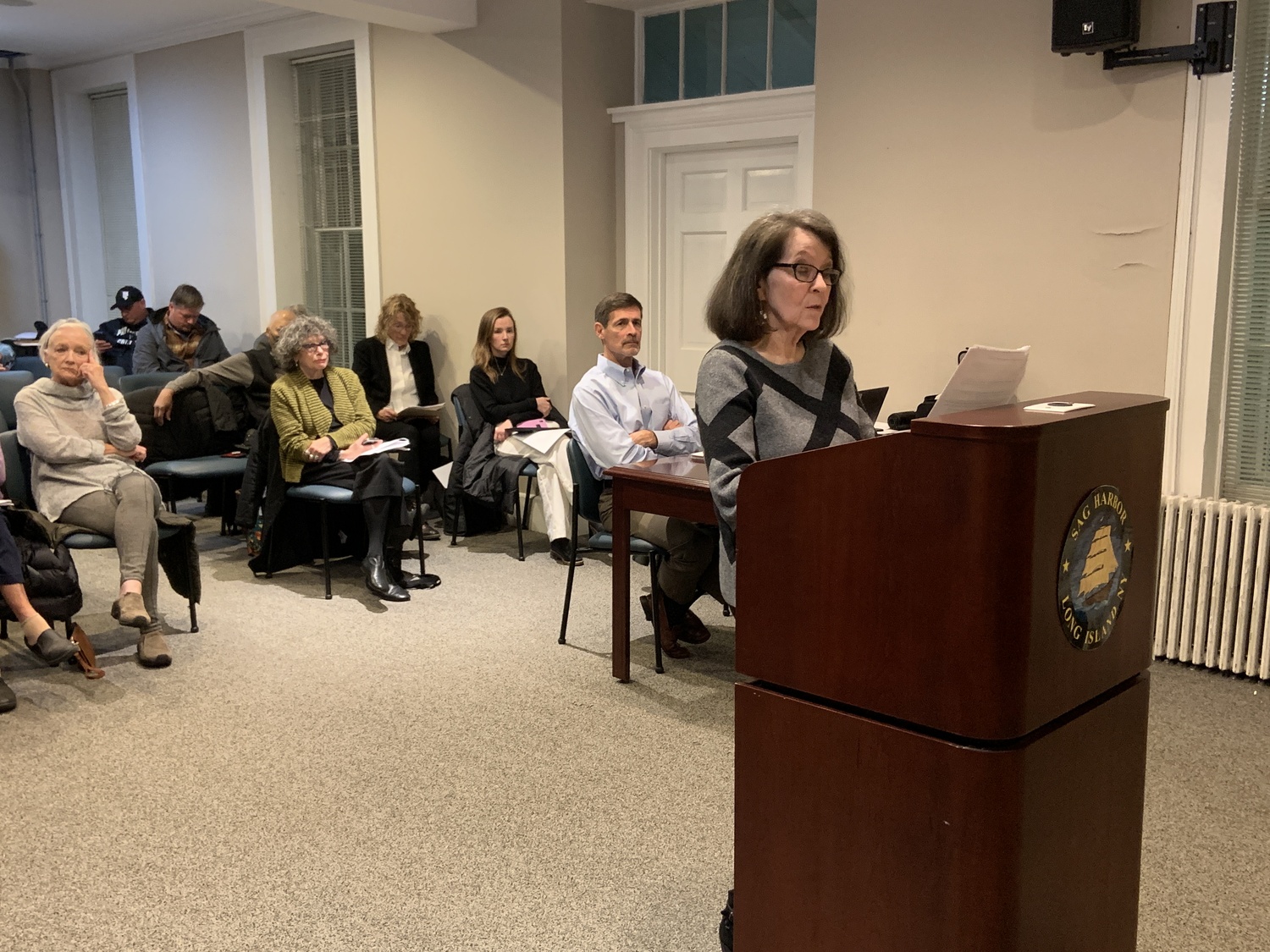
Eileen Rosenberg urged the Sag Harbor Village Board to tighten its proposed tree preservation legislation. STEPHEN J. KOTZ
An overwhelming majority of speakers urged the Sag Harbor Village Board at a public hearing on Tuesday, November 14, to significantly tighten a proposed tree preservation law — from one that would require permits to remove a tree measuring 18 inches in diameter at breast height, to one that would afford that protection to trees measuring 12 inches dbh, or even as small as 8 inches dbh.
The board has been debating on and off for the past seven years legislation that initially sought to impose clearing restrictions, but has since morphed into a law aimed at protecting village trees.
After listening to an hour’s worth of comments, the board concluded that more work remained to be done on the measure and tabled it until next month. Mayor Tom Gardella, who had suggested a 15-inch compromise last month, said he was beginning to lean toward a 12-inch limit, based on the public testimony, although other board members appeared to remain divided.
Eileen Rosenberg, a village resident who has championed the effort along with Jayne Young of Noyac, asked how the village had decided on an 18-inch limit in the first place. She said arborists she had spoken to had recommended a much smaller 12-inch limit.
“The age and size of trees directly correlates with the benefits we receive from them,” said Rosenberg, who pointed out that an 18-inch tree could be 75 years old. “Tree removal, especially of large trees, has serious multi-generational impacts. By endorsing a 12-inch dbh threshold for removal permits, we are acknowledging the importance of trees and their canopies to our community.”
Former Mayor Kathleen Mulcahy said she was the second of four mayors who had seen the legislation come before them. While she said some progress had been made — the code now contains language outlawing clear-cutting a building lot, for instance — she lamented what had been lost. “I do shudder to think how many trees came down in between those four and a half years,” she said of the period since she was elected in 2019 and today.
Mulcahy urged the board to adopt a 12-inch limit. “Get it done. Get it done strongly, get it done right, get it done now,” she said. Borrowing a phrase from Corish, she told the board, “Don’t let perfect get in the way of good,” adding that if the 12-inch limit proves to be too onerous for homeowners, the board could revisit it.
Mary Ann Eddy, a member of the Harbor Committee, also urged the board to think of the entire community, not just property owners.
“The trees of Sag Harbor belong to us as a community, just like the bay and cove,” she said, “and it’s not particularly important where their roots reside. It is a common resource for all of us. The trees calm us, they soothe us, they are a source of inspiration and beauty and elegance. We have to be very careful because once they come down, they do not come back.”
Arborist Jackson Dodds also supported a stricter law. “The number-one thing with trees, it’s a numbers game,” he said. “The more trees we can preserve if something should go bad — and I think everyone has seen [Route] 114 with the southern pine beetle, how it just decimated a whole ecosystem — it’s the number of trees that’s going to recover.”
He said if people continued to cut down 12- or 13-inch trees, “there won’t be a second or third generation to replace those larger trees that are lost later.”
Landscaper Silas Marder urged an 8-to-12-inch limit. “Tree preservation is fundamental to public health, welfare, quality of life and property value,” he said. “It is required for mitigating the harmful effects of the climate crisis. Trees protect the soil from erosion. They provide habitat on which wildlife depends, including beneficial insects, migratory birds and endangered species.”
Landscape architect Ed Hollander, who has recommended an 18-inch limit, was the last speaker. Hollander said any regulations needed to be accepted and respected by residents so it is “something they buy into and not something that is just being imposed on them.”
He urged the village to make a distinction between clearing restrictions, which might use 8-to-12-inch limits and tree preservation, which might set an 18-inch limit.
“They are different things, and I think clearing needs to be dealt with in a much more stringent way,” he said. “Clearing unimproved property is something that really impacts the entire ecosystem of the village more than a homeowner removing tree A or tree B.”
After the public had spoken, Gardella said the board needed more time to discuss the matter. He suggested the board should visit a parcel of land it owns between Spring and Garden streets and mark trees with three different colored ribbons, depending on their size and use the visual to help guide its final decision.


 Stephen J. Kotz on Nov 15, 2023