


 1 Photo
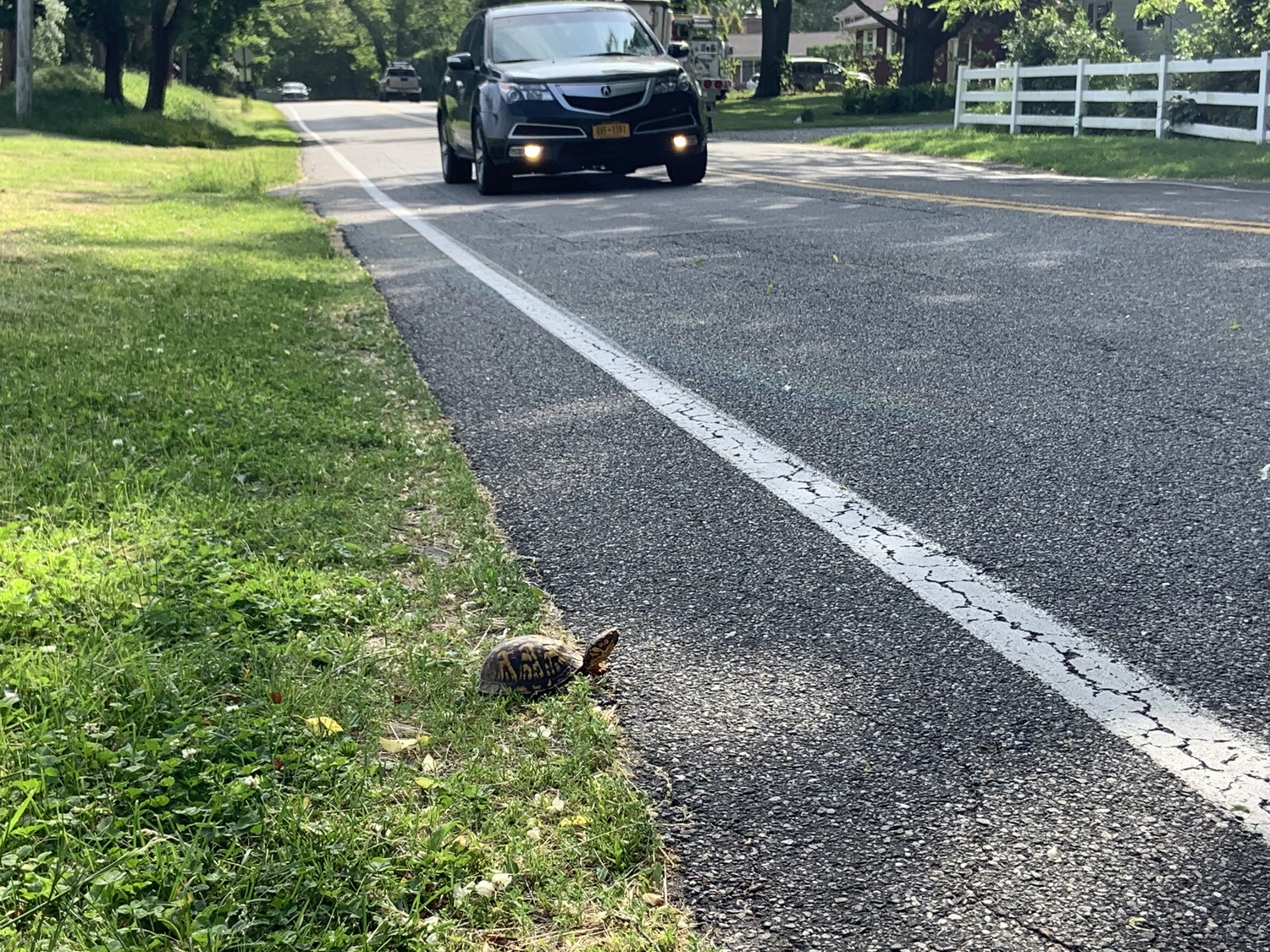
Eastern box turtles face a daunting task when they try to cross a road. STEPHEN J. KOTZ
Dr. Anna Thonis, an herpetologist who is currently a post-doctoral researcher at New York University, is launching a long-term study of the effects of urbanization on eastern box turtle populations on Long Island and Staten Island.
Over the course of eight years, Thonis and her colleagues, as well as local volunteers, will survey areas measuring about 0.25-by-0.25 kilometers on two days in May and June at each of four sites across the region to get a better idea of the age and sex of the box turtle population as well as take blood samples for genetic research and mark their shells with notches for future identification.
The sites that will be studied include a section of the Long Pond Greenbelt just south of its nature center and the grounds of the Brookhaven National Laboratory, which are considered more rural habitat, and Alley Pond Park in Queens and the Staten Island Greenbelt, which are obviously more urban.
Eastern box turtles are considered a species of special concern by the State Department of Environmental Conservation.
On the East End, it’s easy to see why. They are being squeezed out of their habitat by development, and they face predators in the wild such as raccoons, which can kill the turtles themselves or eat their eggs.
Perhaps the biggest threat is found on the roads, where they are no match for motorists who either don’t notice them slowly crossing the road or intentionally run them over.
Thonis is seeking volunteers, who will be asked to comb the targeted sites for any sign of turtles. The work, she warns, will be tedious because volunteers will be asked to work from 7 a.m. to 4 p.m. on each day. They will be joined by two dogs, which are trained to sniff out turtles, and their handlers.
Thonis, who has conducted extensive research into the Anolis lizard of Puerto Rico said, “Box turtles do not occur at high population densities. I can capture and release 30 lizards in an hour. I’m hoping we can find five turtles a day.”
Although two days will be spent at each site, “they won’t be back to back,” Thonis said. “There will be time between the two surveys because we need to give them a chance to move about.”
The study will be conducted over eight years, she said, so that “robust estimates of demographic characteristics can be compiled.”
Along with the habitat study, Thonis said she is thinking of developing a system that would make it easy for people to report road kills to provide researchers with a better understanding of the animals’ range.
Thonis said the budget for her study is approximately $8,500 for all four sites for the first year. The study is being underwritten by the Andrew Sabin Family Foundation and the Seatuck Environmental Association. The Friends of the Long Pond Greenbelt are accepting donations to help fund the study at their website, longpondgreenbelt.org/donate or by check to FLPG, PO Box 1130, Bridgehampton, New York 11930.
Thonis can be reached by email at at6689@nyu.edu.


 Stephen J. Kotz on Apr 16, 2025