


 2 Photos
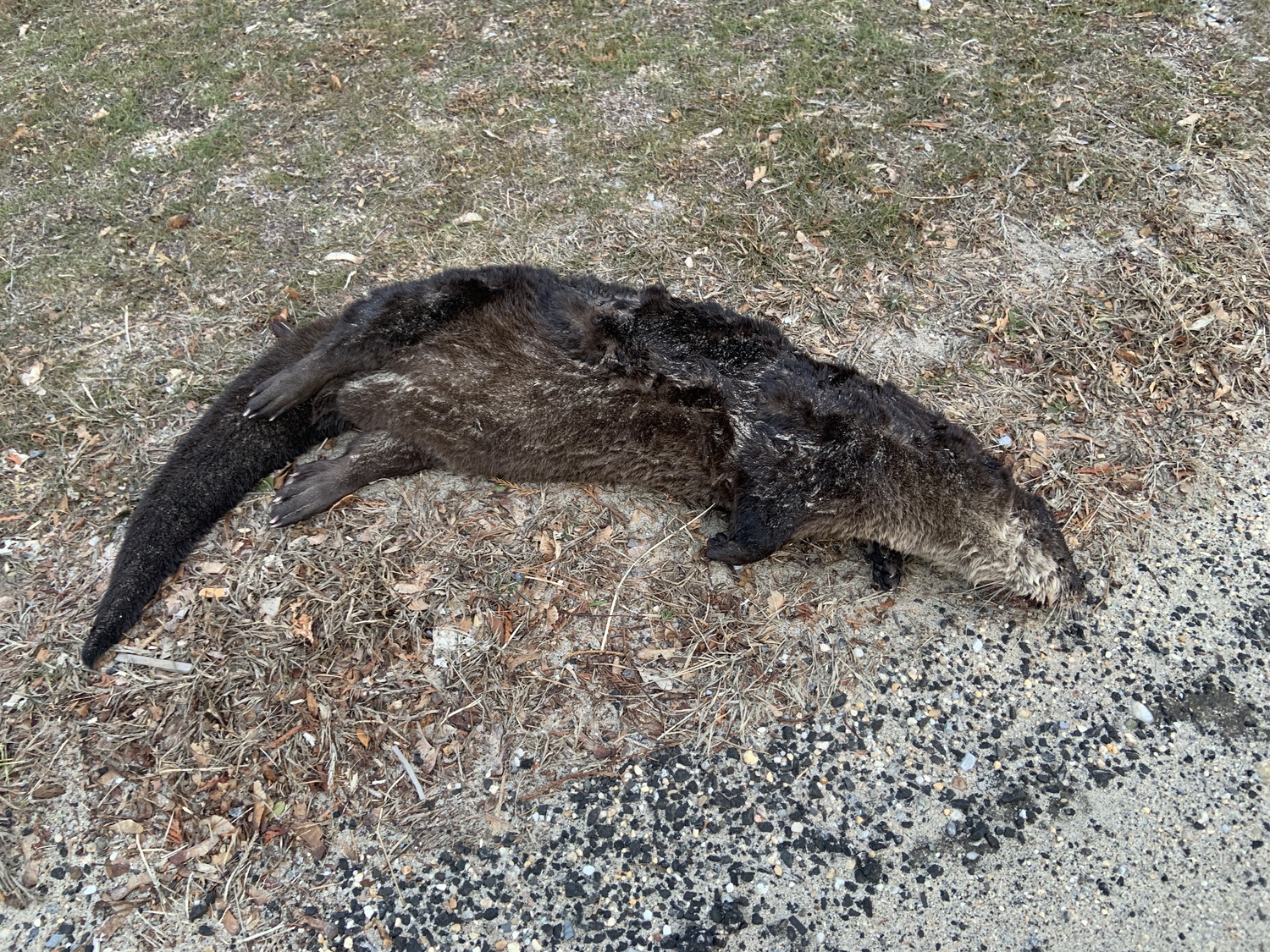
A river otter fell victim to a motor vehicle last week on the Bridgehampton-Sag Harbor Turnpike in Sag Harbor. It is a common fate for the rare mammals that have only begun to repopulate the region in the last 20 years. STEPHEN J. KOTZ
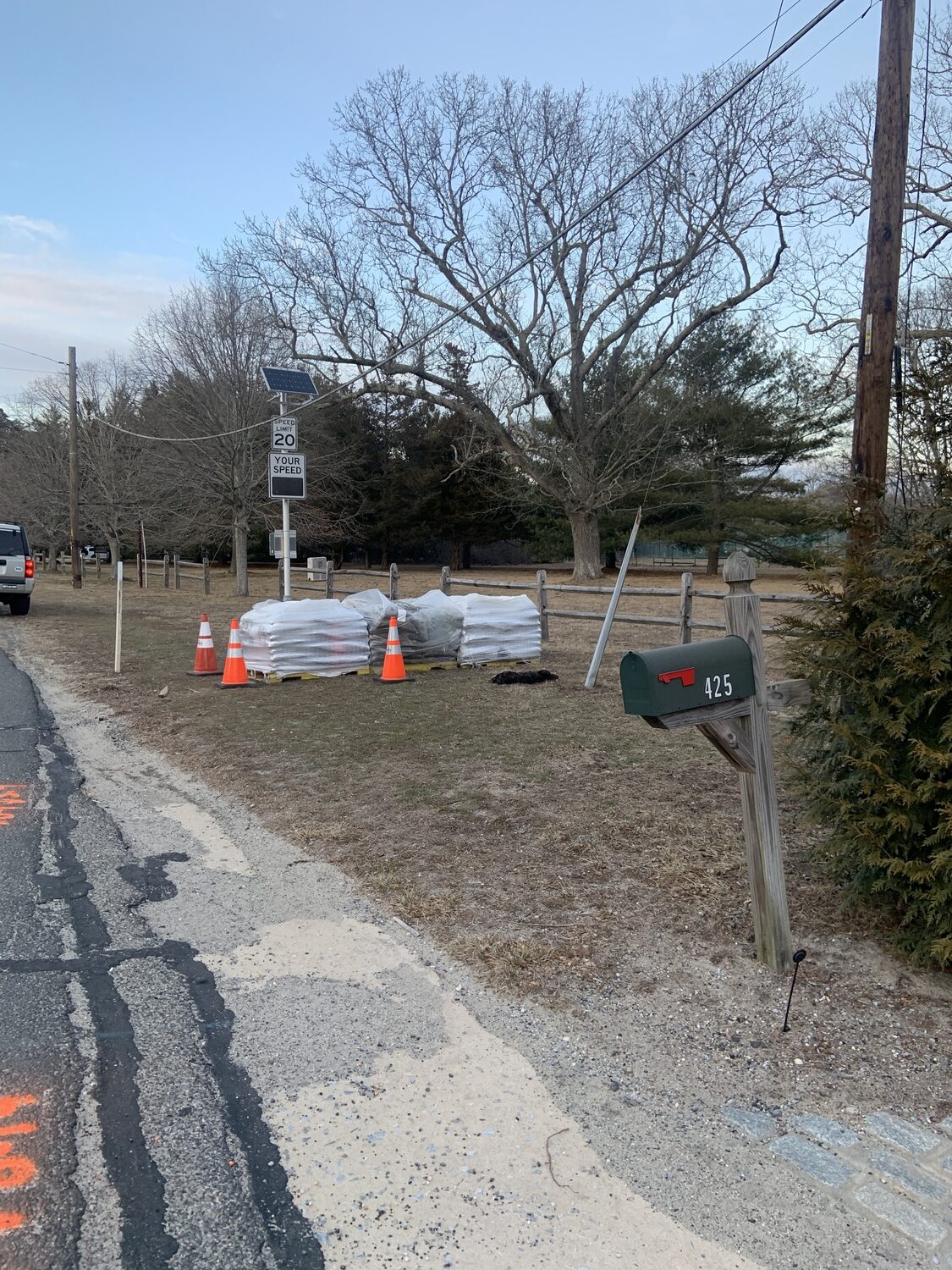
A river otter that was struck by a motor vehicle in Sag Harbor last week was initially found on the side of the road before being moved to the side by a passerby. STEPHEN J. KOTZ
Roadkill, be it deer, raccoon or rabbit, rarely draws much more than a passing glance from motorists. But Jane Peterson, a former veterinarian trauma technician who is now a real estate broker, thought something looked different about the dark brown animal she saw lying next to the Bridgehampton-Sag Harbor Turnpike in Sag Harbor on the morning of February 19.
Her interest piqued, Peterson returned to take a closer look later that day.
“I thought it was a large cat or a small dog,” Peterson said, “but then I realized it was an otter, which really surprised me. I had heard they used to be here but were no more.”
Another driver also stopped and reported the finding to Mike Bottini, a biologist who has been studying the slow, fitful return of river otters to Long Island since 2008, primarily under the auspices of the Seatuck Environmental Association.
Ironically, Bottini was in Peru, where he was attending a conference — on otters — hosted by the International Union for Conservation of Nature.
Perhaps, even more ironically, the dead otter was found lying directly below the speed monitor sign that reminds drivers to slow down to 20 mph as they enter the village from the south, and only about a quarter-mile south of Otter Pond.
Not surprisingly, cars and otters don’t mix. The nocturnal mammals, which are such graceful and agile swimmers, are at a decided disadvantage when they are on the land, with their short legs and webbed feet.
“Roadkills appear to be the major source of mortality among otters (other than old age), impeding the recolonization of Long Island,” Bottini said via email.
Since 2018, when their presence was discovered in the Long Pond Greenbelt, there have been at least four otters struck and killed by motor vehicles in that “general watershed,” Bottini said, leaving him doubtful that any are still living in the area.
A report complied last year by Bottini for the Seatuck Environmental Association listed 28 known otter deaths from motor vehicles across Long Island and cited efforts to make road crossings safer for them.
Enrico Nardone, the executive director of the Seatuck Environmental Association, said otters can have a range that easily extends to 20 miles. “They will move up and down streams,” he said. “They are usually in water or next to water.”
Often, he added, their access to water is blocked by roads, which forces them into a vulnerable position.
Nardone said his organization has worked on building basic stairways and ramps to help otters climb dams. He was on the South Fork recently to discuss with Bottini the idea of constructing an underpass connecting Poxabogue County Park on the north side of Montauk Highway and the Sagg Swamp Preserve on the south side, where an otter was struck by a car, to provide the animals with safe passage across that busy stretch of road.
River otters were once found across much of the continental United States, including the Northeast, but the fur trade wiped out their population, with the animals considered to be extirpated from Long Island by the early 1800s. Thanks to conservation efforts, the animals have begun a slow return to Long Island.
Bottini, who first studied otters as a graduate student in New Hampshire in the early 1980s, continued to search for signs of them after taking a job with the then-Group for the South Fork in 1987. Although he had heard of the occasional otter sighting on Long Island, he had no luck finding signs of their presence until he did a comprehensive survey between 2008 and 2009.
Although most of the evidence of otter habitation pointed to the north shore of Nassau County, he did find signs of a single otter on the East End. Later research uncovered their presence in North Sea, North Haven and several other sites.
Although Bottini found no evidence of otters in the Long Pond Greenbelt during his initial study, a decade later, in 2018, Callie Velmachos, who Bottini described as “the most knowledgeable wildlife track and sign person I know of on Long Island,” found signs of the presence of at least one otter in the greenbelt.
“I’ve been in the greenbelt for decades. I’ve been tracking easily for 25 years,” Velmachos said. “And when you do that, you notice things.”
Velmachos noted “a disturbance at the end of Long Pond,” where something had messed up leaves. She found scat that could be pinpointed to an otter and not a raccoon or other mammal.
Otters, though social, do not pair up, Bottini said. Instead, a female raises her pups alone before they go out on their own after about five or six months. He said from the trail camera images he had seen from the greenbelt, he couldn’t confirm if there was more than one otter present.
The otter that was killed in Sag Harbor was likely on its way to or from Ligonee Brook, a small stream that flows west of the turnpike, said Frank Quevedo, the executive director of the South Fork Natural History Museum. Quevedo picked up the carcass and turned it over to the State Department of Environmental Conservation for research.
“It was my first-ever visual of a river otter, dead or alive, on Long Island,” Quevedo said. “It’s sad to see it was dead, but at the same time, it’s encouraging to see that they are reestablishing themselves on eastern Long Island.”


 Stephen J. Kotz on Feb 25, 2025