


 2 Photos
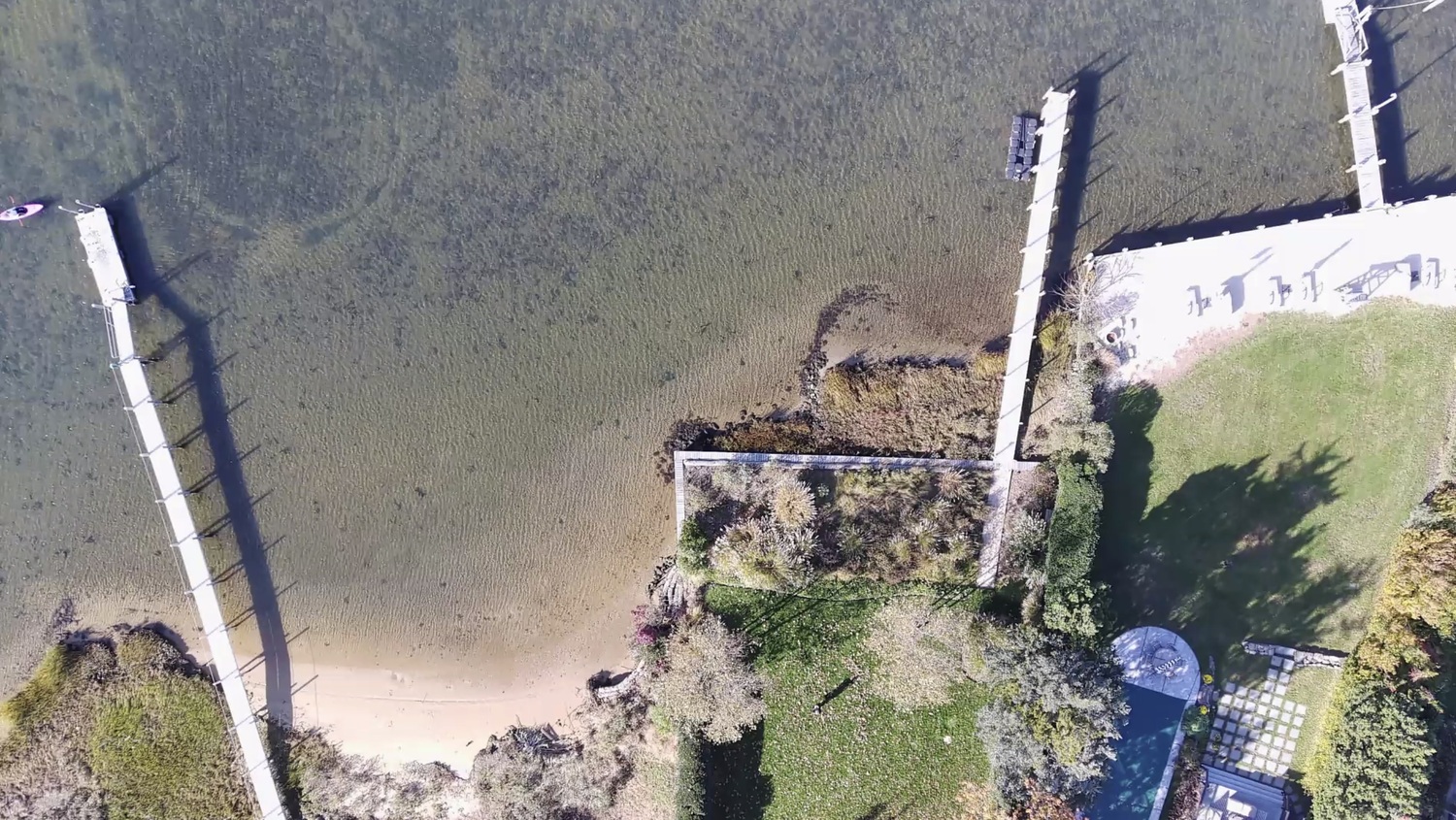
Aerial view from more than two years ago of the shoreline at John Schwartz’s property at 188 Redwood Road (center, with bulkhead), which was shown to the Harbor Committee in January, 2022.
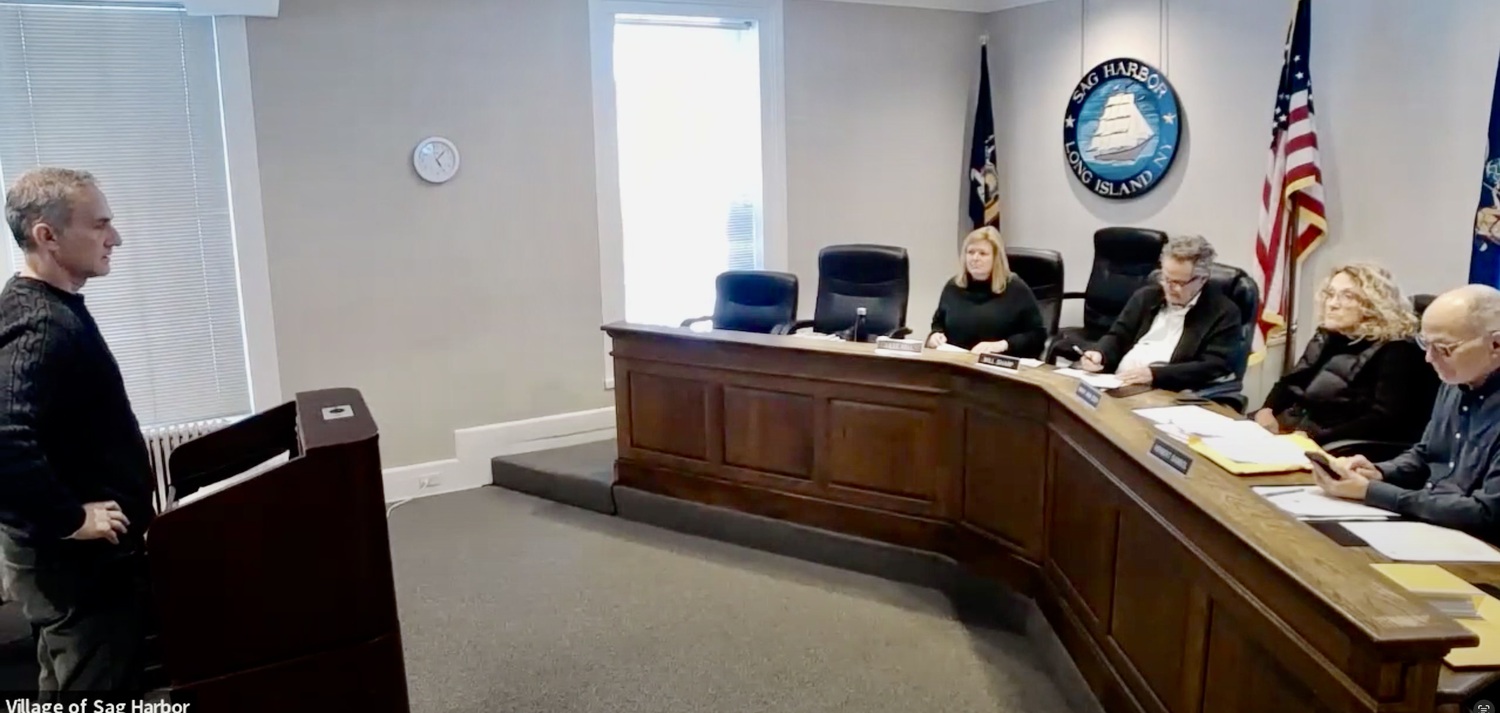
Josh Schwartz, the owner of the erosion-threatened waterfront property at 188 Redwood Road in Sag Harbor, told the Harbor Committee on April 4 that he has been unable to start the revetment work and retaining wall it approved two years ago until now. He complained that the board’s refusal to allow him to rebuild an aging bulkhead and extend its 90-degree return “wasn’t the right decision."
Blocked in his quest to rebuild a 1950s bulkhead and double its 24-foot return to protect his property at 188 Redwood Road in Sag Harbor from severe erosion, Josh Schwartz came back in person before the Harbor Committee on April 4 to ask for more time to carry out the work the panel did allow two years ago: a 24-foot rock revetment at the shoreline and a buried retaining wall farther inland.
“I have been trying since the board approved the permit” in April 2022, good for two years, “to get this work done, and it has literally taken until now, four and a half years, for a 24-foot issue,” Josh Schwartz told the Harbor Committee.
He was referring to the time lost since he first began work to address the erosion problem and to the area of shoreline at the southwest corner of his property that he wants to protect.
After his plea, the Harbor Committee without debate approved a two-year permit extension.
“It wasn’t right that I didn’t get the extension of the bulkhead,” Schwartz told the committee, adding that the severe erosion just to the west of his 100-foot-wide lot “was not bulkhead scour,” which committee members and their environmental consultant two years ago argued it appeared to be.
He blamed the problem on activities that he did not specify at the neighboring property. “I feel I have borne the brunt of a lot of stuff that was not my doing,” he said.
“The bottom line is, I have been trying since the day the board approved the permit” for the revetment and retaining wall in 2022, “and it has literally taken until now [to] get a shovel in the ground.” Meanwhile, “the neighboring property has just disappeared, and mine would have, too, if I didn’t do something.”
Schwartz has been using coir logs — large, dense fibrous tubes made of vegetative matter — to stabilize his shoreline, but he said they do not last more than 18 to 24 months.
Since the board’s first look at his original bulkhead proposal in late 2021, the committee resisted, arguing that the village code allows new bulkheads only when a principal structure is threatened by erosion. Noting that bulkheads are known to leave adjacent unprotected downstream properties vulnerable to scouring, committee members, as well as their consultant, said that Schwartz’s bulkhead most likely was the cause of the severe erosion at the southwest corner of the property — not what Schwartz’s consultant, Chuck Hamilton, called a “wave attack.”
Then-committee Chair Mary Ann Eddie warned Schwartz in early 2022 that the panel would vote to deny his application if he did not abandon the bulkhead plan. In March 2022, Hamilton, after having vowed since January to stick with the bulkhead plan as the only viable solution, presented the alternative plan for a rock revetment.
The proposal, which the committee quickly approved in April, also called for burying a 24-foot retaining wall set back from the shoreline behind a line of shrubs, vegetative coir logs atop the revetment to help dispel wave energy, an additional 20 feet of vegetative buffer on the property, and the installation of stones in front of the existing return.
Schwartz told the committee this month, “I understand this desire to not have a hardened shoreline, but I truly believe this wasn’t the right decision.” He pledged, nevertheless, to carry out the approved plan, even though he was not sure it would work.
It took two-and-a-half years to win approval from the State Department of Environmental Conservation and the Southampton Town Board of Trustees, Schwartz said, before he even applied to the Harbor Committee for the bulkhead work. “I got here. You didn’t want that to go on. I think we worked well to change it,” he said.
Since then, he said the cost has gone from an initially estimated $16,000 to $55,000 “to deal with this committee,” and $47,000 “to do this project.” It took a year and a half to get a building permit for the work in September 2023, he said, before which “nobody would put me on a schedule.”
“I get the permit,” he added, “and then I’m told, ‘Will you please wait until we get approvals of the neighboring properties.’”
He blamed the severe erosion next door on “things that were done” there “that were not malicious but had big ramifications.” He said he replaced his coir logs last fall “to get through the winter.”
“I’m sitting here every winter for the last four” fearing the loss of his property, so “I called the contractor two days prior to the March 7 meeting” of the Harbor Committee, when his application for a permit extension first appeared on the agenda, and “said I want to move forward.”


